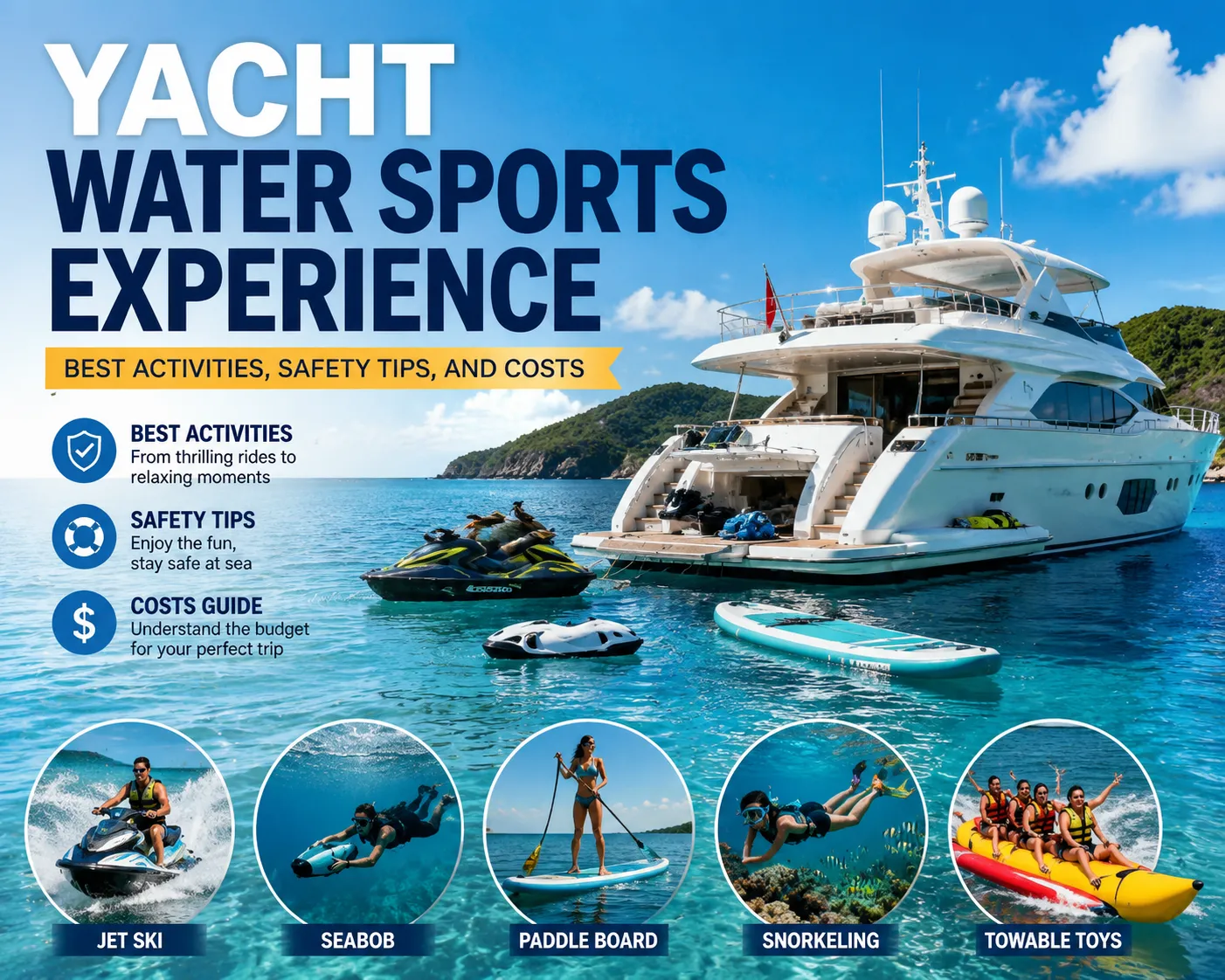
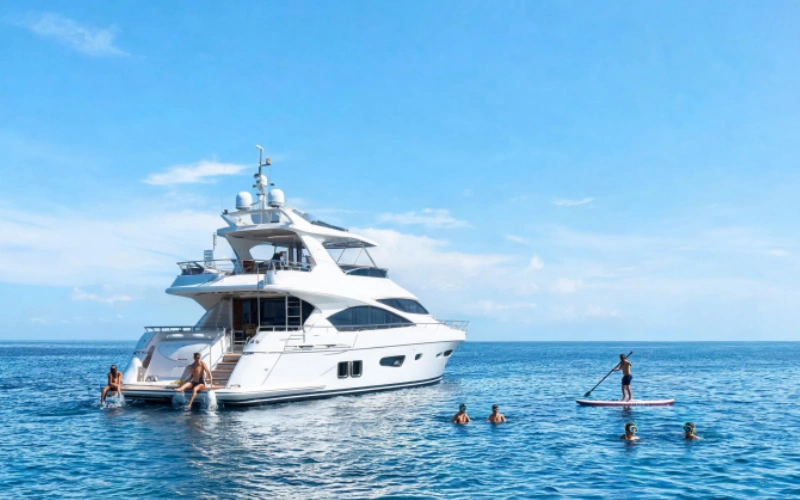
A yacht water sports experience is a comprehensive activity that uses a yacht as a mobile base at sea, allowing participants to enjoy a variety of water-based leisure activities whilst underway or at anchor, combining speed, freedom, socialising and the natural marine environment.
Key activity types:
- Leisure: swimming, SUP, floating mats
- Exploration: snorkelling, Seabob, sea scooters
- Powered: jet skis, towable toys, wakeboarding
- 35–40ft: Swimming, snorkelling, SUP (basic setup)
- 40–50ft: Multi-activity use with better deck access and water toys
- 50ft+: Full water sports setup with greater storage, guest space, and equipment flexibility
- All water sports should always follow real-time sea conditions and be supervised with proper life-saving equipment onboard.
What Is a Yacht Water Sports Experience?
A yacht water sports experience is a combination of marine leisure activities conducted from a yacht while it is safely anchored, moored, or positioned by the crew for water access.These typically include swimming, snorkelling, paddleboarding, and selected powered water sports, depending on the yacht configuration and local regulations.
Unlike traditional beach or resort settings, it offers mobility, privacy, and multi-activity flexibility in a single environment.
Differences from Ordinary Maritime Entertainment
| Activity | Yacht Water Sports | Beach Entertainment |
| Setting | Mobile maritime platform | Fixed area |
| Privacy | High | Low |
| Activity Density | Multiple combinations | Single |
| Flexibility | Can be adapted to sea conditions | Limited |
| Experience Level | High-end lifestyle | Ordinary leisure |
Why It Has Become a High-End Lifestyle Trend
In recent years, yacht water sports have gradually evolved from mere recreational activities into a lifestyle, driven primarily by the following factors:- The rise of micro-holidays: short, high-quality maritime experiences
- Upgraded social settings: a blend of family, friends and business networking
- The combination of sport and relaxation: a dual experience offering both excitement and leisure
- The proliferation of entry-level yachts: lowering the barrier to entry
Target Audience
Yacht water sports experiences are primarily suited to the following groups:- Families enjoying seaside outings with children
- Weekend gatherings and parties with friends
- Those seeking short island trips and holidays
- Adherents of a high-end lifestyle
- Private social and business hospitality settings
Best Water Sports You Can Enjoy on a Yacht
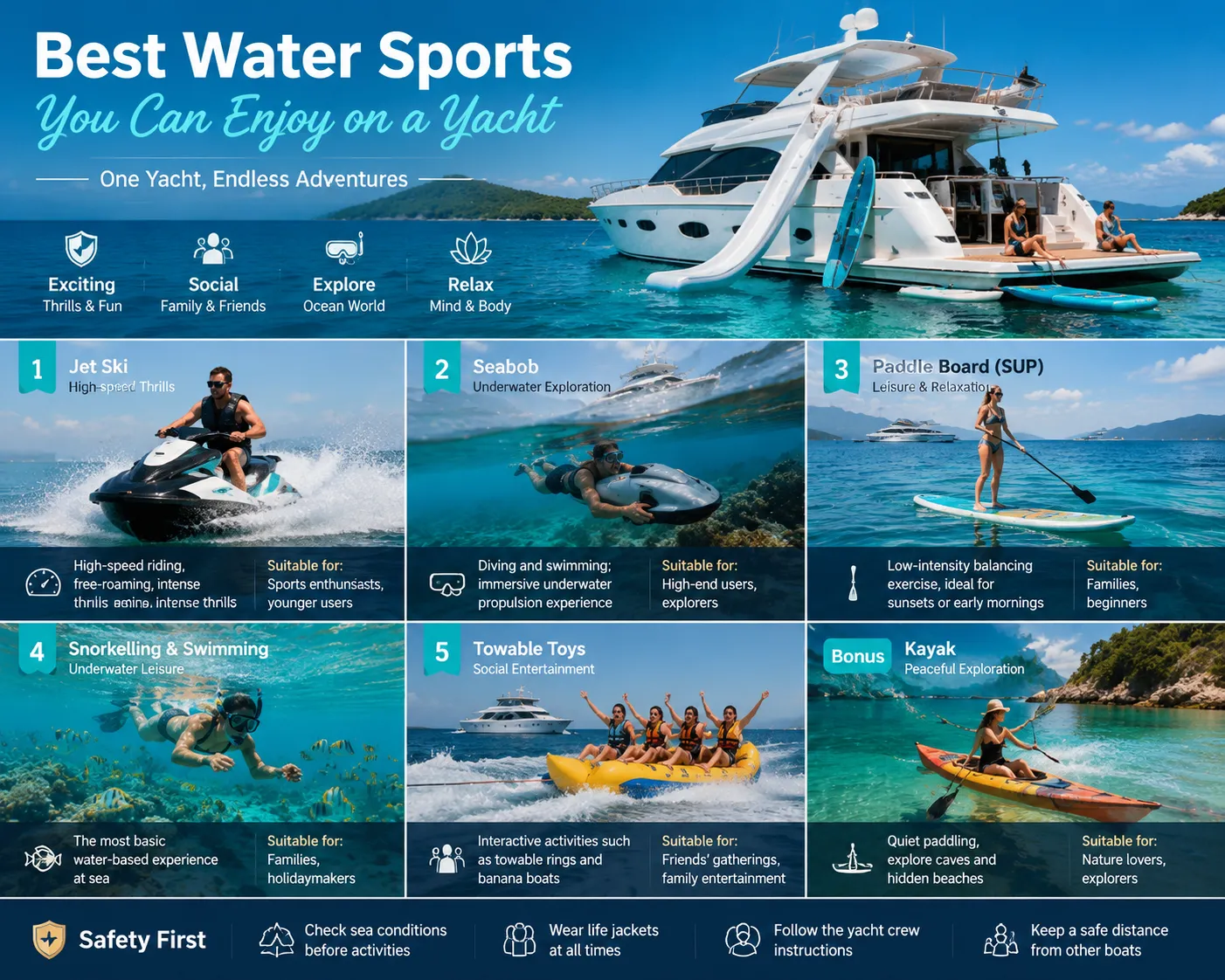
The core value of yacht-based water sports lies in the fact that a single yacht can accommodate a variety of maritime activities with completely different paces. From high-speed thrills to quiet relaxation, and on to underwater exploration, a single outing at sea allows you to switch between multiple experiences.Below are the most common types of water sports enjoyed on yachts, as well as those with the highest frequency of use:
| Water Sport | Experience Type | Key Features | Suitable for | Yacht Requirements |
| Jet Ski | High-speed motorised | High-speed riding, free-roaming, intense thrills | Sports enthusiasts, younger users | 45ft+, preferably with a swim platform or garage |
| Seabob | Underwater/surface exploration | Diving and swimming; immersive underwater propulsion experience | High-end users, explorers | 40ft+, requires electrical or charging support |
| Paddle Board (SUP) | Leisure and relaxation | Low-intensity balancing exercise, ideal for sunsets or early mornings | Families, beginners | 38–42ft is sufficient |
| Snorkelling & Swimming | Underwater leisure | The most basic water-based experience at sea | Families, holidaymakers | 38ft+, requires clean waters |
| Towable Toys | Social entertainment | Interactive activities such as towable rings and banana boats | Friends’ gatherings, family entertainment | 40–50ft, requires stern propulsion |
How to Choose the Right Yacht for Water Sports?
Step 1: Start with Group Size
The primary factor in choosing a yacht for water sports is not the activity itself, but the number of people and space requirements.| Number of People | Recommended Yacht Type | Key Experience Features |
| 2–4 people | Small sports yacht | Flexible, quick to set up |
| 5–8 people | 38–45ft flybridge yacht | Balance between family and entertainment |
| 8 or more people | 45–50ft catamaran | Maximum space, most comprehensive facilities |
Step 2: Match Yacht Size with Experience Level
Different sizes determine what you can do, rather than what you prefer.| Yacht Size | Experience Level | Typical Water Sports Potential |
| 35–40ft | Entry-level | Basic water activities |
| 40–45ft | Standard configuration | Multi-activity package |
| 45–50ft | Advanced systems | Jet skis + full range of water toys |
Yacht length alone does not determine equipment capacity. Deck layout, storage, platform load limits and launching systems are equally important.
Step 3: Consider Sea Conditions
Many people overlook this, but it is actually one of the most critical limiting factors.| Type of Waters | Recommended Yacht Type | Reason |
| Calm Harbour | Any type | Supports a wide range of water sports |
| Calm or moderately open waters | Catamarans preferred | Catamarans can provide more deck space and stable activity platforms, depending on hull design and sea state. |
| Areas with Strong Winds and Waves | Sporty deep-V yachts | Better wave resistance, safer |
Step 4: Define Your Water Sports Goal
The essence of choosing a yacht is deciding what kind of maritime lifestyle you want.| Experience Objective | Recommended Activity Combination | Recommended Yacht Type |
| Relaxation | SUP + Swimming + Snorkelling | 38–42ft |
| Thrill-Seeking | Jet Ski + Towable Toys | 45ft+ |
| Family-Oriented | Multi-equipment setup + Safety first | Catamaran |
| Social/Party | Multi-zone decks + Water toys | 45–50ft flybridge yacht |
Safety Tips for Yacht Water Sports
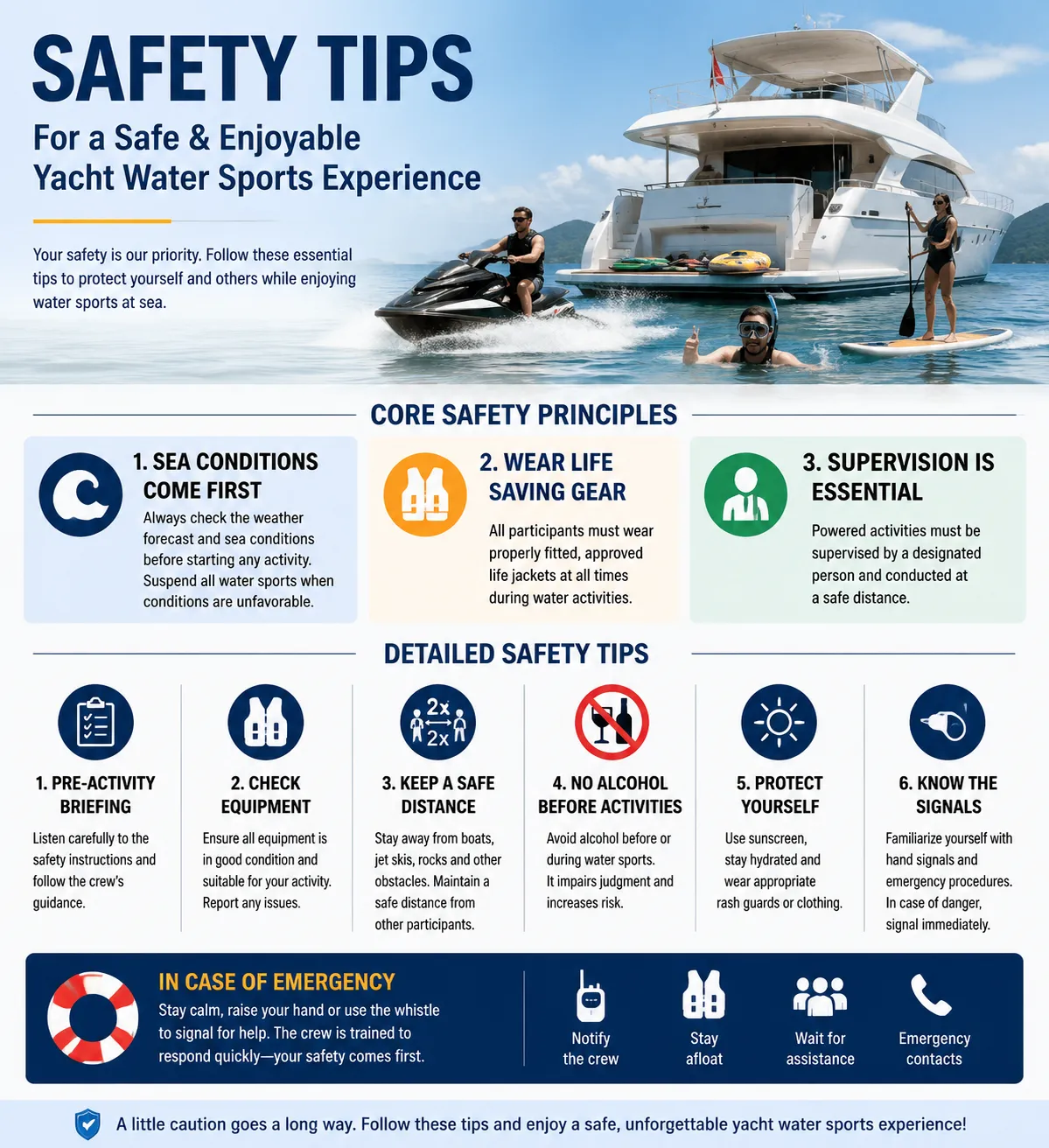
The core principle of yacht water sports is not simply what activities you engage in, but enjoying yourself whilst keeping risks under control. As these activities typically involve high speeds, towing on the water and open-sea environments, safety management must be systematic rather than relying on ad-hoc reminders.Sea Conditions Always Take Precedence Over Activity Plans
Whether it is jet skiing or snorkelling, real-time sea conditions must be the primary criterion for decision-making. Water activities should be immediately scaled back or suspended if any of the following conditions arise:- A significant increase in wind and waves
- Reduced visibility or rapidly changing weather conditions
- Areas with complex tidal currents or busy shipping lanes
Standardised Safety Equipment for All Participants
All participants should be uniformly equipped with basic safety gear; this is not a matter of personal choice:- Compliant lifejackets
- Non-slip footwear or foot protection when barefoot
- Waterproof communication devices or whistles
Safety Supervision Must Be in Place for Motorised Activities
High-speed activities such as jet skis, Seabobs and towed toys must have a clear monitoring mechanism in place:- A designated person must be responsible for observation and direction
- Maintain a safe distance from yachts
- Limit the activity area to a defined water zone
Standardise Entry and Retrieval Procedures
Many accidents occur during entry and exit from the water; therefore, procedures must be standardised:- Participants must enter the water one at a time; multiple people jumping in simultaneously is prohibited
- Participants should not approach the stern, propulsion area or swim platform until the engines are disengaged and the crew confirms that it is safe
- The retrieval of equipment and participants must be carried out by designated personnel
Priority Protection for Children and Inexperienced Participants
When travelling with families or mixed groups, priority should be given to members with less experience:- Children must be accompanied by an adult at all times
- Beginners should prioritise low-risk activities such as snorkelling and stand-up paddleboarding (SUP)
- Participation in powered water sports without supervision is prohibited
Yacht Water Sports Pre-Departure Checklist
- Confirm weather, wind and sea-state limits
- Check which equipment is included in the charter
- Verify age, licence and local operating requirements
- Inspect lifejackets and communication equipment
- Assign a spotter for powered and towing activities
- Confirm engine shutdown and water-entry procedures
- Keep beginners and children within supervised zones
How Much Does a Yacht Water Sports Experience Cost?
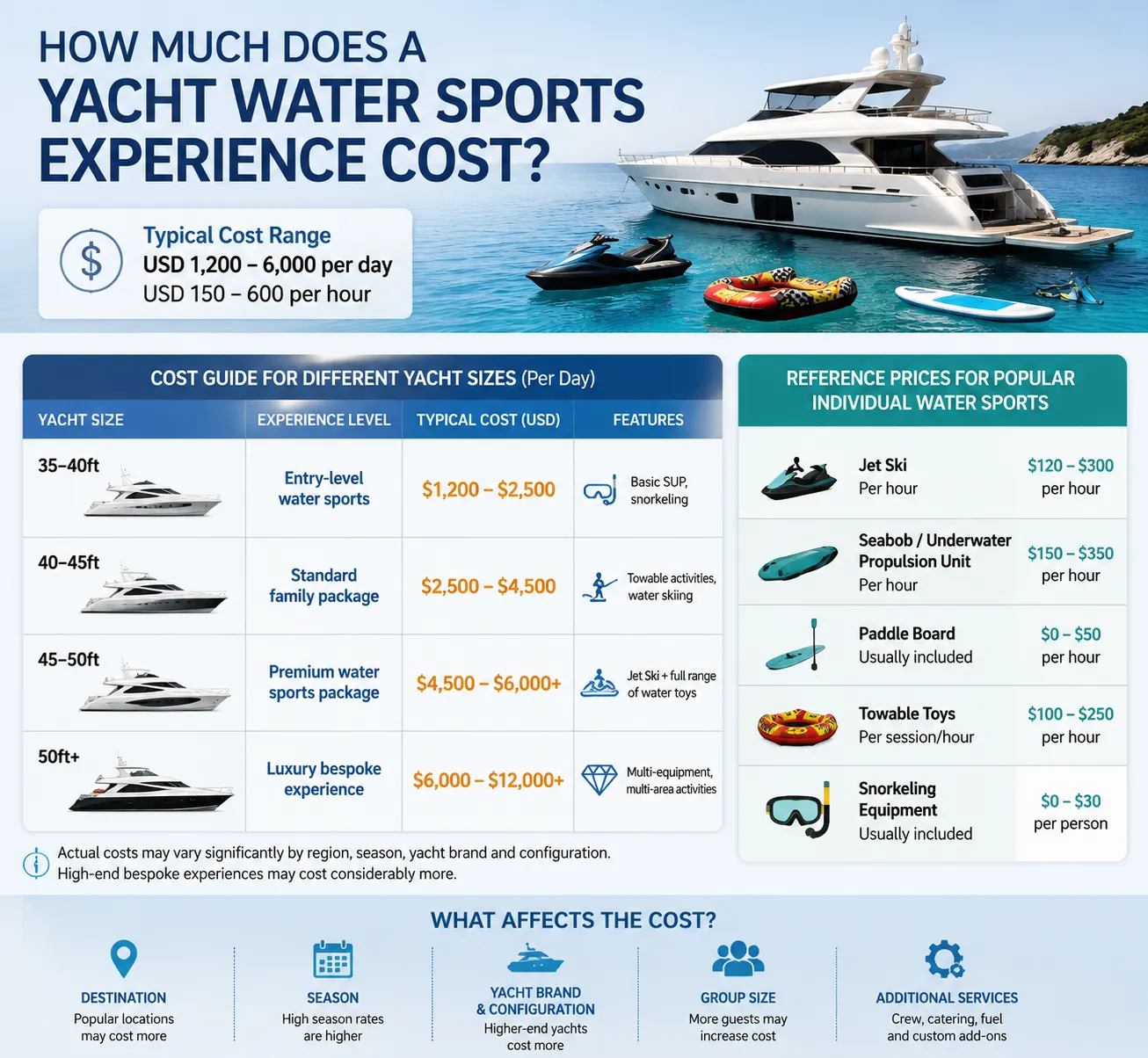
Prices vary substantially by destination, yacht class, charter duration, season, fuel policy and whether water toys are included, crew-operated or supplied by a third-party provider. The overall market range is approximately: USD 1,200–6,000 per day, or USD 150–600 per hour for a combination of water activities.Cost Guide for Different Yacht Sizes
| Yacht Size | Experience Level | Typical Cost (per day) | Features |
| 35–40ft | Entry-level water sports | USD 1,200–2,500 | Basic SUP, snorkelling |
| 40–45ft | Standard family package | USD 2,500–4,500 | Towable activities, water skiing |
| 45–50ft | Premium water sports package | USD 4,500–6,000+ | Jet Ski + full range of water toys |
| 50ft+ | Luxury bespoke experience | USD 6,000+ | Multi-equipment, multi-area activities |
Actual costs may vary significantly depending on region, season, yacht brand and configuration; high-end bespoke experiences may be considerably higher than this range.
Reference Prices for Popular Individual Water Sports
| Water Activity | Billing Method | Price Range |
| Jet Ski | Per hour | USD 120–300/hour |
| Seabob / Underwater Propulsion Unit | Per hour | USD 150–350/hour |
| Paddle Board | Usually included | USD 0–50/hour |
| Towable Toys | Per session/hour | USD 100–250/hour |
| Snorkelling Equipment | Usually included | USD 0–30 per person |
Recommended Yachts for Water Sports
The following are classic models commonly found on the market and widely used for water sports, covering different needs ranging from high-speed activities and family leisure to the stability of catamarans and high-end bespoke experiences.Axopar 45 XC Cross Cabin: Ideal for those who enjoy high-speed cruising and switching between various water sports; its open deck and modular layout allow for efficient transitions between jet skiing and snorkelling, offering exceptional flexibility.
Pardo 43: Suitable for those seeking stylish design and a sun deck experience; it emphasises open spaces and social interaction, making it ideal for paddle boarding, swimming and short water-based activities.

Pardo Yachts 43
- Length45 ft
- Cabins2
- Top speed36 kn
- TypeBusiness yacht
The Pardo Yachts 43 is a high-performance commercial yacht combining speed, luxury, and comfort. Its spacious deck and comfortable cabins are ideal for sightseeing, corporate hospitality, or rental operations. Powered by twin IPS engines, it offers a range of 300–360 nautical miles and accommodates 12–16 passengers, with a flexible layout to suit various commercial needs.
Beneteau Gran Turismo 45: Suitable for families and those engaging in light water sports, balancing speed with comfort. Its swim platform is user-friendly, making it ideal for towing toys and group outings.

Beneteau Gran Turismo 45
- Build Year2022
- Length48.60 ft
- Cabins2
- Top speed30 kn
- TypeFlybridge yacht
The Beneteau Gran Turismo 45 is an approximately 48-foot sport cruiser, part of the new generation of Express Cruisers, emphasising the fusion of ‘performance, comfort and social space’.Featuring an Air Step® hull and hardtop design, the vessel offers a seamless indoor-outdoor experience through large portholes and an opening roof.
Princess V50: Suitable for those seeking sporty performance and a high-end cruising experience. With powerful engines and well-designed deck space, it supports a combination of jet skis and various water sports equipment.
Princess V50 Deck
- Length52.06 ft
- Cabins2
- Top speed31 kn
- TypeSport yacht
Princess V50 Deck is a classic 50-foot luxury sports yacht from the V-Class series of Britain’s Princess Yachts, focusing on flexible handling and luxury leisure, and is a best-selling model in the mid-to-large luxury yacht market. The hull is made of high-strength fiberglass with a deep-V hull design, equipped with twin Volvo diesel engines, balancing power and stability. The interior is bright and modern with a flexible layout, available in open or enclosed main deck configurations, and is equipped with complete entertainment facilities, comfortably accommodating 6-8 people.
Leopard 50: Ideal for families planning extended stays at sea and those prioritising stability; its catamaran hull provides excellent balance, making it an ideal choice for snorkelling, stand-up paddleboarding and family-friendly water activities.
Leopard 50
- Length50.60 ft
- Cabins5
- Top speed12 kn
- TypeCatamaran sailboat
Leopard 50 is a mid-size luxury cruising catamaran built by Leopard Catamarans, designed for comfortable offshore voyages with a perfect balance of stability, space and handling. It features a reinforced twin-hull structure with strong wave resistance and shallow draft, adapting to various cruising waters. Powered by efficient diesel engines, it offers economical fuel consumption, ample range and smooth quiet sailing.
Selection Guide
Seeking speed and versatility → Axopar 45 XC👉 View more sport-cruiser yachts currently on sale.
Emphasis on design and social deck space → Pardo 43
👉 Explore more yachts suitable for water sports.
Family leisure and versatile balance → Beneteau Gran Turismo 45
👉 Compare multi-purpose water sports yachts currently on sale.
Power performance and luxury cruising → Princess V50
👉 Browse more similar high-end cruising motor yachts.
Stability and long-term family use → Leopard 50
👉 Compare more similar catamarans.
Is It Worth Owning a Yacht for Water Sports?
Whether it is worth buying a yacht depends on how often you use it: if you use a yacht frequently throughout the year and value permanent access, equipment customisation and scheduling flexibility, ownership may become more attractive. However, chartering can still be more economical when maintenance, berthing, insurance and depreciation are included.Lifestyle-Based Guidance
| Usage Pattern | Practical Guidance |
|---|---|
| 1–5 times/year | Chartering is usually more practical |
| 6–10 times/year | Compare local charter vs ownership costs |
| 10+ times/year | Ownership may be worth evaluating |
| Frequent weekend use | Ownership value is mainly convenience and access |
Why Is Owning a Yacht More Suitable for Frequent Use?
As the frequency of use increases, the value of a yacht shifts from being a means of enjoyment to a fixed lifestyle, with the advantages primarily reflected in three areas:- More controllable costs: Charter fees accumulate over time, whilst the cost per use of your own yacht decreases progressively
- Greater freedom: No need to book in advance; enjoy water sports such as jet skiing and snorkelling whenever you wish
- Higher utilisation efficiency: Ideal for family weekend trips or regular social gatherings
Comparison: Chartering vs Owning a Yacht
| Category | Chartering | Ownership |
| Cost structure | Pay per trip | High fixed and ongoing costs |
| Access | Requires booking | Greater scheduling freedom |
| Equipment | Depends on each charter | Can be permanently customised |
| Responsibility | Managed by operator | Owner handles maintenance and compliance |
If your water sports activities have reached the stage of regular weekend outings or frequent family use, purchasing a yacht is usually the better option. The next step should be to focus on yacht types and configurations suitable for water sports, rather than continuing to wait.
👉 View recommendations and purchase options for yachts suitable for water sports.
Common Mistakes When Enjoying Water Sports on a Yacht
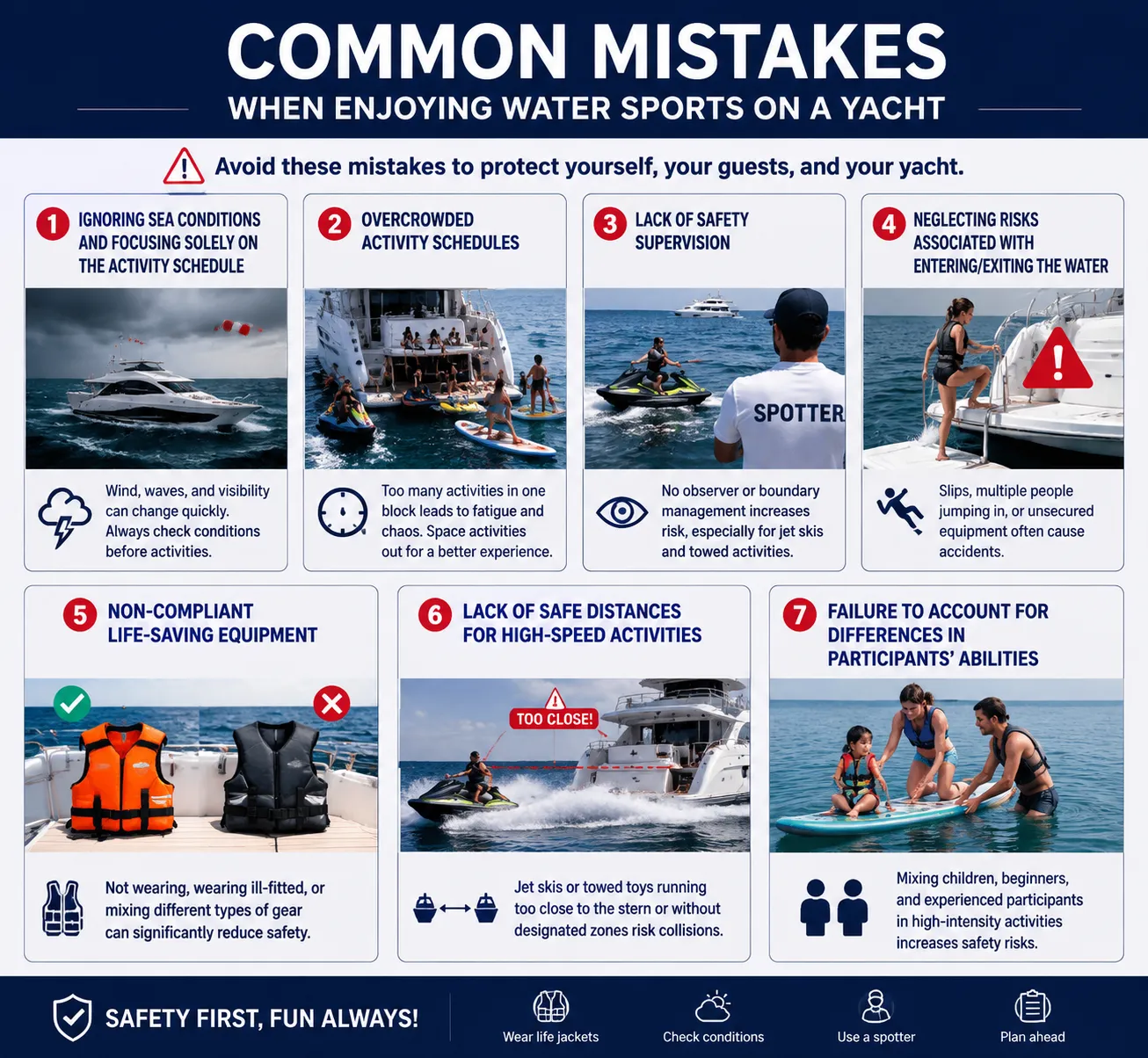
A poor water sports experience on a yacht is often not due to a lack of activities, but rather to incorrect organisation. Below are the most common mistakes, which have the greatest impact on safety and the quality of the experience.Ignoring sea conditions and focusing solely on the activity schedule: Many people prioritise jet-skiing or towing activities, but overlook changes in wind, waves and visibility, which can easily lead to a poor experience or even its interruption.
Overcrowded activity schedules: Squeezing activities such as jet skiing, snorkelling and stand-up paddleboarding (SUP) into a single block can lead to fatigue and organisational chaos. A better approach is to stagger these activities across different time slots.
Lack of safety supervision: The absence of dedicated observers or boundary management during water activities is a common source of risk, particularly for jet skiing and towed activities.
Neglecting risks associated with entering and exiting the water: Many accidents occur whilst ascending or descending from the swim platform, such as slips, multiple people entering the water simultaneously, or equipment not being secured.
Non-compliant life-saving equipment: Failure to wear life jackets, wearing ill-fitting ones, or mixing different types of equipment can significantly reduce safety.
Lack of safe distances for high-speed activities: Jet skis or towed toys operating too close to the stern or without designated activity zones are prone to collision risks.
Failure to account for differences in participants’ abilities: Mixing children, beginners and experienced participants in high-intensity activities increases safety risks.
About the Author
Jelly
Jelly is a yacht market editor at Yachttrading who specializes in yacht water sports experiences, charter planning, and private cruising lifestyle content. She turns real on-water experience and market insights into practical guidance, helping readers understand yacht water sports activities, safety practices, costs, and the right yacht setups for different types of sea-based leisure experiences.
Last updated: June 2026
Disclaimer
This article is provided for general informational and educational purposes only and does not constitute professional maritime, legal, safety, or financial advice. Yacht water sports activities involve inherent risks, and actual conditions may vary depending on vessel type, operator standards, weather, sea state, and local regulations. Readers should always consult certified yacht operators, licensed captains, and relevant maritime authorities before participating in any water sports activities. Cost estimates, yacht specifications, and activity recommendations are indicative only and may differ by region and market conditions. The publisher and author assume no responsibility or liability for any loss, injury, or damage arising from the use of this information. Always prioritize safety, comply with local laws, and use appropriate protective equipment when engaging in yacht-related water sports.
FAQ
Q1: What is yacht water sports?
A: Yacht water sports are recreational activities like jet skiing, snorkeling, and paddle boarding done from a yacht as a floating base on the sea.
Q2: What is the best yacht size for water sports?
A: Most water sports setups work best on 38–50ft yachts, with larger sizes offering more space, stability, and equipment options.
Q3: Can you do jet ski from a yacht?
A: Yes, many yachts support jet skis with a swim platform or garage, especially 45ft+ models designed for water sports use.
Q4: What water sports can you do on a yacht?
A: Common activities include jet skiing, paddle boarding, snorkeling, tubing, swimming, and seabob underwater exploration.
Q5: Do you need a license for yacht water sports?
A: No license is usually required for passengers, but jet ski operators may need certification depending on local maritime regulations.
Q6: What type of yacht is best for families?
A: Catamarans and 40–45ft flybridge yachts are ideal for families due to stability, space, and easy water access.
Q7: How many people can join yacht water sports?
A: Typically 4–12 guests depending on yacht size, layout, and safety capacity limits set by the vessel certification.