Quick conclusion: What documents are required to register a yacht in Malta?
- 5 mandatory documents are required.
- Private yacht registration: approx. 9–14 days.
- Commercial yacht registration: 4–6 weeks.
- 87% of rejections are caused by minor HIN or dimension mismatches (as small as 0.1 m).
Table of Contents:
Why Register a Yacht in Malta? (EU Flag, VAT & Legal Advantages)
Malta Yacht Registration:Private or Commercial?
Documents Required for Malta Yacht Registration (2026 Checklist)
Registration Fees and Tax Requirements (by Type)
Malta Yacht Registration Process and Required Timeframe
Summary
FAQ
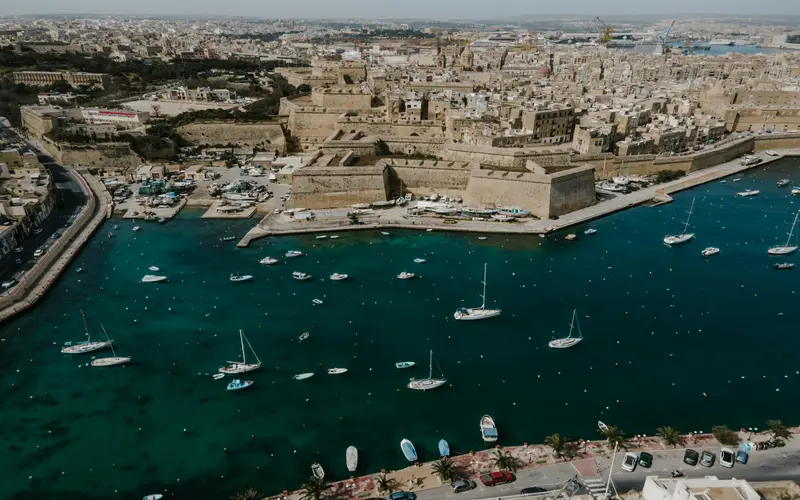
As a core EU flag state in the Mediterranean, Malta is a top global choice for yacht registration, thanks to its mature legal system, transparent tax compliance, and international standing. When you buy a new yacht, proactive planning is crucial. Assessing the model and maintenance costs based on whether it will be used privately or commercially directly shapes your registration pathway, VAT strategy, and compliance requirements.
This article will systematically outline the comprehensive requirements for yacht registration in Malta, including the requisite documentation, ownership transfer documents, VAT tax compliance, variations in registration costs, and distinctions in registration timelines and procedures between private and commercial yachts.
Why Register a Yacht in Malta? (EU Flag, VAT & Legal Advantages)
As a Mediterranean shipping hub, Malta attracts a significant number of yacht enthusiasts and investors. Its geographical location, legal framework and policies make it an ideal choice for yacht registration. So what are its advantages?
Malta ranks among the most favoured yacht flags within the European Union, combining the legal recognition of an EU flag with comparatively low registration costs. Its registration system is well-established and transparent, facilitating the long-term compliant operation of both private and commercial yachts within EU waters.
It should be noted that registration in Malta does not equate to ‘low scrutiny’. On the contrary, within the EU flag system, Malta's examination of document consistency, VAT compliance structures, and declarations of use is more rigorous than that of certain offshore flags.
If you're registering a yacht in Malta for the first time, consulting with a professional yacht registration service can ensure your documents are in order and prevent potential delays.
We have observed numerous shipowners who underestimated this aspect, subsequently facing repeated requests for supplementary documentation during the filing stage, resulting in actual processing times exceeding initial expectations.
Malta Yacht Registration:Private or Commercial?
Private yachts and commercial vessels exhibit distinct differences in registration procedures, fees, and taxation. The registration process for private yachts is streamlined with a shorter approval cycle, making it suitable for non-commercial recreational use. Commercial vessels, however, entail additional documentation, crew qualifications, and ongoing regulatory oversight, catering to owners intending to engage in charter operations or other commercial activities.
Understanding the key differences between private and commercial yacht registrations is crucial for selecting the appropriate registration route. The table below details the distinctions between these two registration types in terms of intended use, documentation requirements, tax treatment, and other aspects.
| Comparison item | Private yacht | commercial yacht |
| Purpose of Use | Non-commercial, private leisure | Leasing, tourism, or event operations |
| Registration documents | Core files only | Core files plus commercial operating licence |
| Crew requirements | No commercial crew licence required | A licence must be held |
| VAT treatment | Paid or lawfully exempt | Reduced VAT schemes may apply, subject to strict review |
| Regulatory intensity | Lower | Significantly higher |
It should be noted that in practice, any yacht engaging in external charging or leasing arrangements, regardless of frequency, must undergo compliance assessment via the commercial yacht pathway to avoid higher costs arising from subsequent commercial registration and VAT adjustments.
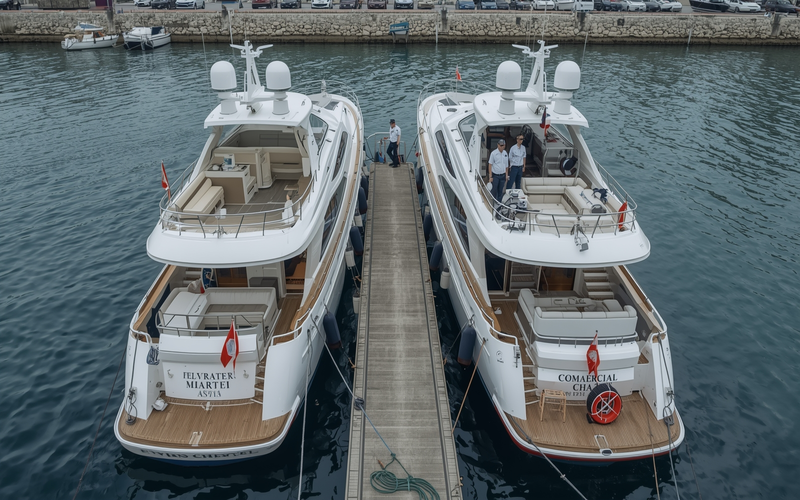
Documents Required for Malta Yacht Registration (2026 Checklist)
The registration requirements for yachts in Malta encompass not only the completeness of documentation but also the absolute consistency of information across all documents. In accordance with Transport Malta's (Merchant Shipping Directorate, 2025) review practices, the Maltese flag registration employs a system verification mechanism centred on ‘field consistency as the primary criterion’. The system does not perform manual conversions for discrepancies in units of measurement or numerical values.
Therefore, to register a yacht in Malta, you will need to prepare the following documents. The table below outlines the documentation required during the registration process and the key points for review, ensuring the completeness and consistency of the documents.
| File name | Applicable Type | Key points for review |
| Boat Title / Bill of Sale | All | Clear chain of title |
| HIN Verification | All | Consistency with construction records |
| EU Compliance Statement | All | Compliance coverage for modifications |
| Certificate of Construction | All | Consistency of technical specifications |
| VAT documentation | All | Consistency of owner name and VAT timeline consistent |
When transferring yacht ownership whilst simultaneously registering the vessel in Malta, the requisite documentation serves not only for the registration itself but also to confirm the lawful continuity of ownership.
Typically, this includes a complete Bill of Sale, a certificate of deregistration from the previous country of registration (where applicable), a certificate of construction, and confirmation that the vessel owner's name remains consistent across all documentation. These documents shall be reviewed as a single chain of title transfer.
Common Reason for Malta Yacht Registration Rejection (2025–2026)
- 87% of first-time rejections are caused by HIN or dimension mismatches.
- Differences as small as 0.1 m will trigger system rejection.
- Transport Malta does not perform unit conversion or discretionary review.
Essential Documentation and Practical Guidance for Private Yacht Registration
The registration process for private yachts is relatively streamlined, yet it remains essential to ensure all documentation is complete to avoid delays or additional approvals. Specific recommendations are as follows:
- Document Preparation Sequence
First prepare the yacht ownership certificate, HIN verification certificate, and EU Declaration of Conformity, ensuring all information is consistent.
- VAT Payment Proof
Even for privately used yachts, proof of VAT payment or legitimate exemption documentation must be provided.
- Considerations for Small Private Yachts
For private yachts under 15 metres, certain documentation may be simplified, though HIN verification and construction certificates remain indispensable.
- Document Organisation Techniques
Organise documents sequentially and prepare multiple copies, accompanied by English translations, to expedite the approval process.
Commercial Yacht Registration Documentation and Compliance Requirements
Commercial yacht registration entails stricter requirements due to leasing and commercial operations, necessitating additional compliance measures:
- Commercial Operating Licence
A valid commercial operating licence must be provided during registration to verify lawful commercial use of the vessel.
- Crew Qualification Certification
All crew members, particularly the skipper and key operators, must hold valid certificates and qualification documentation.
- Insurance and Safety Certification
Commercially operated yachts require proof of commercial liability insurance and safety inspection records to meet maritime authority safety standards for commercial operations.For owners planning charter operations, understanding Malta's VAT and commercial licensing requirements is key. A pre-check by a qualified expert can reduce the risk of document rejections by up to 30%.
- Key Document Review Focus
The maritime authority rigorously verifies document completeness to ensure all information is accurate, thereby preventing registration delays.
Don't overlook these details—in November 2023, at the Valletta Maritime Authority counter, a German owner was rejected on the spot because the HIN and the Bill of Sale differed by 0.1 m. The system flagged "Dimension Mismatch (Field 14-HIN)", and resubmitting the paperwork took another full eight days.
This type of rejection is not logically a ‘document error’ but rather a failure of system fields to match. Within Malta's registration framework, the review process does not perform unit conversions or reasonable inferences, conducting only mechanical comparisons. This is also the risk most readily underestimated by shipowners registering in Valletta for the first time.

Registration Fees and Tax Requirements (by Type)
Understanding yacht registration costs in Malta and tax requirements, including proof of VAT paid within the EU, are essential points every yacht owner must grasp. Significant differences exist in fees and taxation between various yacht types.
Registration fees and tax obligations are crucial factors to consider during the yacht registration process. The table below compares the distinctions between private and commercial yachts regarding registration costs, VAT handling, and regulatory intensity.
| Item | Private yacht | Commercial yacht |
| Registration and maintenance costs | Government fees €1,050 (≤24 m and ≤50 GT) plus agency fees €1,200–1,800 (March 2025 price list), calculated by length and tonnage. | Relatively higher, including commercial approval and compliance-related costs. |
| VAT / Tax Treatment | VAT paid in accordance with regulations, with supporting documentation. | VAT paid in accordance with regulations; commercial VAT concessions may be available. |
| Compliance and Regulatory Intensity | Lower | Significantly higher, involving multiple ongoing compliance requirements. |
Note: Effective from 1 January 2025, the VAT base for yacht charters in Malta shall be calculated at a maximum rate of 60%, with a minimum of 30% payable as an advance payment (pursuant to Article 4.2 of TM VAT Notice 01/2025). The primary objective of this adjustment is to prevent circumvention of the EU VAT principle of actual place of use through ‘nominal charters’.
In practice, private yachts are more commonly registered for owners intending to use them solely for personal leisure, while commercial yachts are suited to owners planning to engage in charter, tourism, or other commercial operations. For owners intending long-term use of their yacht, registration is merely the first step. The cost to livie on a yacht full-time must also be assessed, encompassing annual expenditures such as mooring fees, fuel, maintenance, and insurance.
Malta Yacht Registration Process and Required Timeframe
In practice, the time required for yacht registration in Malta depends more on the consistency of documentation and compliance with regulatory structures than on the yacht's size or value itself.
According to Transport Malta's publicly available data (Merchant Shipping Directorate, 2025), assuming complete documentation, the average registration period for private yachts is approximately 2–3 weeks, while commercial yachts take around 4–6 weeks. The actual duration primarily depends on the consistency of documentation and the complexity of commercial compliance reviews.
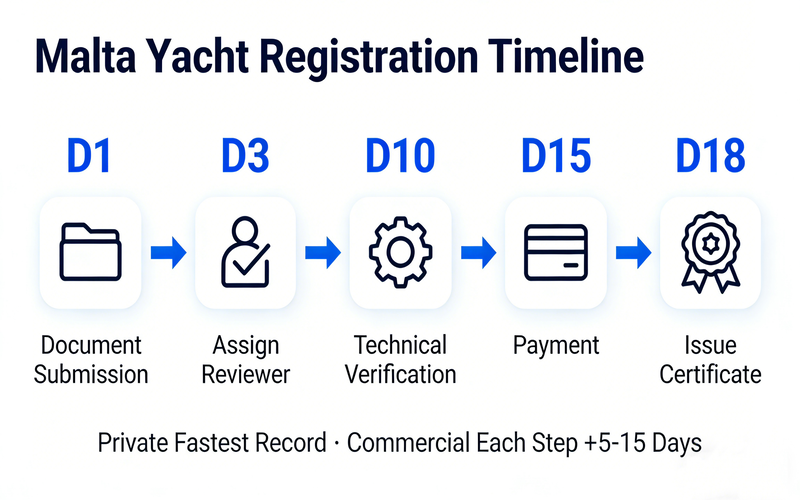
As a yacht broker with ten years' experience, I advise owners to proceed methodically through the following steps to ensure efficient and smooth registration.
Submission of Documents
The first step in registration is to submit all necessary documentation to the Transport Malta (TM), including:
- Proof of yacht ownership (Boat Title / Bill of Sale)
- Hull Identification Number Verification Certificate
- EU Declaration of Conformity
- Proof of construction or vessel construction documentation
- VAT payment proof or exemption documentation
Vessel Inspection and Approval
Upon receiving the application, the Authority will conduct a documentary review and necessary technical verification of the yacht. This includes HIN information cross-checking, confirmation of construction certificate consistency, and compliance assessment of EU-related and VAT documentation. Where commercial use is involved, commercial licences and crew qualification documents will be reviewed concurrently.
Issuance of Registration Certificate
Upon successful review, the Transport Malta (TM) will issue the formal Vessel Registration Certificate. This document constitutes the essential legal basis for the yacht's navigation, berthing, and insurance coverage within EU waters. Commercial yachts must ensure all commercial operating licences and crew qualifications are duly registered prior to certificate issuance.
In practice, provided documentation is complete and information is highly consistent, the registration process typically proceeds as expected. Conversely, any alteration in intended use or inconsistency in document fields—even minor discrepancies—can significantly prolong the overall approval cycle.
By following the above steps, yacht owners can efficiently complete the full registration process for yacht registration requirements in Malta, while ensuring tax compliance, document integrity and operational security.
Summary
The core of Malta yacht registration lies not in ‘complex procedures’, but in document consistency, clarity of purpose, and VAT-compliant structures.
For long-term owners, however, annual yacht operating costs should not be overlooked ; for first-time registrants or charter planners, a professional pre-check can cut rejection risk by up to 30% and ensure VAT and licensing requirements are met.
FAQ
Q1: What is the yacht tax in Malta?
A1: Private yachts are subject to a one-off 18% VAT payment under EU standards, requiring proof of payment; commercial charters may utilise the Maltese leasing scheme, reducing the tax base to 60% – resulting in an effective tax rate of approximately 10.8% – though an initial deposit exceeding 30% must be paid in upfront. This upfront deposit is non-refundable and must be remitted before the charter agreement is signed, ensuring compliance with Malta’s VAT regulations.
Q2: How many ships are registered in Malta?
A2: By the end of the first quarter of 2025, the total number of vessels registered in Malta had exceeded 10,000 (2024 full year: 10,384 vessels | Source: Transport Malta Statistical Overview 2025, p.8), making it Europe's largest and the world's sixth-largest flag state registry. This figure also includes a significant number of specialised vessels such as luxury superyachts.
Q3: Is it possible to obtain financing or leverage when registering a yacht in Malta?
A3: Yes. Malta permits the use of yachts as collateral for ship loans from EU banks, with financing available up to 60–70% of the appraised value. Interest rates are typically 1–2 percentage points lower than those for personal loans. However, banks require completion of provisional registration in Malta and submission of insurance and mortgage agreements prior to disbursement. Full registration certificates are issued only upon full repayment of the loan.
Q4:May the yacht depart Maltese waters during the registration period?
A4:Upon obtaining a Provisional Certificate, you may legally depart the port; however, insurance and radio licences must be valid concurrently. For commercial operations, crew lists must be registered with MSIS in advance, failing which you may face penalties for “operating without certification” at the next port of call. Always check local port-state control requirements before departure to avoid delays or fines.
Regulatory and Compliance Background
This document has been prepared in accordance with Transport Malta (Merchant Shipping Directorate) registration review criteria for the year 2025. The focus of registration approval is not on individual documents, but rather on an overall compliance assessment. This encompasses technical standards of the vessel, its operational nature (private or commercial), and its EU VAT compliance status.
This document is compiled based on current Maltese flag state practice and the EU maritime regulatory framework, aiming to assist shipowners in completing compliance preparations prior to formal application.
About the Author
Brian G. Steller
Yacht Broker
Qualifications: SAMS Certified Surveyor, No. AMS #1249
Last Updated: 2026
Disclaimer:
The content herein is for reference only and does not constitute investment advice. Yacht specifications are based on publicly available data for 2025; actual configurations shall be subject to classification society certificates. Prior to purchase, an independent surveyor (not appointed by the seller) must be engaged to conduct sea trials and verify certificates. We accept no liability for any losses arising from reliance on this information. Transport Malta reserves the right to amend fee scales, rejection codes, and document lists at any time; all updates shall be governed by the regulatory notices in force at the time. Neither the author nor the publishing platform guarantees the subsequent accuracy of this information.