Quick answer:
Most boats do not follow one fixed depreciation rate. As a broad planning range, a new recreational boat may lose approximately 10%–20% of its value in the first year, 20%–40% cumulatively by year five and 30%–60% by year ten.
Actual resale value can fall outside these ranges depending on boat type, brand, engine hours, maintenance records, condition, location, equipment, market demand and whether the comparison uses asking prices or completed sale prices.
For a reliable valuation, compare recent sales of the same make, model, age and engine configuration rather than relying on age alone.
Important: These figures are planning ranges, not guaranteed industry averages. Luxury yachts, pontoons, fishing boats, powerboats and sailboats may follow materially different resale patterns.
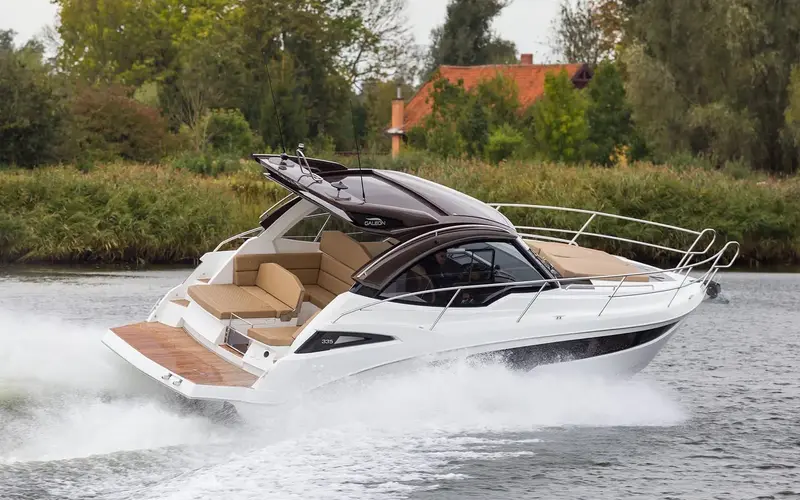
Boat Depreciation Rate at a Glance
Boat depreciation refers to the decline in a vessel’s market value over time. Unlike cars, boats do not follow a standardized depreciation curve because resale prices are influenced by many variables beyond age.
A five-year-old boat with complete maintenance records, low engine hours and strong market demand may retain significantly more value than a newer boat with poor upkeep or outdated equipment.
For general planning purposes, the following table shows a typical depreciation range for recreational boats.
Boat Depreciation Rate by Year
| Boat Age | Estimated Cumulative Depreciation | Estimated Value Retained | Main Valuation Considerations |
|---|---|---|---|
| 1 year | 10%–20% | 80%–90% | New-to-used price adjustment, warranty status, dealer discounts |
| 3 years | 19%–32% | 68%–81% | Engine hours, condition, model updates and remaining warranty |
| 5 years | 27%–43% | 57%–73% | Service records, electronics, upholstery and equipment condition |
| 7 years | 31%–48% | 52%–69% | Major servicing, system condition and buyer demand |
| 10 years | 37%–56% | 44%–63% | Survey results, refit history and comparable sales |
How These Depreciation Figures Are Calculated
The above table uses two compounded planning scenarios rather than simply adding annual depreciation percentages together.
Boat values usually decline based on the remaining value of the vessel, not the original purchase price every year.
Strong-retention scenario
A boat with good market demand and proper maintenance may follow a slower depreciation pattern:
- Year 1: 10% depreciation
- Years 2–5: approximately 5% per year
- Years 6–10: approximately 3% per year
Higher-depreciation scenario
A boat with weaker demand, faster technology changes or higher ownership costs may depreciate faster:
- Year 1: 20% depreciation
- Years 2–5: approximately 8% per year
- Years 6–10: approximately 5% per year
The depreciation rates are compounded against the boat’s remaining value rather than added directly.
For example, a $100,000 boat losing 10% in the first year is worth approximately $90,000. A further 10% depreciation in the second year would apply to $90,000, not the original $100,000.
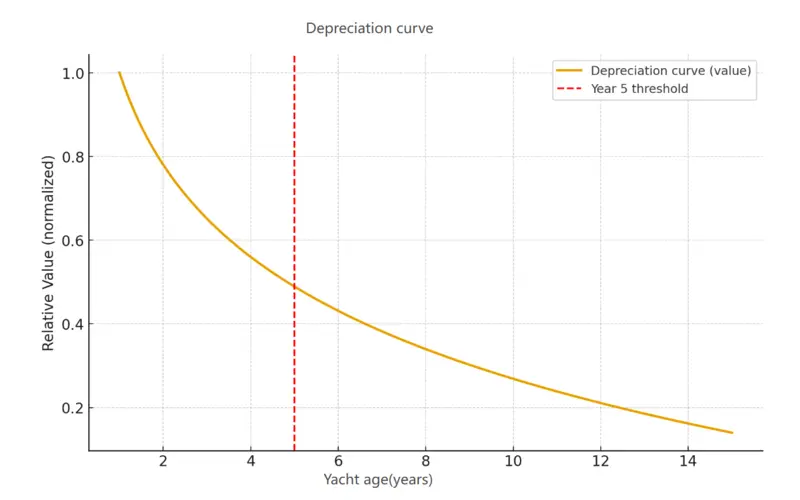
Estimated Boat Value After 1–10 Years
Many buyers are less interested in depreciation percentages and more interested in one practical question:“How much will my boat be worth after several years?”
The following examples show estimated resale values based on different original purchase prices.
Example 1: $50,000 Boat Depreciation Schedule
| Boat Age | Estimated Value Range |
|---|---|
| New | $50,000 |
| 1 year | $40,000–$45,000 |
| 3 years | $34,000–$41,000 |
| 5 years | $29,000–$37,000 |
| 7 years | $26,000–$35,000 |
| 10 years | $22,000–$32,000 |
Example 2: $100,000 Boat Depreciation Schedule
| Boat Age | Estimated Value Range |
|---|---|
| New | $100,000 |
| 1 year | $80,000–$90,000 |
| 3 years | $68,000–$81,000 |
| 5 years | $57,000–$73,000 |
| 7 years | $52,000–$69,000 |
| 10 years | $44,000–$63,000 |
Example 3: $250,000 Boat Depreciation Schedule
| Boat Age | Estimated Value Range |
|---|---|
| New | $250,000 |
| 1 year | $200,000–$225,000 |
| 3 years | $170,000–$203,000 |
| 5 years | $143,000–$183,000 |
| 7 years | $130,000–$173,000 |
| 10 years | $110,000–$158,000 |
These figures are only valuation estimates, not guaranteed resale prices.
A boat’s actual market value can differ because buyers typically evaluate:
- Recent comparable sales
- Engine hours
- Maintenance history
- Survey results
- Equipment condition
- Storage environment
- Regional demand
- Seasonal market conditions
A well-maintained 10-year-old boat may sell close to the higher end of the range, while a poorly maintained five-year-old boat may sell below expectations.
Why Boat Depreciation Rates Differ Between Sources
Boat depreciation numbers often vary because different sources measure different markets.
A depreciation percentage reported for a small recreational boat should not automatically be applied to a high-value yacht or specialized vessel.
Several factors explain why published depreciation rates differ:
| Factor | Why It Changes Depreciation |
|---|---|
| Boat category | Fishing boats, pontoons, sailboats and luxury yachts attract different buyers |
| Purchase price | Higher-priced vessels often experience larger initial value adjustments |
| Brand demand | Popular models usually have stronger resale liquidity |
| Market location | Regional demand, taxes and transport costs influence value |
| Data source | Asking prices and completed sales can produce different results |
| Economic conditions | Interest rates, supply and demand affect used boat pricing |
| Equipment level | Engines, electronics and optional upgrades affect buyer interest |
For example, a mainstream recreational boat may show a relatively moderate depreciation curve, while a luxury yacht market can experience larger early declines because of higher initial pricing, customization and equipment changes.
Large luxury yachts also follow a more complex valuation process involving builder reputation, refit history, tax status, classification records and brokerage demand. See our separate yacht depreciation rate guide for that market.
How to Calculate Boat Depreciation
Boat depreciation involves three key terms:
- Annual depreciation rate: Value lost in one year
- Cumulative depreciation rate: Total value lost compared with the original purchase price
- Remaining value: Current value as a percentage of the original price
Boat depreciation is usually calculated using the remaining value, not by simply adding yearly percentages together.
Formula 1: Cumulative Depreciation Rate
(Original purchase price − Current market value) ÷ Original purchase price × 100
Example:
A $100,000 boat is worth $70,000 after five years:
($100,000 − $70,000) ÷ $100,000 = 30%
The boat has depreciated by approximately 30%.
Formula 2: Estimated Resale Value
Original purchase price × (1 − depreciation rate)
Example:
A $100,000 boat with 35% depreciation:
$100,000 × 0.65 = $65,000 estimated value
For long-term ownership, depreciation should be compounded because each year’s loss is calculated from the boat’s remaining value rather than the original price.

New vs Used Boat Depreciation
A common question among buyers is: “Should I buy a new boat or a used boat to minimize depreciation?”The answer depends on priorities.
A new boat usually experiences the largest initial depreciation because it immediately transitions from a new retail product to a used vessel.
A used boat may avoid this first depreciation adjustment, but condition and maintenance history become much more important.
| Factor | New Boat | Used Boat |
|---|---|---|
| Initial depreciation | Usually highest after the first sale | Previous owner has absorbed the initial adjustment |
| Warranty | Often covered by manufacturer warranty | Depends on age and transfer conditions |
| Purchase price | Higher | Lower for similar size and model |
| Condition risk | Generally lower | Survey and maintenance history are critical |
| Technology | Latest design and equipment | May require electronics or system upgrades |
| Future depreciation | Usually faster during early ownership | Often slower, but highly condition-dependent |
| Best suited for | Buyers prioritizing customization and warranty | Buyers prioritizing purchase value |
Powerboat vs Sailboat Depreciation
It is difficult to state that one category always depreciates faster than another.
Powerboats and sailboats are affected by different resale factors.
Powerboats are often influenced by:
- Engine hours
- Propulsion technology
- Fuel systems
- Generator condition
- Electronics
Sailboats are often influenced by:
- Standing rigging
- Sails
- Mast and deck condition
- Sailing design popularity
- Auxiliary engine condition
Powerboat vs Sailboat Depreciation Comparison
| Factor | Powerboat | Sailboat |
|---|---|---|
| Main mechanical exposure | Engines, drives, generators and electronics | Rigging, sails, mast, deck hardware and auxiliary engine |
| Engine hours | Often a major pricing factor | Usually less dominant than comparable powerboats |
| Technology changes | Can affect value faster | Often slower depending on equipment |
| Major age-related costs | Engines, drives, fuel systems | Standing rigging, sails, deck maintenance |
| Buyer demand | Influenced by fuel costs and engine reputation | Influenced by design, condition and sailing market |
| Depreciation conclusion | May decline faster when propulsion becomes outdated | May retain value well, but major refit costs affect resale |
Asking Price vs Actual Selling Price
One of the most common mistakes when estimating boat depreciation is comparing:Original retail price → Current listing price
without considering whether the boat actually sells at that price.
A listed asking price does not always represent the final transaction value.
The difference can be affected by:
| Factor | Impact on Resale Value |
|---|---|
| Dealer discounts | New boats may sell below advertised prices |
| Optional equipment | Some upgrades add value, while others only appeal to specific buyers |
| VAT and tax status | International buyers may value boats differently depending on tax position |
| Inflation | Historical purchase prices may not directly compare with current markets |
| Broker commission | Transaction costs influence final proceeds |
| Negotiation | Final selling prices are often below asking prices |
| Market supply | Excess inventory can reduce achievable prices |
For accurate depreciation analysis, owners should prioritize:
- Completed sales of comparable boats
- Similar age and model year
- Similar engine configuration
- Similar equipment level
- Similar geographic market
Therefore, depreciation calculations based only on listing prices may overestimate retained value.
Once you have a realistic valuation, use our guide to making an offer below asking price to plan your opening bid.
What Affects Boat Resale Value Most?
| Factor | Potential Effect | What Owners Should Keep |
|---|---|---|
| Brand and model demand | Strong buyer demand improves liquidity | Original specifications and model documentation |
| Engine hours | Excessive hours may reduce buyer confidence | Verified engine-hour records |
| Maintenance history | Missing records create uncertainty | Service invoices and maintenance logs |
| Hull condition | Structural problems can significantly reduce value | Survey reports and repair documentation |
| Electronics | Older systems may reduce usability | Installation records and manuals |
| Storage environment | UV, moisture, salt and freezing accelerate deterioration | Storage and winterization records |
| Accident history | Undisclosed damage can affect buyer decisions | Insurance and repair records |
| Modifications | Personal customization may reduce buyer pool | Professional installation documents |
| Location | Taxes, transport costs and regional demand affect pricing | Registration and tax documents |
| Market timing | Supply and demand influence resale prices | Recent comparable market data |
How to Reduce Boat Depreciation
Boat depreciation cannot be completely avoided, but owners can reduce unnecessary value loss by maintaining the vessel properly, keeping accurate records and making decisions that support future resale demand.The goal is not to stop depreciation, but to keep the boat in a condition that attracts buyers and supports stronger resale value.
10 Practical Ways to Protect Boat Resale Value
1. Maintain Complete Service RecordsA documented maintenance history improves buyer confidence and supports resale value.
Keep records of engine servicing, repairs, upgrades, inspections and major maintenance work.
2. Follow the Manufacturer’s Maintenance Schedule
Regular servicing helps prevent avoidable damage and reduces concerns during buyer inspections.
Pay particular attention to engines, electrical systems, fuel systems and safety equipment.
3. Avoid Excessive Engine Hours and Harsh Operation
Normal use does not necessarily reduce value if the boat is properly maintained.
However, excessive engine hours, aggressive operation and poor care can accelerate depreciation.
4. Store the Boat Properly
Storage conditions directly affect long-term condition.
Protect the vessel from UV exposure, saltwater corrosion, moisture and freezing temperatures through proper storage and winterization.
5. Upgrade Equipment Strategically
Useful upgrades can improve resale appeal, especially modern navigation systems, safety equipment and reliable electronics.
Avoid expensive customizations that only suit a narrow group of buyers.
6. Choose Models With Strong Market Demand
Boats with established brands, reliable parts support and practical layouts usually have stronger resale liquidity.
Broad buyer demand is often more important than unique features.
7. Protect Cosmetic Condition
Appearance strongly influences buyer perception.
Maintain upholstery, gelcoat, teak, paint, canvas and interior finishes to keep the boat attractive during resale.
8. Keep Professional Inspection Records
Survey reports and repair documentation provide evidence of proper ownership.
A transparent history can reduce buyer concerns and simplify negotiations.
9. Avoid Excessive Personal Modifications
Highly customized interiors, unusual layouts and non-standard installations may limit the buyer pool.
Prioritize practical improvements that appeal to a wider market.
10. Sell at the Right Market Timing
Boat prices are affected by seasonality, inventory levels, economic conditions and regional demand.
Choosing a favorable selling period may improve the final transaction result.
When Is the Best Age to Buy a Used Boat?
Many buyers assume the newest boat is always the best purchase.However, depreciation patterns mean different ownership stages offer different advantages.
The best buying age depends on whether the buyer prioritizes:
- Lower purchase price
- Remaining warranty
- Lower maintenance risk
- Modern equipment
1–3 Years Old: Nearly New Boats
Advantages:- Previous owner has absorbed much of the initial depreciation
- Modern design and equipment
- Lower wear compared with older vessels
- Possible remaining warranty coverage
- Purchase price may still be relatively high
- Popular models may retain strong pricing
4–7 Years Old: The Value Balance Period
For many buyers, boats in this age range provide the strongest balance between price and condition.Advantages:
- Significant initial depreciation has already occurred
- Maintenance history is easier to evaluate
- Most major systems are still serviceable
- Purchase prices are often more attractive
- Electronics may require updates
- Major maintenance items may approach replacement cycles
8–10 Years Old: Lower Purchase Price, Higher Inspection Importance
Older boats can offer excellent value, but buyers need stronger due diligence.Important inspection areas include:
- Engine condition
- Structural integrity
- Electrical systems
- Electronics
- Upholstery
- Plumbing
- Previous repairs
About the Author:
This article was prepared by the YachtTrading editorial team based on yacht market research, resale analysis and industry experience.
Our goal is to provide practical information to help boat owners and buyers better understand depreciation trends, resale factors and ownership decisions.
Disclaimer:
The information provided in this article is for general reference only. Boat depreciation varies by vessel type, brand, market conditions, location, condition and other factors.
The depreciation ranges discussed are planning estimates and should not be considered guaranteed future values or investment advice.
Before buying or selling a boat, owners and buyers should review comparable market data, professional surveys and relevant transaction information.
FAQ
Q1: How much does a boat depreciate in the first year?
A: A new recreational boat may lose approximately 10%–20% of its value during the first year, although dealer discounts, brand demand and market conditions can produce results outside this range.
Q2: How much does a boat depreciate after five years?
A: Under the compounded planning model in this guide, a boat may lose approximately 27%–43% of its original value after five years, leaving an estimated residual value of around 57%–73%.
Q3: How much is a $100,000 boat worth after five years?
A: A $100,000 boat may be worth approximately $57,000–$73,000 after five years under the model used in this guide. Its actual value should be based on comparable completed sales and its current condition.
Q4: How much is a boat worth after ten years?
A: The model estimates that a ten-year-old boat may retain approximately 44%–63% of its original price. At this age, survey condition, engine history, upgrades and market demand usually matter more than age alone.
Q5: Do used boats depreciate more slowly than new boats?
A: Used boats usually avoid the largest new-to-used price adjustment, but they do not always offer better value. Deferred maintenance, structural problems and outdated equipment can produce substantial additional costs.
Q6: Do powerboats depreciate faster than sailboats?
A: Not always. Powerboats are strongly affected by engine hours and propulsion technology, while sailboats are affected by rigging, sails, deck condition and design demand. Condition and model popularity can be more important than propulsion type.
Q7: How do I calculate boat depreciation?
A: Subtract the boat’s current market value from its original purchase price, divide the difference by the original price and multiply by 100. Use a completed sale value where possible rather than an advertised asking price.
Q8: Do boats depreciate faster than cars?
A: There is no universal answer. Some new boats experience a significant first-year adjustment, but desirable and well-maintained models may retain value better than expected. Boat values are especially sensitive to condition, location, engine history and seasonal demand.