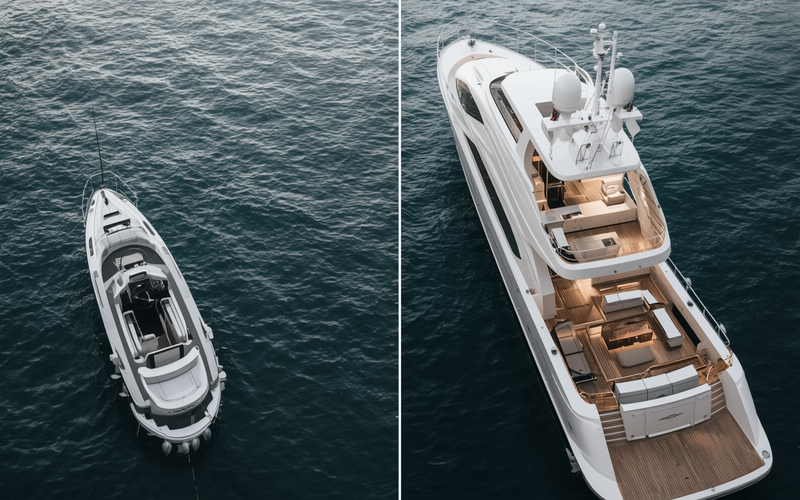
A yacht is typically over 33 feet and designed for overnight living, while a boat is smaller and used for day trips.
Key differences:
- Size: Yacht >33 ft, Boat <33 ft
- Function: Living vs Day use
- Cost: $200K+ vs $15K–$150K
Yacht vs Boat: Quick Comparison Table
Here’s a quick side-by-side comparison to understand the key differences between a yacht and a boat at a glance:
| Comparison Factor | Yacht | Boat |
| Typical Length | 33 ft and above | Under 33 ft |
| Primary Use | Overnight living, long-distance cruising | Day trips, fishing, short leisure |
| Onboard Amenities | Cabin, galley, bathroom (head) | Basic seating and storage |
| Offshore Capability | 20+ nautical miles, open sea ready | Mostly inshore or near-coastal |
| Price Range | $200,000 to multi-million | $15,000 – $150,000 |
| Annual Ownership Cost | ~15–25% of purchase price | ~5–10% of purchase price |
| Crew Requirement | Owner or hired crew | Typically owner-operated |
| Lifestyle | Liveaboard / luxury cruising | Casual recreational use |
In short, yachts are designed for living on the water, while boats are built for short-term recreational use.
What Qualifies as a Yacht? The 4 Criteria That Matter
The difference between yacht and boat starts here. While 33 feet is the common threshold, what qualifies as a yacht depends on four factors:- Overnight Capability: Enclosed sleeping quarters, not convertible benches.
- Self-Contained Living :Galley + head = yacht. One or neither = boat.
- Offshore Range :20+ nautical miles capability with full navigation.
- Legal Classification :USCG documented vs state registered.
Yacht vs Boat Difference: Beyond the 33-Foot Rule
In everyday usage, many people use the terms ‘yacht’ and ‘boat’ interchangeably, but in reality there are fundamental differences between the two in terms of size, function and market positioning.The term ‘yacht’ generally refers to a vessel equipped with self-contained living facilities (cabin, galley, bathroom), emphasising its ability for extended cruising and the experience of living at sea; the term ‘boat’, on the other hand, refers broadly to various types of small vessels under 33 feet in length, intended primarily for day trips.
However, the practical significance of this threshold often lies in functionality rather than mere numbers—I once inspected a 32-foot Sea Ray which, simply because it lacked a separate toilet, was ultimately classified as a cruiser rather than a yacht. This is also the key to determining whether a vessel can be called a yacht: it is not the numerical length that matters, but the functional layout.
Boat vs Yacht Price Comparison
The price range for yachts varies enormously (from hundreds of thousands to tens of millions of dollars), but being able to ‘afford’ one and being able to ‘maintain’ one are two entirely different matters.In terms of purchase price, entry-level yachts (35–45 feet) typically cost between US$250,000 and US$450,000. Entry-level models from mass-market brands such as Bavaria in Germany have fallen to around US$300,000—yet boats of the same size cost just US$15,000–150,000, a difference of nearly tenfold.
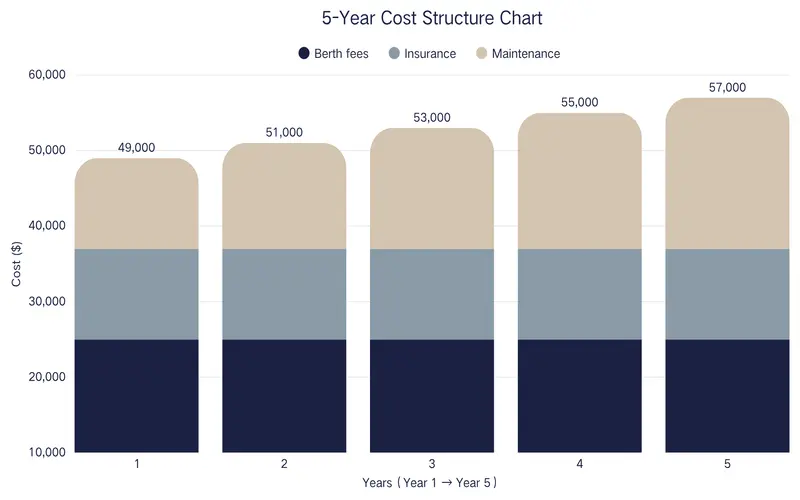
The real cost lies in the running costs. Data from the YATCO platform shows that the annual running costs for a yacht typically amount to 10–15% of the purchase price. However, the clients I work with in Florida actually need to budget for 20%.
And that’s just the first year. Taking a 40-foot yacht costing $220,000 as an example, the first-year running costs amount to approximately $44,000 (20% of the purchase price). The breakdown of costs over five years is as follows:
| Cost Item | Annual Average | 5-Year Total |
| Mooring Fees | $25,000 | $125,000 |
| Insurance | $12,000 | $60,000 |
| Maintenance & Repairs | $15,000 | $75,000 |
| Total | $52,000/year | $260,000 |
These practical tips for buying a new yacht are often more important than the choice of boat itself.
Yacht vs Boat Size Comparison: The 33-Foot Rule Explained
According to the global yacht trading platform YATCO, 33 feet (approximately 10 metres) is a common threshold for distinguishing between a yacht and a boat – ‘any recreational vessel exceeding 33 feet is generally regarded as a yacht’. When understanding the difference between a yacht and a boat, size and classification are the most fundamental criteria. Although 33 feet is a common industry benchmark, the true distinction lies in the details.Range of boat sizes
In most markets, the term ‘boat’ refers to smaller vessels with relatively simple construction, typically ranging from 10 to 30 feet in length. Common types include:- Small fishing boats (12–20 ft)
- Centre-console boats (18–30 ft)
- Small sailing boats
- Workboats or recreational craft
In practical terms, the key advantages of small boats lie in their low cost, simple maintenance and manoeuvrability. For those who enjoy weekend trips out to sea, inshore fishing or short cruises, a boat is a more practical choice.
Yacht size classification system
By comparison, the classification of yachts is much clearer; the industry typically categorises them by length, which is key to understanding the comparison between yacht and boat sizes.| Type | Length Range | Typical Use |
| Small Yacht | 33–50 ft | Family cruising, weekend getaways |
| Power Yacht | 50–80 ft | Long-distance cruising, social & entertainment |
| Superyacht | 80–120 ft | Luxury cruising, commercial operation |
| Megayacht | 120 ft+ | Global cruising, bespoke luxury |
As can be seen from this structure, the core characteristic of a yacht is its ability to sail and accommodate a crew for extended periods. As the size increases, hull stability, fuel capacity and living facilities all improve significantly.
The Critical Transition Zone: The 30–40 Foot Grey Area
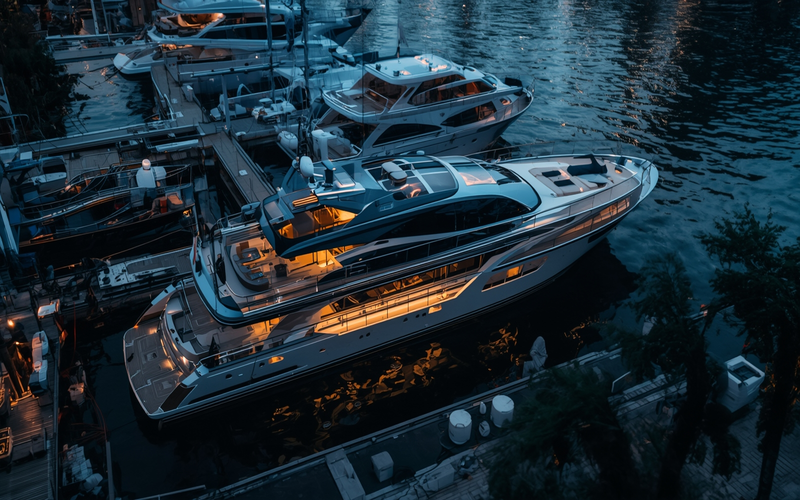
In the real world, the 30–40-foot range is the most prone to confusion. For example:- 28-foot Centre Console: Primarily used for day fishing, it is generally regarded as a boat
- 35-foot Cruiser: Equipped with a cabin, galley and bathroom, it is classified as a small yacht
Guidelines:
- Under 30 feet → Generally classified as a boat
- 33–40 feet → Depends on living facilities; may be a small yacht or cruiser
- Over 40 feet → Generally regarded as a yacht
👉 Used Boats for Sale (30–50 ft) — Filter certified pre-owned boats between 33 and 40 feet to find the perfect match for your needs
Boat vs Yacht: Fundamental Differences Compared
Having understood the internal classification of yachts, a more practical question to ask is: what is the fundamental difference between a boat and a yacht? The table below compares the two from a practical perspective:| Comparison Dimension | Boat | Yacht |
| Length Range | < 33 ft (typically 15-30ft) | ≥ 33 ft (typically 33ft+) |
| Core Feature | Day-use activity, utility-focused | Overnight capability, living-oriented |
| Amenities | Seating / basic storage | Cabin + galley + head |
| Typical Price | $15K - $150K | $200K - multi-million USD |
| Annual Cost | 5-10% of purchase price | 15-25% of purchase price |
| Use Case | Fishing, day cruising | Family vacations, long-distance cruising |
| Operation Requirement | Operated by owner | Operated by owner or crew |
This comparison highlights a simple principle: if you need to stay overnight, choose a yacht; if you’re making a day trip, a boat is more practical. But this is just the starting point—in the next chapter, we’ll delve into the finer details of functionality and explain why ‘being able to sleep’ and ‘sleeping comfortably’ are two very different things.
Is a 40ft Boat a Yacht?
The 33-foot rule isn't absolute. The real test is functionality, not length.Yacht = Boat when:
- No enclosed sleeping quarters
- No galley or head
- Day-use only design
Real-world examples:
- 35-foot cruiser with cabin, galley, head = yacht
- 40-foot center console without toilet = still a boat
Size guidelines:
- Under 30 ft → generally a boat
- 33–40 ft → depends on amenities
- Over 40 ft → usually a yacht
it's a yacht—regardless of the tape measure.
Differences in Features and Luxury Experience
When evaluating these vessels, luxury and comfort—aside from size—are also key distinctions.Features of Boat
- Primarily designed for daytime cruising or recreational use along the coast, these vessels lack sleeping quarters, a galley and full bathroom facilities.
- Simple to operate, low-cost and easy to maintain, they are ideal for short trips and users on a limited budget.
- Typical uses include weekend fishing trips, lake cruises or short family outings, with a focus on day trips.
Features of a yacht
- Offers a comprehensive living space, including cabins, a galley, bathrooms and high-end leisure facilities.
- Equipped with advanced navigation systems and facilities designed for extended voyages, it offers excellent stability and is ideal for family cruising, long-term holidays or socialising at sea.
- Its long-range capability allows owners to enjoy life at sea for several days or even weeks at a time, offering greater freedom and privacy whilst accommodating more crew or guests.
Small Yacht vs Boat: Key Differences
For this size range, which is the most prone to confusion, the key criteria are:- Is the vessel capable of multi-day voyages (fuel and fresh water reserves)
- Does the vessel have a self-contained living quarters (not open-plan berths)
- Does the vessel have a complete navigation system (capable of operating more than 20 nautical miles offshore)
Yacht vs Boat for Beginners
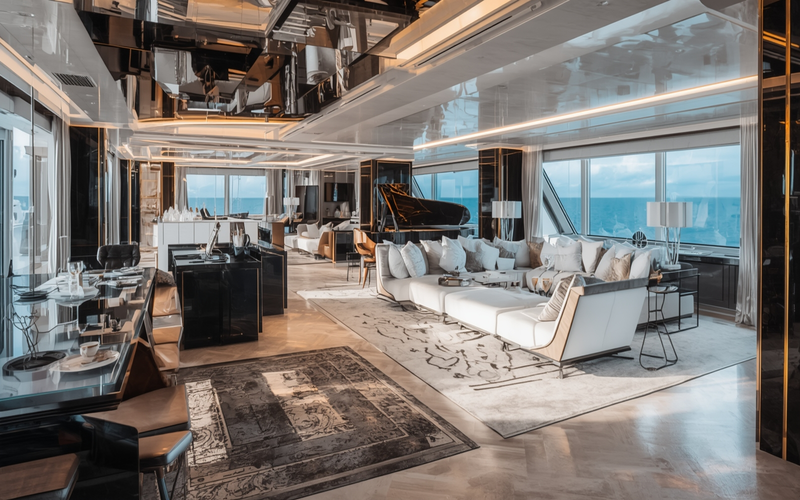
Once you've grasped what sets them apart, the real question becomes: which one suits your needs? There’s no one-size-fits-all answer to this; it all depends on your budget, how often you’ll use it, and your sailing requirements.Choose a Boat If:
- Weekend sea fishing or short family trips
- Cruising on lakes or in coastal waters
- Rare trips to sea
- Budget of $15,000–$150,000
straightforward maintenance schedules and the ability to be transported
by trailer, the overall cost of ownership remains manageable. For first-time
boat buyers, a boat is also the most reliable way to embark on a life of sailing.
Choose a Yacht If:
- Extended cruising and family holidays
- Multi-day voyages
- Business or social entertainment
- Long-term ownership plans
- Budget for $200,000+ plus 20% annual costs
capable of supporting voyages lasting several days or even weeks.
In 2024, I met a client who had his eye on a 2017 Bavaria S40, a 40-foot model, priced at $220,700. As a German mass-market brand, Bavaria is renowned for its value for money, but the first-year maintenance costs for a nine-year-old yacht still amounted to $48,000 – nearly 22% of the purchase price.
This includes routine maintenance, repairs for ageing engine seals common in nine-year-old vessels, and additional mooring fees incurred whilst waiting for parts from European manufacturers. A low entry price does not equate to low ownership costs; a five-year ownership cost calculation must take into account brand premiums and the vessel’s age.
Typical requirements include:
- Family cruising or holiday use
- Multi-day voyages
- Business or social entertainment
- Long-term ownership plans
👉 Book a consultation with a surveyor — have the vessel inspected to avoid hidden cost pitfalls
Decision Logic Based on Usage Scenarios
In the real world, brokers typically use intended use to guide their recommendations:- Short-distance leisure trips and budget-conscious buyers → boat
- Family cruising and long-distance voyages → yacht
If you do not go out to sea very often, buying a yacht may result in a waste of resources; conversely, if you plan to go on extended cruises, a boat will not meet your needs. Therefore, a rational decision regarding boat purchase should be based on your actual usage scenarios.
Conclusion
Overall, the key difference between a yacht and a boat lies in their function and intended use, rather than simply their size. A boat is better suited to short trips close to shore and everyday leisure, whilst a yacht is designed for extended cruising and the experience of life at sea.When making your choice, a simple rule of thumb applies: a vessel with living quarters and the capacity for extended voyages is closer to being a yacht. For prospective buyers, the choice should be based on actual usage requirements—opt for a boat for short trips and a yacht for long-term cruising—to strike the right balance between cost and experience.
About the Author
Brian G. Stetler
Yacht Broker
Qualifications: SAMS Certified Surveyor, No. AMS #1249
Last Updated: January 2026
Disclaimer:
This content is for reference only and does not constitute investment advice. This article has not received sponsorship from any shipyard, financing institution, or brand; the author has not participated in brokerage transactions involving the vessels cited herein. Yacht specifications are based on publicly available information as of 2026; actual prices may vary due to regional and market fluctuations. Actual configurations shall be subject to classification society certificates. Prior to purchase, it is imperative to hire an independent surveyor (not affiliated with the seller) to conduct sea trials and verify certificates. Neither the author nor this platform is responsible for any losses incurred as a result of reliance on the information provided herein. Regulations and fees are subject to change; always check current requirements.
FAQ
Q1: When is the best time to buy a second-hand yacht?
A: Dealers offer the biggest discounts when clearing stock between October and December; private sellers are active all year round, but the best room for negotiation is between February and March—before summer maintenance costs rise.
Q2: What documents must be checked when buying a second-hand yacht?
A: List of essential documents: Certificate of Registration, engine maintenance records, hull repair history, latest survey report, and proof of any outstanding mortgages.
Q3: Do you need a special license to operate a yacht?
A: In most US states, there is no compulsory licence requirement for recreational vessels under 50 feet, but it is recommended that you complete a Coast Guard safety course; vessels over 50 feet or those used for commercial operations usually require a skipper’s licence.