This guide uses U.S. consumer-finance and vessel-documentation examples; lending and ownership rules differ in other jurisdictions.
What Is a Joint Boat Loan?
A joint boat loan is a financing arrangement in which two people apply together to borrow money for a boat or yacht purchase. Both applicants enter into the loan arrangement, with their contractual obligations determined by the loan agreement.Joint boat financing may suit spouses, unmarried partners, family members or other buyers who intend to share the cost of purchasing a vessel. For example, two buyers purchasing a motor yacht may apply together rather than having one person finance the entire purchase independently.
It is important to distinguish between joint borrowing and joint ownership. The loan agreement establishes the borrowers' obligations to the lender. Ownership depends on the purchase documents, applicable title or registration system and relevant law. Signing the same loan does not automatically give both borrowers equal ownership shares.
Co-Borrower vs. Co-Signer
A co-borrower and a co-signer may both take on financial obligations connected with a loan, but they do not necessarily have the same contractual role.| Consideration | Co-Borrower | Co-Signer |
|---|---|---|
| Role | Applies for credit jointly with another applicant | Agrees to guarantee or otherwise support another borrower's debt |
| Financial Assessment | Generally subject to the lender's underwriting requirements | Generally subject to the lender's requirements for guarantors or co-signers |
| Repayment Responsibility | As specified in the loan agreement; may include liability for the full balance | As specified in the guarantee or other signed agreement |
| Ownership Rights | Does not automatically acquire ownership by signing the loan | Does not automatically acquire ownership by signing a guarantee |
The exact distinction depends on the lender's documents and the legal structure of the transaction. The FTC's guide to cosigning a loan explains that a co-signer may have to repay the debt if the primary borrower fails to do so, without automatically receiving ownership of the financed property.
Before signing, ask whether you will be a joint borrower, a guarantor or a co-signer, and confirm the extent of your potential liability.
Can You Apply for a Boat Loan With Two Borrowers?
Yes, some lenders accept joint boat loan applications. However, not every lender offers the same application arrangements, and eligibility depends on its policies, both applicants' financial circumstances and the vessel being financed.For example, Truist's published information for its LightStream unsecured boat loan specifically addresses joint applicants. Eligibility and approval remain subject to the lender's requirements.
Before applying, confirm that the lender accepts your proposed co-applicant relationship. Ask whether both applicants must meet minimum credit requirements, whether their eligible incomes can be considered together and whether any restrictions apply to the vessel or intended ownership structure.
What Lenders May Review
| Factor | What the Lender May Assess |
|---|---|
| Credit History | Each applicant's credit profile and whether it meets the lender's criteria |
| Income and Employment | Eligible income sources, employment details and the ability to support repayments |
| Existing Debts | Current liabilities and other financial commitments |
| Down Payment | Available funds and the amount to be financed |
| Loan Amount | Whether the requested financing fits the lender's limits and affordability assessment |
| Vessel Details | Purchase price, age, type, condition, value and eligibility as collateral |
| Supporting Documents | Identification, financial records and purchase or vessel documentation required by the lender |
A lender may consider both applicants' financial positions, but combining their incomes does not automatically establish affordability or guarantee approval. Existing debts, credit history and other underwriting factors may also influence the decision.
Boat financing requirements can differ from those for standard personal loans. Some lenders may restrict the vessel's age, type or value, or require a survey or independent valuation before final approval.
For an initial overview of available financing options, buyers can consult the BoatUS boat loans page. Confirm the current terms and joint-application requirements directly with any lender you are considering. Buyers comparing lenders and financing structures can also review different yacht financing options before deciding which option best fits their purchase and financial circumstances.
How Does a Joint Boat Loan Affect Rates and Loan Amounts?
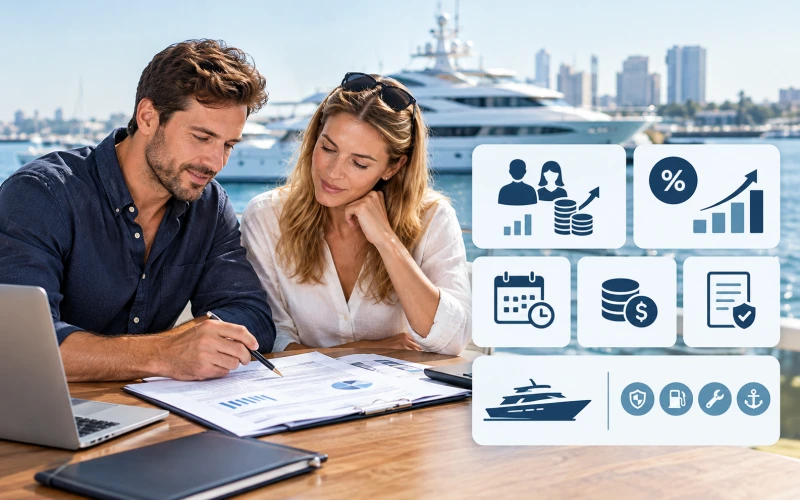
A joint boat loan application may affect how a lender assesses borrowing capacity and repayment risk. However, combining two applicants does not guarantee approval, a larger loan or a lower interest rate. The outcome depends on both applicants' financial profiles, the vessel and the lender's underwriting criteria.
Approval and Borrowing Capacity
A second applicant may strengthen an application if their eligible income supports the proposed repayments. However, the lender may also consider their existing debts, credit history and other financial commitments.For example, two buyers may have sufficient combined income to support a particular monthly payment, but substantial existing debt could reduce their borrowing capacity. A stronger applicant's financial profile does not automatically offset weaknesses in the other applicant's application.
Interest Rates and Loan Terms
When comparing joint boat loan offers, review the total cost of borrowing rather than focusing only on the monthly payment or advertised interest rate.| Factor to Compare | What to Check |
|---|---|
| APR | The annual percentage rate, including applicable fees reflected in its calculation |
| Interest Rate | The rate used to calculate interest on the outstanding balance |
| Total Repayment Amount | The total payable over the loan term, including principal, interest and applicable charges |
| Loan Term | The repayment period and its effect on monthly payments and total interest |
| Fees and Early Repayment | Origination, documentation, prepayment or other applicable charges |
| Down Payment | The upfront contribution and resulting loan balance |
| Collateral and Transfer Restrictions | Vessel security requirements and any lender consent needed to sell or transfer the boat |
APR and interest rate are not necessarily the same. The Consumer Financial Protection Bureau's explanation of APR and interest rates can help you compare financing offers.
A longer loan term may reduce monthly payments but increase total interest. A larger down payment may reduce the amount borrowed, but buyers should retain sufficient funds for insurance, maintenance and unexpected repairs.
Include the Cost of Owning the Boat
Loan repayments are only one part of the ownership budget. Before deciding how much to borrow, estimate insurance, mooring or storage, fuel, routine maintenance and repairs.For a used yacht, also budget for an independent pre-purchase survey and any necessary repairs. Reviewing estimated yacht ownership costs can help both applicants assess whether they can manage ongoing expenses alongside loan repayments.
Who Owns the Boat With a Joint Loan?
A joint boat loan does not automatically mean that both borrowers own equal shares of the vessel. Loan liability and legal ownership are separate matters.Before completing the purchase, clarify three things:
- Loan Agreement: Who owes the lender and what repayment obligations apply
- Ownership and Registration Documents: How ownership is recorded under the applicable title or vessel registration system
- Co-Ownership Agreement: How the buyers share costs, use the vessel and manage future decisions or disputes
What Should a Co-Ownership Agreement Cover?
If two people intend to own and use a boat together, a written agreement can help prevent disputes when their financial circumstances or plans change.Consider addressing these six areas before closing:
- Ownership Shares and Contributions: Each owner's share and initial investment.
- Loan Payments and Running Costs: How repayments, insurance, mooring, fuel and repairs will be divided.
- Vessel Use and Maintenance: Scheduling, operating responsibilities and approval for major expenses.
- Missed Payments: How payment shortfalls will be handled.
- Buyout, Sale and Transfer: How an owner can exit and how a buyout or sale will be managed.
- Dispute Resolution: Procedures for addressing disagreements, including negotiation or mediation.
What Happens If One Co-Owner Wants to Exit?
If one owner wants to leave the arrangement, the parties may consider a buyout, sale of the vessel or refinancing in the remaining owner's name.However, transferring an ownership share does not automatically release the departing borrower from the loan. The lender may need to approve a borrower substitution, refinancing or formal release of liability. Until the lender agrees to the change, the original loan obligations may remain in place.
For a high-value yacht, consider obtaining legal advice when drafting the agreement, particularly if the owners live in different countries, the vessel is registered abroad or the financing involves a corporate owner.
Check Ownership and Mortgage Records Before Buying
The appropriate checks depend on where the vessel is registered and which legal system applies. Before closing, use a structured boat title and lien check to identify the records and potential encumbrances relevant to the vessel's registration and jurisdiction.For a U.S. Coast Guard-documented vessel, buyers can request an Abstract of Title from the National Vessel Documentation Center (NVDC) to review recorded ownership transfers, mortgages and notices of claim of lien. A certified copy of the Certificate of Documentation may also be useful for documentation checks, but it is not a substitute for an Abstract of Title when reviewing recorded mortgages and claims.
An Abstract of Title should not be treated as a complete search for every possible lien or competing claim. Buyers should confirm which records and jurisdictions are relevant to the vessel and transaction.
If the vessel has a recorded mortgage, the closing arrangements should specify how the outstanding debt will be paid, how the required mortgage satisfaction or release documents will be obtained and recorded, and how purchase funds will be disbursed. Paying off the loan does not necessarily mean the public record has already been updated.
For a state-titled boat, buyers may need to check the relevant state agency. For an internationally registered yacht, the appropriate flag-state registry and additional jurisdiction-specific searches may be required.
Before transferring funds, confirm the seller's authority to sell, identify relevant encumbrances and establish how any outstanding security will be discharged at closing. For complex or high-value transactions, a maritime attorney can help determine which searches and legal checks are appropriate.
What Happens If One Co-Borrower Stops Paying?
If two people sign a boat loan agreement and one stops contributing, the other should not assume that the lender will pursue only the person who missed their agreed share.The consequences depend on the loan contract, security arrangements and applicable law.
Who Must Cover the Missed Payment?
If both borrowers are jointly and severally liable, the lender may be able to pursue either borrower for the full amount owed, subject to the agreement and applicable law. Other contractual arrangements may define liability differently.A private agreement between co-owners may require each person to pay a particular share, but that arrangement does not automatically limit the lender's rights under the loan contract. One borrower may therefore need to cover more than their agreed contribution to prevent the loan from falling into default.
How Can Default Affect Both Borrowers?
Depending on the loan terms and applicable rules, missed payments may lead to:- Late Fees or Other Charges: If permitted by the loan agreement
- Credit-Reporting Consequences: Delinquencies or defaults may affect one or both borrowers, depending on how the account is reported and applicable rules
- Collection Activity: The lender may use the remedies available under the contract and applicable law
- Enforcement Against Collateral: If the boat secures the loan, the lender may have rights to enforce its security interest following default
Can the Lender Repossess the Boat?
If the vessel secures the loan, default may put it at risk of repossession or other enforcement action. The lender's rights, required procedures and available remedies depend on the security agreement and applicable law.If the vessel is sold following enforcement, the proceeds may not cover the outstanding balance and permitted costs. Where applicable law allows recovery of a deficiency balance, the borrowers may remain liable for the shortfall.
Before signing, review the default provisions and ask the lender to explain its rights over the vessel and the borrowers' obligations if payments are missed.
What Should the Borrowers Do If One Stops Paying?
Act promptly rather than allowing missed payments to accumulate.- Contact the lender. Explain the situation and ask whether payment arrangements or hardship options are available. Obtain written confirmation of any agreed changes.
- Review the loan agreement. Check repayment obligations, default provisions, notice requirements and available remedies.
- Document contributions and communications. Keep records of payments, missed contributions and agreements between the co-borrowers.
- Monitor account status. Where the lender permits it, arrange for both borrowers to receive account statements or payment-status notifications.
- Seek advice if the dispute escalates. If the parties disagree about liability or the vessel is at risk of enforcement, obtain advice based on the contract and applicable law.
How to Apply for a Joint Boat Loan
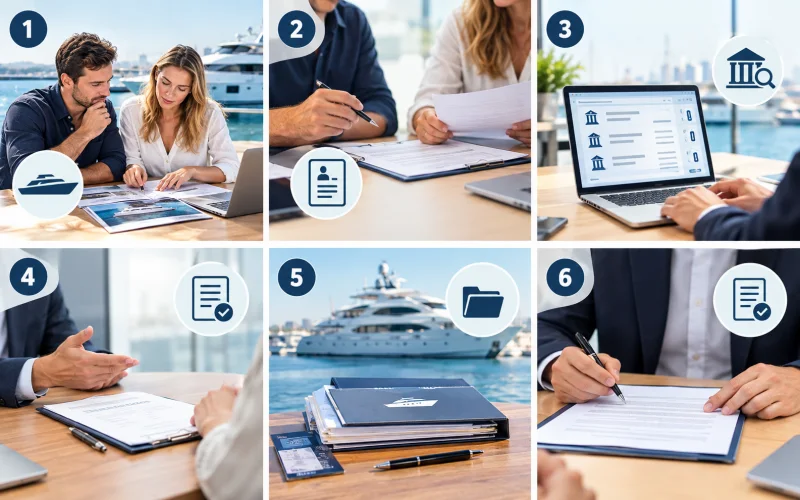
Applying for a joint boat loan involves setting a shared budget, reviewing both applicants' finances, comparing lenders and confirming the vessel's eligibility before signing.
Step 1: Agree on the Purchase Budget
Choose the boat or yacht you intend to buy and establish a realistic purchase price, down payment and borrowing amount.Include insurance, mooring or storage, fuel, maintenance and repairs in your budget. For a used vessel, allow for a professional pre-purchase survey and potential repair costs.
Both applicants should agree on their initial contributions, monthly payments and responsibility for ongoing expenses.
Step 2: Review Both Applicants' Finances
Review each applicant's credit history, income, existing debts and financial commitments before applying.Prepare the information the lender may request, including:
- Personal and employment details for both applicants
- Income records and details of existing financial obligations
- Evidence of down-payment funds, where required
- The vessel's type, age, purchase price and intended use
Step 3: Compare Lenders That Accept Joint Applications
Confirm that the lender accepts joint applications and ask how it assesses both applicants' income, credit histories and debts.Compare APR, fees, down-payment requirements, loan terms and vessel eligibility. Also clarify whether both applicants will be borrowers or whether one will act as a guarantor or co-signer, as their contractual responsibilities may differ.
Step 4: Request Prequalification or a Preliminary Assessment
Some lenders offer prequalification or a preliminary assessment to help buyers understand their potential financing options. This is not a guarantee of final approval or the terms offered.Ask whether the assessment involves a soft or hard credit inquiry and whether it may affect either applicant's credit score. The process varies by lender.
Final approval may depend on verified financial information, underwriting and satisfactory vessel documentation or valuation.
Step 5: Submit the Application and Vessel Documents
Submit the joint application and supporting documents required by the lender. These may include identification, financial records, a purchase agreement and vessel details.For a used boat or yacht, confirm early whether an independent survey or valuation is required. Ask which ownership, registration and mortgage documents the lender needs and whether funding depends on satisfactory vessel checks.
Requirements may differ for state-titled boats, U.S. Coast Guard-documented vessels and internationally registered yachts.
Step 6: Review the Final Offer Before Signing
Before accepting the loan, review the final offer and loan agreement carefully.Confirm:
- The approved loan amount, APR and applicable fees
- The repayment schedule and total amount payable
- Each borrower's contractual repayment obligations
- Default provisions, collateral rights and enforcement terms
- Any conditions that must be satisfied before funding or closing
If the loan terms, ownership arrangements or release conditions are unclear, obtain clarification before signing or transferring funds.
Is a Joint Boat Loan Right for You?

A joint boat loan may be worth considering when two buyers want to share the cost of a boat or yacht and both understand their financial responsibilities.
It may be less suitable if one applicant has uncertain finances, the buyers disagree about ownership or future use, or either person could not manage the repayments if the other stopped contributing.
Before applying, use this checklist:
- Both applicants have reviewed their credit histories, income and existing debts
- The budget includes the down payment and ongoing costs such as insurance, mooring, maintenance and repairs
- Both applicants understand their contractual obligations if one person cannot pay
- The proposed ownership arrangement is compatible with the lender's requirements and applicable registration rules
- The buyers have agreed on missed payments, buyouts, transfers and a possible sale
- The applicants have compared APR, fees, loan term and total financing costs
For a high-value yacht or a transaction involving multiple jurisdictions, consider obtaining professional advice on the loan, ownership structure and vessel documentation before committing to the purchase.
Planning to Buy a Yacht Together?
Choosing the right yacht involves more than securing loan approval. Compare suitable vessels, review the purchase details and make sure your financing plan aligns with your budget and ownership goals.

About This Guide
This guide explains joint boat financing, co-borrower responsibilities and ownership considerations for buyers purchasing boats or yachts. Lending eligibility, underwriting, interest rates, collateral requirements and legal obligations vary by lender, vessel and jurisdiction. Confirm current financing terms with your chosen lender and obtain qualified legal advice where necessary.
Disclaimer: This article is for general informational purposes only and does not constitute financial, lending or legal advice.
FAQ
Q1: Can You Remove a Co-Borrower From a Boat Loan?
A: Usually, the lender must approve the change. Refinancing or paying off the loan may be necessary. Transferring ownership alone does not release a borrower from liability.
Q2: Can You Get a Joint Boat Loan If You Are Not Married?
A: Yes. Some lenders accept applications from unmarried partners, relatives or friends, subject to their eligibility requirements.
Q3: Can You Get a Joint Boat Loan If One Applicant Has Bad Credit?
A: Possibly. Approval depends on both applicants' credit histories, income, debts and the lender's underwriting criteria.
Q4: Does a Joint Boat Loan Affect Both Borrowers' Credit?
A: It may. Payment history and missed payments can affect both borrowers' credit records, depending on how the account is reported and applicable rules.
Q5: Does a Joint Boat Loan Require a Larger Down Payment?
A: Not necessarily. The required down payment depends on the lender, vessel, loan amount and applicants' financial profiles.