Quick Answer: How should a beginner choose their first yacht?
For first-time boat buyers, there are five key considerations:
- Optimal Size — 30–40 ft, offering the best balance between handling and cost
- Easy-to-Handle Types — Twin-engine powerboats or catamarans
- System Selection — Simple design with a complete maintenance history
- Maintenance Difficulty — Outboard motors are generally easier to maintain than inboard engines
- Budget Guidelines — Annual operating costs ≈ 8%–12% of the boat’s purchase price
If you're buying your first boat, this 2026 guide—based on industry experience—will help you find a manageable, confidence-inspiring vessel. The 30–40-foot range hits the sweet spot for new boaters: large enough for family trips, small enough for easy handling, and the best yacht under 50 ft for beginners in terms of total ownership costs.
What First-Time Owners Should Look For
When purchasing a boat for the first time, the key consideration is not whether it is “fully equipped,” but whether it is manageable. According to the NMMA’s 2024 Industry Sales Report, used boat sales accounted for 78.3% of the year’s total sales of 858,798 vessels—experienced buyers generally opt for used boats that have already depreciated, with their primary concerns being to avoid the complexity and uncertainty of new boat systems and to verify the integrity of the maintenance history.
Predictable handling
Twin-engine power yachts or catamaran sailboats are more stable at low speeds and are easier to control, particularly when docking and navigating in narrow waters, making them the quintessential “easiest yacht to handle” option.
For example, a 35-foot twin-engine motorboat, such as the Chris-Craft Calypso 35, allows low-speed turning in place by operating the engines in opposite directions, making docking easier and safer for beginners. For beginners operating alone or in pairs, this hull type significantly reduces the risk of accidents and boosts confidence in handling the vessel.
Simple Systems
While complex propulsion, navigation, and living systems offer a wealth of features, they also increase the likelihood of malfunctions and raise maintenance costs. For beginners, a standard propulsion system paired with basic navigation equipment is sufficient for most coastal cruising and weekend sailing needs. A simpler system means easier maintenance and makes it easier to understand the vessel’s performance.
Visibility and Layout
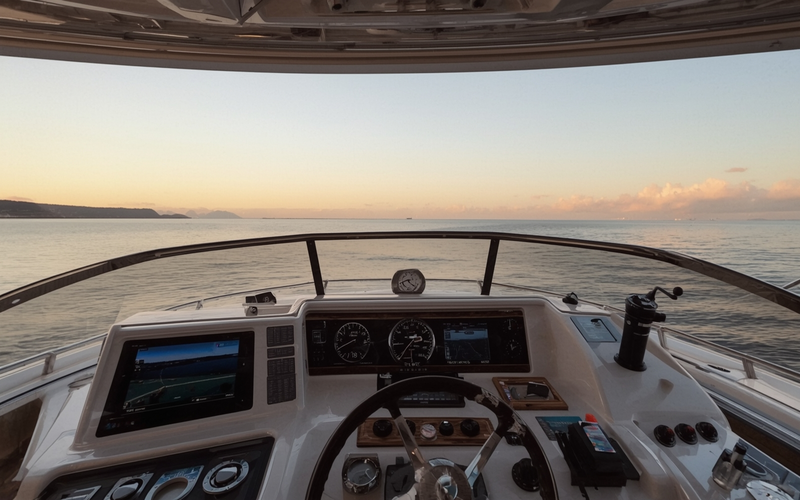
The driver’s field of view and deck layout directly impact the handling experience. A clear forward view, unobstructed side deck access, and a well-positioned steering wheel all help reduce operational stress during docking and low-speed maneuvers. Catamarans, with their wide hulls and open decks, also contribute to a greater sense of safety and operational flexibility.
Maintenance History
Compared to brand and specifications, a complete maintenance history has a more direct impact on ownership costs and reliability over the next 3–5 years. When purchasing a yacht, you should focus on: engine maintenance intervals, the history of electrical system upgrades, and records of deck sealing and hull structural inspections. A well-maintained used yacht is often safer and more cost-effective than a new one.
Best Yacht Sizes for Beginners
Choosing the right size is the aspect where beginners are most likely to make a mistake. From the perspectives of practical use and cost structure, 30–40 ft is the ideal range and is widely recognized as the best yacht under 50 ft for beginners. Here's why this isn't conservative—it's math:
Step up from 35 ft to 45 ft, and you're not just buying 10 extra feet. You're buying $2,400 more in annual docking fees, $1,800 in extra insurance, $3,000 in fuel burn, and $2,500 in maintenance labor. That's $9,700 per year—every year—for space you'll use maybe 20 days annually.
Over a 5-year holding period, you've burned enough cash to buy a second small boat. Unless you're certain you'll be on the water weekly, not monthly, every foot beyond 40 is a penalty, not a perk.
At 30–40 ft, you get:
- Suitable for family outings or small social cruises
- Can be operated by one or two people
- Mooring and insurance costs are manageable
- Moderate system complexity
When the length exceeds 45 ft, costs and complexity increase significantly:
Therefore, for first-time buyers, managing the size of the yacht is an integral part of risk management.
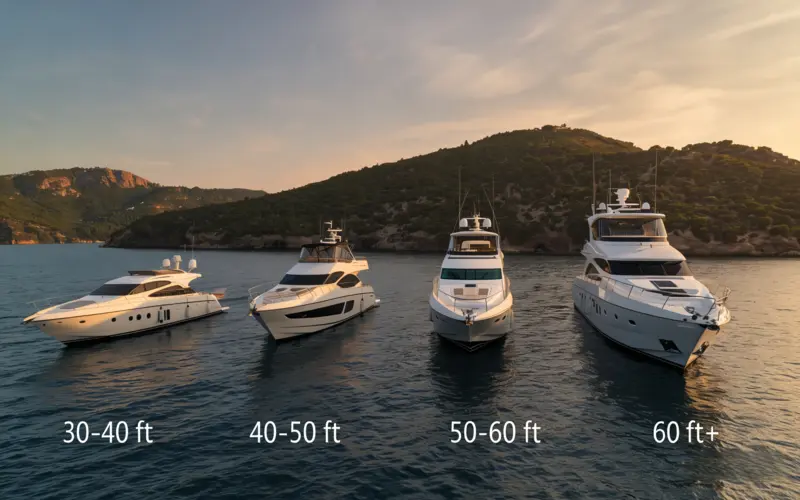
When selecting a yacht for the first time, the length range directly affects passenger capacity, handling difficulty, and the costs of berthing and insurance. The table below lists key parameters for different length ranges to help illustrate how size choices impact operation and costs:
| Length Range | Suitable for | Handling Difficulty | Mooring/Insurance Cost | Notes |
| 30–40 ft | 1–4 people | Easy | Medium | Ideal for beginners, easy to operate and maintain |
| 40–50 ft | 2–6 people | Medium | Higher | Increased system complexity, requires some experience |
| 50–60 ft | 2–8 people | High | Even higher | Professional crew recommended to ensure comfort and safety |
| 60+ ft | 4+ people | Very high | Very high | Suitable for experienced owners or long-term liveaboards; high operating costs |
As the table shows, yachts between 30 and 40 ft are easier to manage in terms of operation, maintenance, and cost, making them a typical choice for first-time buyers. As the length of the yacht increases, system complexity and costs rise significantly, which is why models longer than 45 ft are generally not recommended for beginners.
Best Beginner Yachts Under 50ft
The following three models span Scandinavian reliability, Italian performance, and contemporary Gulf craftsmanship. Each adheres to the 30–40 ft beginner sweet spot while offering distinct ownership experiences.
- Length: 31 ft (9.4 m)
- Highlights: American-built classic dayboat; single or twin outboard options; handcrafted mahogany accents; open cockpit layout
- Why it works for beginners: Outboard maintenance is simple—no hull intrusion. Fits standard slips. Timeless design holds value. Strong dealer support.
- Length: 38 ft (11.6 m)
- Highlights: European-designed performance cruiser; twin outboard configuration; minimalist Scandinavian-influenced interior; efficient hull design
- Why it works for beginners: Twin outboards offer maneuverability and backup power. Outboards simplify maintenance. Smaller size keeps berthing and insurance costs low.
- Length: 40 ft (12.2 m)
- Highlights: UAE-built cruiser; twin outboard options; open-plan deck; modern composite
- Why it works for beginners: Outboards eliminate inboard maintenance—tilt and service without entering hull. Open deck improves visibility when docking. Modern but not over-gadgeted.
👉 Browse beginner-friendly yachts (under 50 ft) available now → New For Sale (30-50ft)
Easiest Yacht Types to Maintain
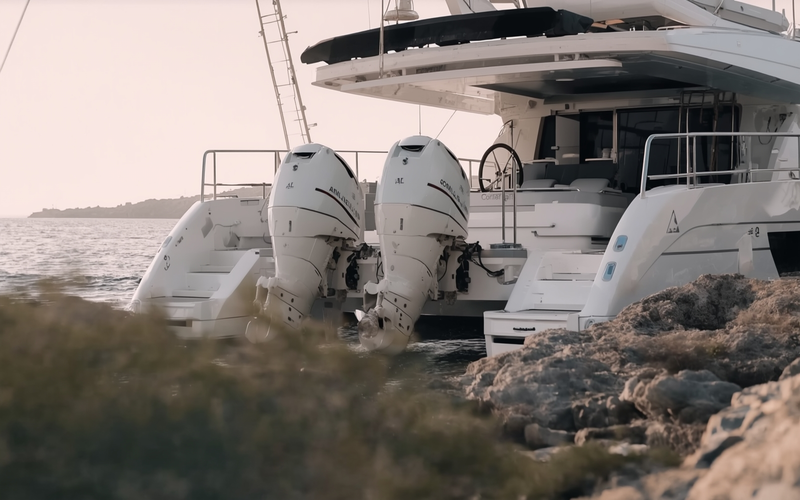
Maintenance complexity directly impacts long-term usability and costs, yet it is often underestimated by first-time boat buyers. The propulsion system is a key consideration: Outboard motors are the top choice for many beginners because they are mounted separately, easy to service, have a straightforward maintenance routine, and are simple to diagnose when problems arise.
In contrast, inboard engines involve cooling circuits, drive shafts, and complex internal layouts, resulting in high maintenance costs and lengthy turnaround times. Industry experience shows that the failure rate of cooling systems in yachts with inboard engines over eight years old rises significantly.
The market for 30–40-foot cruising motorboats features a large existing fleet, readily available parts, and relatively manageable maintenance costs; while motor catamarans offer superior stability and space, they also come with increased system complexity and operating costs. The table below summarizes the maintenance difficulty and cost ranges for common propulsion systems and hull configurations, for the reference of first-time boat buyers:
| System Type | Common Issues | Estimated Cost (USD) | Maintenance Difficulty | Fuel Type Recommendation |
| Outboard Engine | Routine maintenance | $200 – $500 | Low | Primarily gasoline; suitable for use < 100 hours |
| Inboard Engine | Cooling system corrosion, transmission wear | $1,000 – $5,000 | Medium-High | Low gasoline purchase cost, economical with long-term diesel use |
| Electrical System | Battery depletion, circuit aging | $500 – $3,000 | Medium | / |
| Hull Structure | Small cracks, water seepage | $1,000 – $10,000 | High | / |
As shown in the table, outboard motors are easy to maintain and have transparent costs; paired with gasoline engines, they are well-suited for recreational boaters who use their boats only a few hours a year. If a diesel engine is chosen for an inboard system, it offers better long-term fuel efficiency, but the purchase and maintenance costs are significantly higher. Prioritizing a boat model with a simple design and a complete maintenance history offers greater long-term value than pursuing a model with more comprehensive features.
How to Choose a Yacht for Beginners: Budget & Cost Breakdown
When it comes to the practical decision-making process of “how to choose a yacht for beginners,” a budget is never just a single figure, but rather an ongoing series of costs.
Overview of Annual Operating Costs
Taking a 30–40-foot cruiser as an example, industry experience shows that the annual operating costs for a 30–40-foot motorboat typically amount to 8–12% of the vessel’s purchase price, primarily consisting of four major expenses: docking fees, insurance, maintenance, and fuel.
- Berthing and insurance: These costs are relatively fixed and typically account for 40%–50% of total expenses.
- Fuel and maintenance: These costs fluctuate depending on usage frequency and the vessel’s condition; expenses may increase by 20%–30% during peak seasons.
Assuming you go out to sea twice a month, expenses for fuel and minor repairs could be $1,000–$2,000 higher than expected. Factoring these ongoing costs into your budget early on can help make the financial burden of buying your first boat more manageable.
The Impact of Size on Cost
For every 10-foot increase in the ship's length, overall operating costs may rise by more than 30%:
- Significant increase in fuel consumption
- More complex system maintenance and higher labor costs
- Stricter port call requirements and higher insurance costs
New vs. Used: Market Data as a Guide
Tips for buying a new yacht: Pay close attention to the shipyard’s delivery timeline, warranty terms, and first-year depreciation. However, a July 2025 report by Boats Group notes that, amid high interest rates, buyers have shifted significantly toward the used market, where “used boats hold steady”—demand remains robust and prices are more resilient. The risk in the used market, however, lies in the transparency of maintenance records.
For vessels lacking a complete service history, the costs associated with hidden defects may offset the benefits of depreciation—which is why the inspection process is non-negotiable. Based on my observations for 2024–2025, approximately 60% of first-time boat buyers ultimately opt for used yachts, a significant increase from the roughly 40% recorded in 2020–2023, aligning with the “shift toward used boats” trend highlighted in the Boats Group report.
These buyers generally assess the total cost over a holding period of three to five years, rather than simply comparing purchase prices—an approach that allows for a more accurate determination of whether a yacht truly fits a newcomer's long-term needs.
👉 Compare real yacht prices and ownership costs → Used For Sale (30-50ft)
First Time Yacht Buyer Mistakes: Avoid These 5 Costly Errors
Even after researching starter boats and entry-level cruisers, many first-time buyers still make mistakes during the decision-making process. These issues often do not surface at the time of purchase but gradually become more pronounced as the yacht is used.
Overestimating frequency of use
Many buyers envision going out on the water every week before purchasing a boat, but in reality, they only do so 30 to 40 days a year—about 30 to 40% of what they had hoped for. This discrepancy often leads to buying a boat that is too large, resulting in wasted fixed costs of over $5,000 annually. We recommend renting a boat for six months first to assess your actual usage frequency before making a purchase.
Size-driven decision-making
While more space and more features may seem appealing, once a boat exceeds 45 ft in length, handling becomes significantly more complex, and docking and low-speed maneuvering become much more difficult. This choice also leads to a simultaneous increase of over 30% in insurance, berthing, and maintenance costs. We recommend that beginners stick to a maximum of 40 ft, with 30–35 ft being the preferred length for single-handed operation.
Ignoring system complexity
The more features a boat has, the more potential points of failure there are. Industry observations indicate that most problems do not stem from the hull structure but are concentrated in the electrical and mechanical systems. Repair costs can easily exceed the budget by 50%, and breakdowns at sea pose extremely high risks. It is recommended to prioritize outboard motors with simple designs and avoid over-emphasizing luxury features.
Ignoring the long-term holding costs
Focusing solely on the purchase price is a classic mistake. Buying a boat is just the beginning of the expenses; the true costs lie in subsequent maintenance and operation. Annual operating costs can amount to 8–12% of the boat’s purchase price, and if your budget is insufficient, you may find yourself in a situation where you can afford to buy the boat but not to maintain it. We recommend estimating annual costs at 10% of the purchase price and setting aside operating funds for three years.
Insufficiently inspected or skipped inspection
Maintenance records for used yachts are often opaque, and new yachts may also have manufacturing defects. Repairs for hidden defects can cost over $10,000 and, in severe cases, pose a safety hazard. We recommend mandating the hiring of an independent surveyor (not one designated by the seller) and insist on conducting sea trials without compromise.
A yacht is an asset that requires ongoing maintenance, not a one-time purchase. By avoiding these five mistakes, your first yacht is more likely to be a source of enjoyment rather than a burden.
Summary
For first-time boat buyers, the key isn't brand or features—it's whether the boat is easy to handle, maintain, and afford. The 30–40-foot range hits the sweet spot for newcomers: large enough for weekend trips, small enough for single-handed docking. These are the most forgiving, confidence-inspiring designs on the water.
Go too big or too complex, and maintenance becomes a burden. Instead, match size to actual use, prioritize simple systems, and verify every maintenance record. The owners who get this right typically start with a 30–40 ft cruiser, twin outboards, simple electronics—and they rarely regret it.
👉 Explore available beginner yachts or talk to a yacht advisor before buying
About the Author
Brian G. Steler
Yacht Broker
Qualifications: SAMS Certified Surveyor, No. AMS #1249
Last Updated: January 2026
Disclaimer:
This content is for reference only and does not constitute investment advice. This article has not received sponsorship from any shipyard, financing institution, or brand; the author has not participated in brokerage transactions involving the vessels cited herein. Yacht specifications are based on publicly available information as of 2026; actual prices may vary due to regional and market fluctuations. Actual configurations shall be subject to classification society certificates. Prior to purchase, it is imperative to hire an independent surveyor (not affiliated with the seller) to conduct sea trials and verify certificates. Neither the author nor this platform is responsible for any losses incurred as a result of reliance on the information provided herein. Regulations and fees are subject to change; always check current requirements.
FAQ
Q1: Do new yachts lose value quickly for first-time owners?
A: Yes. Yachts naturally depreciate over time, and new yachts lose value fastest during the first 3–5 years, typically 15–25%. Well-maintained used yachts retain value better, making them a smarter choice for beginners.
Q2: What is the cheapest yacht suitable for first-time owners?
A: For first-time buyers, a cheap yacht usually costs $50,000–$100,000. These are smaller (20–30 ft), simpler in design, and easier to maintain, though they may require slightly more hands-on care than larger models.
Q3: Which country has the cheapest yacht?
A: Countries with lower yacht prices usually have lower taxes and larger used yacht inventories. Examples include the US (Florida/Gulf Coast), Spain, and Greece, where supply and depreciation help reduce costs for beginners.