



If you intend to use the boat primarily for weekend coastal cruising, a vessel under 40 feet is usually sufficient; if you plan to live on board long-term or undertake transoceanic voyages, a 45–50-foot model will offer greater comfort; for families, safety, storage space and cabin layout should be top priorities; and if you seek handling and speed, a lightweight, performance-oriented catamaran is more suitable.
The true logic behind buying a boat is not to ‘buy the most expensive’, but to find the one that best suits your lifestyle.
Core Guide to Choosing the Right Size
The size of a sailing catamaran determines not only the amount of space available, but also future running costs, sailing comfort and ocean-going capability. A common mistake made by first-time buyers is to underestimate the long-term costs associated with larger boats, or to overestimate the long-term liveability of smaller ones.
To begin with, here is a brief overview of the differences between the various size categories:
| Size Range | Suitable For | Key Features |
| 30–50ft | Beginners, couples, weekend cruising | Low cost, easy to handle |
| 50–80ft | Families, long-term living on board | Balance of space and performance |
| 80ft+ | Round-the-world sailing, high-end users | Luxury, strong ocean-going capability |
Catamarans in the 30–40-foot range are generally better suited to weekend cruising, short trips and those new to sailing. The greatest advantage of this size is lower maintenance costs, a wider choice of moorings and less pressure on a single operator. For a couple or a small family, it is already capable of meeting basic cruising needs. However, when it comes to long-term living on board, storage capacity and fresh water and fuel reserves are significantly limited, making it more suitable for a ‘lightweight life at sea’ .
The 40–50-foot range is currently the most popular ‘golden’ size on the market. Boats in this category begin to offer genuine long-term living capabilities, featuring larger saloons, more comprehensive galley layouts, more practical cabin designs and greater range. Many popular models, such as the Lagoon 46, Fountaine Pajot Astrea 42 and Bali 4.6, fall within this size range, as it strikes a balance between comfort, long-range capability and manageable costs.
Catamarans of 50 feet and above are gradually approaching the concept of ‘small superyachts’. These vessels offer a greater sense of space, more comprehensive energy systems and superior long-range capabilities, making them ideal for round-the-world voyages, high-end liveaboard living and commercial charter operations. However, maintenance costs, mooring fees and operational complexity also increase significantly.
Your Choice Depends on How You Plan to Use the Boat
When buying a boat, many people are drawn to its appearance and specifications, but what truly determines future satisfaction is how you intend to use it.
If your primary use is coastal cruising—for example, around Thailand, the Maldives, Singapore or the Mediterranean—then comfort is usually more important than extreme long-distance cruising capability. This is because most of the time, you’ll be enjoying leisurely island hopping, seaside holidays and socialising with friends. For this type of user, a holiday-oriented catamaran is more suitable, as the larger open spaces, more comfortable flybridge and more powerful air-conditioning system will significantly enhance the living experience.
However, if your goal is transoceanic sailing—such as across the Indian Ocean, the Pacific or even a round-the-world voyage—the logic behind your choice will be entirely different. You need to focus on hull structural strength, water storage capacity, energy systems and long-term offshore survivability. In offshore conditions, what truly matters is no longer luxury fittings, but stability and reliability.
For families, the greatest advantage of a catamaran lies in its ‘stability’. Compared to monohull sailboats, catamarans experience less rolling, making them safer for children to move about on board. At the same time, the larger kitchen, saloon and cabin layout are better suited to long-term family life. Consequently, an increasing number of families taking their children out to sea are now prioritising catamarans.
Budget Recommendations and Allocation
Many first-time buyers of catamarans tend to focus primarily on the ‘purchase price’ itself, but it is only after long-term use that they realise buying the boat is merely the beginning.
This is particularly true for catamarans, as the demands of long-term living on board, ocean-going voyages and energy self-sufficiency are higher; consequently, the costs of subsequent upgrades and maintenance often far exceed the expectations of many novices.
A truly sensible budget plan should cover the following areas: purchase costs, subsequent modifications, safety equipment, annual maintenance and contingency funds. After all, owning a catamaran that remains reliable and seaworthy over the long term is never as simple as simply ‘buying it’.
Below are some common budget guidelines currently available on the market (using 40–50-foot catamarans as an example):
| Budget Item | Recommended Percentage | Reference Budget (USD) | Main Components |
| Vessel Purchase | 65%–75% | $450,000 – $1,200,000 | Purchase of new or used vessel |
| Fittings and Upgrades | 10%–15% | $30,000 – $150,000 | Solar panels, lithium batteries, watermakers, Starlink, etc. |
| Safety equipment | 3%–5% | $10,000 – $40,000 | Life rafts, AIS, EPIRB, spare equipment |
| Annual maintenance costs | 5%–10% | $20,000 – $80,000 | Engine, rigging, hull maintenance |
| Contingency Fund | 5%–10% | $20,000 – $100,000 | Overseas repairs, unexpected breakdowns |
For most boat owners, retrofitting is almost inevitable. Although many new boats come with basic specifications, once owners embark on long-term cruising, they typically add solar systems, lithium-ion battery banks, watermakers, satellite internet and more advanced autopilot systems.
Particularly when living aboard for extended periods, the importance of the energy system far exceeds what novice owners might imagine. When moored in offshore bays for several weeks at a time, a stable power supply directly determines your quality of life. For many long-distance sailors, the biggest expense is not the sails, but the electrical system.
Furthermore, many first-time boat buyers overlook the matter of ‘annual maintenance’. In fact, the maintenance costs for a catamaran are usually higher than those for a monohull of the same size, as it features twin engines, a larger deck area and a more complex system structure.
For instance, a full hull maintenance, engine service and anti-fouling paint application in Southeast Asia can typically cost anywhere from several thousand to tens of thousands of dollars; in Europe, Australia or the Caribbean, the costs are even higher.
Truly experienced buyers generally do not allocate their entire budget to the purchase of the boat itself, but deliberately set aside a portion of their cash flow as long-term operating capital. This is because one of the defining characteristics of life at sea is that ‘there will always be something else in need of repair’.
For those planning long-term voyages, ‘being able to afford the purchase’ is actually not the most important factor; ‘being able to afford the long-term upkeep’ is what truly matters.
Catamarans vs Monohulls: Which is Right for You?
The difference between catamarans and monohulls essentially boils down to two distinct sailing lifestyles.
The greatest advantages of catamarans are their stability and sense of space. Compared to traditional monohull sailboats, they offer less rolling, more living space and a shallower draught, making them more akin to a ‘floating apartment’. This is why an increasing number of families and long-term liveaboards are opting for catamarans.
Monohulls, on the other hand, offer a more traditional sailing experience. They provide greater feedback on the helm, better upwind performance and a more authentic sense of control. Many seasoned sailors still prefer monohulls because they offer a more direct connection between ‘man and sea’.
For beginners, catamarans are generally easier to adapt to. This is because their living arrangements are more akin to life on land, making it easier for families to accept a long-term life at sea.
To learn more about the differences between monohull and catamaran sailboats, read Monohull Sailboat vs Catamaran Sailboat: What Are the Real Differences at Sea?
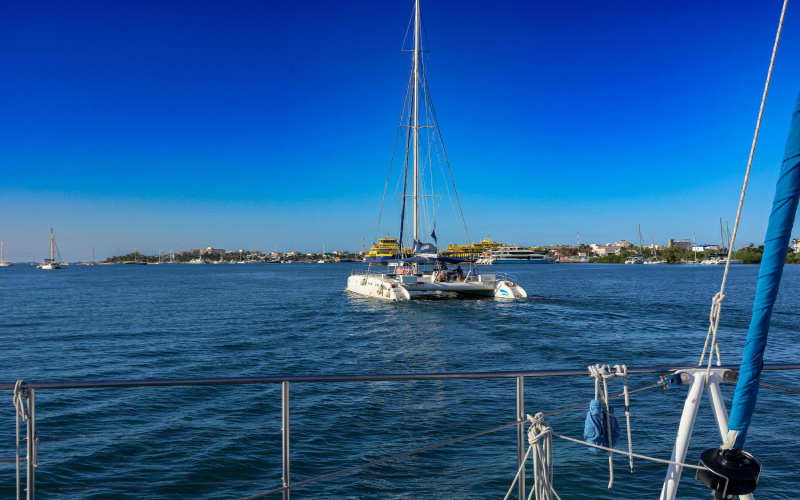
Essential Checklist for Inspecting Hull Structure and Equipment When Buying
When purchasing a second-hand catamaran, the most dangerous issue is often not that the boat is ‘old’, but that it ‘looks new’.
Many catamarans that have been in long-term tropical service may appear well-maintained on the outside, but their internal structures may have suffered fatigue. Therefore, a truly professional inspection focuses not on the surface, but on the structure and systems.
Firstly, it is essential to check the underside of the bridge for long-term wave-slamming damage, as this is the area where catamarans are most prone to structural fatigue. At the same time, it is necessary to check for delamination in the hull, cracks in bulkhead joints, water ingress in the collision compartment, and any previous damage to the keel area.
The propulsion system is equally important. For many older catamarans, the real issues lie not with the sails, but with the engine and power systems. Engine hours, the cooling system, wear on the shaft seals, and the generator’s maintenance records all require careful scrutiny.
Furthermore, avionics are an area that many buyers tend to overlook. The cost of upgrading autopilots, AIS, radar and chartplotting systems is often far higher than anticipated.
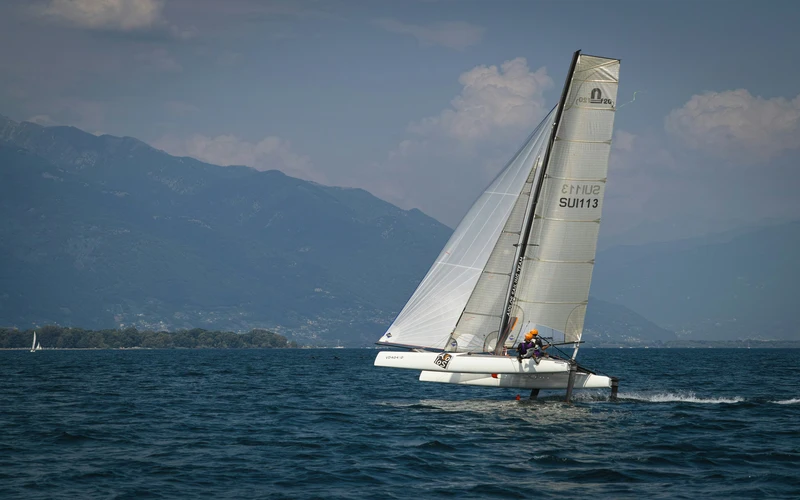
Recommended Popular Models Worth Considering
If you are a family cruiser, the Lagoon SIXTY 5 remains one of the most well-balanced family catamarans on the market today. It features a highly refined layout, excellent children’s play areas and superb safety circulation, which is why it has long been popular with family owners.
👉 See Lagoon SIXTY 5

Lagoon SIXTY 5
- Length67.50 ft
- TypeSailboat
Sleek and daring, with a thirst for adventure amidst the waves, the SIXTY 5 is designed for exploring both familiar and uncharted waters, crafted specifically for sharing adventures with loved ones. Yet most importantly, it offers you the ultimate experience of being one with your beloved yacht, body and soul.
If you are more inclined towards long-term living on board or retirement living, the Fountaine Pajot Thira 80 is a highly practical choice. It excels in terms of storage capacity, energy efficiency and ease of long-term maintenance, making it ideal for extended life at sea.
👉 Browse Fountaine Pajot yachts
Fountaine Pajot Thira 80
- Length79 ft
- Cabins6
- Top speed14 kn
- TypeCatamaran yacht
The Thíra 80 is the stunning flagship of Fountaine Pajot's power catamaran range, representing the pinnacle of luxury, innovation, and design collaboration with Berret-Racoupeau Yacht Design. At nearly 24 meters in length, she delivers an unprecedented level of elegance across both private accommodations and expansive social areas.
For novice sailors, the Bali 4.6 offers an exceptionally user-friendly layout. The unique ‘Bali Door’ design enhances ventilation and natural light, whilst the relatively simple controls make it easier to get to grips with.
👉 View Bali 4.6 for sale

Bali 4.6 Catamaran
- Build Year2022
- Length47 ft
- Cabins4
- Top speed9 kn
- TypeCatamaran sailboat
The Bali 4.6 is a 46.9-foot modern sailing catamaran that combines comfortable living spaces with excellent sailing performance. Its spacious main deck, open salon, and flexible cabin layout make it ideal for family cruising, long-distance exploration, or team sailing, offering a perfect balance of leisure and functionality.
For those planning serious ocean-going voyages, performance-oriented catamarans such as the Outremer or Catana offer superior long-distance capabilities and sailing performance.
Summary
Buying a catamaran sailboat is not, in essence, about choosing the ‘best boat’, but rather selecting the boat that best suits your future lifestyle.
Many people initially focus on size, speed or brand when buying a boat, but after using it for a long time, they discover that comfort, reliability and ease of maintenance are the key factors that influence their enjoyment of sailing.
If you intend to use it primarily for family cruising, stability and a sense of space are paramount; if you plan to undertake transoceanic voyages, structural strength and energy systems are key; and if you are a novice, you should prioritise ease of handling and simple maintenance.
A catamaran that suits you is not merely a means of transport, but a long-term way of life at sea.
FAQ
Q1: What size catamaran is best for beginners?
A: For most beginners, a vessel of around 40 feet is usually the most balanced choice. It offers ample living space without the added handling challenges that come with a larger vessel.
Q2: Is a catamaran better than a monohull?
A: If you prioritise stability, spaciousness and family comfort, a catamaran is generally the better choice; if you seek a more traditional sailing experience, a monohull still has its unique advantages.
Q3: How much does it cost to maintain a catamaran?
A: Annual maintenance costs are usually around 5–10% of the boat’s purchase price, depending on size, mooring location and whether the boat is used for extended voyages.
Q4: Is a catamaran suitable for ocean crossings?
A: Yes. Modern catamarans are widely used for round-the-world sailing. In particular, cruising catamarans in the 40–50-foot range are ideal for long-distance transoceanic cruising.