- New Yachts: Brand-new systems and full warranty, but depreciate 10–15% in the first year; best suited for long-term ownership of 10 years or more.
- Pre-Owned Yachts: Yachts 3–7 years old are 20–40% cheaper than new ones; depreciation has already been factored in, offering better value for money.
- Key Consideration: Budget-conscious or planning to trade in within 3–5 years → Used; Seeking long-term stability → New
New vs Used Yacht: Key Differences
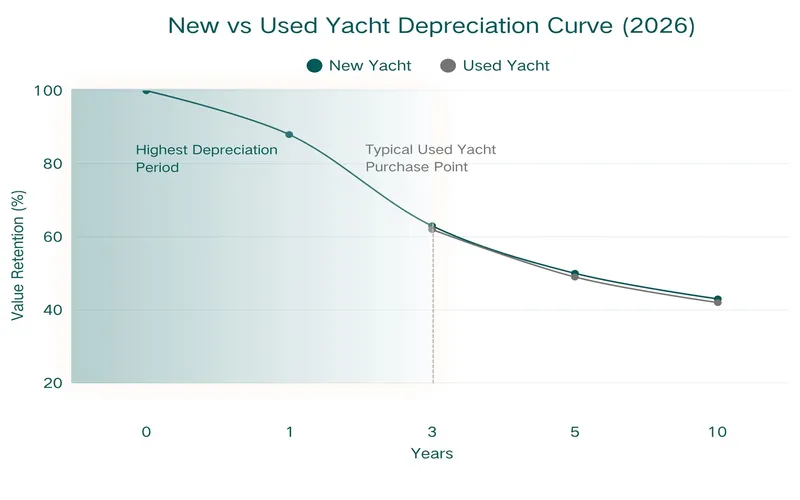
In the yacht market, the differences between new and used yachts are primarily reflected in depreciation, risk, and long-term cost structures—not just the purchase price. Many first-time buyers assume that new yachts are safer and used yachts are cheaper, but the real distinction lies in the total investment and stability over the yacht’s entire lifecycle.According to YATCO’s 2025 yacht market research, the depreciation curve for new yachts shows a distinct pattern of high depreciation in the early years followed by a gradual decline: approximately 10%–15% in the first year, with cumulative depreciation reaching 40%–50% over the first five years, after which the rate levels off. This pattern directly influences the valuation logic for both new and used yachts.
The key advantage of a new yacht is its predictability. The hull, engine, and electronic systems all come from the shipyard’s standard specifications and are backed by manufacturer warranties; in the early years, routine maintenance is typically all that is needed to ensure reliable operation. This predictability is particularly important for inexperienced buyers, as it reduces early technical risks and the pressure of repairs. However, the cost structure of a new yacht has a distinct characteristic: depreciation is most pronounced during the first three years.
After a new yacht is delivered, its market value declines rapidly with use. This depreciation does not reflect a decline in the vessel’s condition but is simply a result of market dynamics. In contrast, pre-owned yachts—especially those between 3 and 7 years old—have typically passed the steepest phase of depreciation, and their prices have stabilized. As long as they have complete maintenance records and have undergone a professional survey, the risks can be effectively managed.
New vs Used Yacht: Side-by-Side Comparison
| Factor | New Yacht | Used Yacht (3–7 Years) |
| Purchase Price | High | 20–40% lower |
| Depreciation | Fast (first 3–5 years) | Slower, mostly stabilized |
| Risk Level | Low (factory condition) | Depends on survey & records |
| Maintenance | Minimal early years | May require selective upgrades |
| Customization | Full (factory options) | Limited |
| Resale Value | Drops early | More stable |
| Best For | Long-term owners (8–10+ years) | Budget-conscious / short-term owners |
Pros and Cons of Buying a New Yacht in 2026
When weighing the pros and cons of used yachts versus new vessels, start with these tips for buying a new yacht.Key Advantages of the New Yacht
The system and structure are fully controllableThe biggest advantage of a new yacht is that there is no risk associated with its past use. The engine, fuel system, electrical equipment, and hull structure are all factory-original, so the likelihood of malfunctions is relatively low. For first-time buyers, this means they can focus on enjoying the sailing experience during the first few years without having to deal with frequent repair issues.
Comprehensive warranty and technical support
New boats typically come with a manufacturer’s warranty and an authorized service network, covering support for the engine, hull, and electronic systems. Should any issues arise, they can be addressed by the manufacturer’s technical team, making maintenance costs and downtime more manageable—a key reason why many long-term owners choose new boats.
Major Disadvantages of New Yachts
Depreciates relatively quicklyThe biggest drawback of a new yacht is its rapid depreciation. In the years following delivery, its market value continues to decline; even if the yacht is kept in perfect condition, its price will still be affected by market conditions. This means that selling a new yacht in the short term typically results in a significant loss.
High initial investment
New yachts not only come with a high purchase price but also entail additional expenses such as taxes, registration fees, insurance, and equipment upgrades. The total cost in the first year typically amounts to about 120% of the purchase price, making them a significant financial commitment. As a result, new yachts are better suited for owners who plan to use them long-term or go out to sea frequently.
Advantages of Buying a Used Yacht
To fully understand the pros and cons of used yachts, buyers must weigh visible advantages against potential risks. Used yachts dominate the market due to cost advantages and stable value curves, particularly in the 3–7 year age range. For most buyers, is buying a used yacht worth it? The answer is yes—if you select the right vessel age and condition.Price Advantages and Long-Term Value of Pre-Owned Yachts
For buyers analyzing the pros and cons of used yachts, the most obvious advantage of pre-owned vessels is their price. Typically, yachts that are 3–5 years old are priced 20–40% lower than new models, and this period coincides with the phase of most rapid depreciation. Since the first owner has already absorbed the bulk of the depreciation, the second buyer can enter the market at a more reasonable price. With the same budget, choosing a pre-owned yacht often allows you to acquire a larger vessel or one with higher-end specifications, thereby enhancing the overall cruising experience.At the same time, while new yachts tend to depreciate over time, the prices of pre-owned yachts generally remain stable. As long as they are well-maintained and market demand remains steady, price fluctuations are minimal when it comes time to resell. This is a key reason why many experienced buyers prefer pre-owned yachts. Typically, the best pre-owned yachts to buy are those between 3 and 7 years old; at this stage, the vessel’s systems are still relatively new, and prices have already stabilized, making this the most cost-effective range.
Visibility and Potential Risks of Purchasing a Used Yacht
Another advantage of pre-owned yachts is their “visibility.” While new yachts feature advanced systems, these require time to prove their reliability. In contrast, the condition of a pre-owned yacht’s electronics, engine performance, and hull structure can be directly assessed through professional inspections and sea trials, thereby reducing uncertainty in the decision-making process.However, this also carries potential risks: if maintenance records are incomplete or the survey is inadequate, repair costs may rise rapidly down the line. Therefore, when purchasing a used yacht, a professional survey and review of historical maintenance records are essential steps that cannot be overlooked. It is recommended to engage a third-party surveyor who adheres to the SAMS principles of independent surveying to avoid conflicts of interest with the seller.

Best Used Yachts to Buy: Brand Recommendations
In the used boat market for vessels between 3 and 7 years old, the following brands have demonstrated strong resale value and liquidity in the North American and Asia-Pacific markets due to their consistent build quality and extensive service networks. Buyers planning to purchase a used boat in this age range should note the following key points regarding each brand:| Brand | Country | Used Boat Buying Advice | Suitable Scenarios |
| Boston Whaler | USA | 10-20% depreciation in the first year, but prices remain resilient after 3 years; strong second-hand demand | Family cruising, inshore fishing, Center Console |
| Grady-White | USA | Leading retention rate in the fishing boat segment; fast turnover when maintenance records are complete | Inshore/offshore fishing, family cruising |
| Princess | UK | Major depreciation completed at 3-7 years of age; transparent pricing | Long-distance cruising, business entertaining |
| Viking Yachts | USA | Benchmark in sportfishing yachts; better second-hand liquidity for large sizes than European brands | Deep-sea fishing, competitive tournaments |
| Azimut | Italy | Strong demand in the Asia-Pacific market; if planning to sell in 3-5 years, the listing period is usually shorter than European brands | Stylish cruising, Mediterranean/Asian waters |
| Ferretti Yachts | Italy | Private transactions are active in the second-hand market; recommended to negotiate via a broker | Customized builds, long-term ownership |
The selection of these brands is based on build quality, service networks, and resale value, as outlined in BoatTrader’s Guide to Yacht Brands with High Resale Value.
👉 See [all yacht brands with model lineups and price guides] to continue your research.
Cost Comparison: New vs Used
In the actual market, new and used yachts exhibit significant differences in terms of price, depreciation, and risk profiles (as shown in the table below):| Factor | New Yacht | Used Yacht |
| Purchase Price | High | Lower (approx. 20–40% cheaper) |
| Depreciation | Fast (first 3–5 years) | Slow (tends to stabilize) |
| Maintenance (early stage) | Low | Variable |
| Risk | Low (new systems) | Depends on survey results |
| Resale Value | Significant decline | Relatively stable |
The Impact of Depreciation on Total Costs
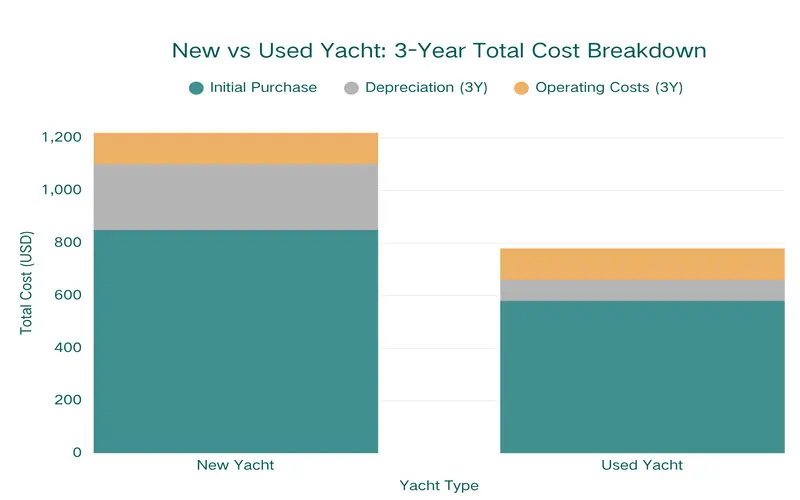
Of all cost factors, yacht depreciation is the most easily overlooked yet has the greatest impact. Take a transaction we handled in 2024 as an example:The client is comparing two 40-foot cruisers: a new boat priced at $850,000 and a three-year-old used boat of the same model priced at $580,000. A professional inspection revealed that the used boat has only 180 engine hours (an average of 60 hours per year, indicating light use), no repair history on the hull, and factory-original electronic systems.
After the deal was finalized, the client not only saved $270,000 on the purchase price but also avoided the depreciation loss of approximately $297,500 (35%) typically incurred in the first year of ownership of a new boat. This means that even if the boat were sold after three years at the same rate, the holding costs for a pre-owned boat would still be more than $180,000 lower than those for a new boat.
In practice, new boats may lose 20–40% of their value within three years, while the prices of used boats of the same age tend to fluctuate much less.
Operating cost variances are limited
There is no significant difference between new and used yachts in terms of fuel, berthing, insurance, and routine maintenance. The primary factors determining these costs are the yacht’s model, size, and frequency of use, rather than whether it is new.For example, taking a 43-foot motor catamaran (such as the Leopard 43 PC) as an example, whether new or pre-owned, there is generally no significant difference in fuel consumption, docking fees, and insurance costs. Therefore, over the long term, the key factors determining costs are the initial purchase price and depreciation, rather than day-to-day operating expenses.
Summary of Cost Logic
- New yachts: High upfront cost + high depreciation + low initial risk
- Pre-owned yachts: Low upfront cost + low depreciation + manageable risk
Which Option Is Better for You?
When making your buying new vs used yacht decision, there is no one-size-fits-all answer; the key factors are budget, frequency of use, and the intended holding period. New and used yachts represent two distinct strategies: one prioritizes stability and a long-term experience, while the other emphasizes cost control and value for money. Therefore, determining whether buying a used yacht is worth it requires an analysis tailored to your specific usage scenario.Who Should Consider Buying a New Yacht
If you plan to own a yacht for the long term and hope to use it reliably for more than 10 years, a new yacht is generally the better choice. New yachts come with complete, state-of-the-art systems, and the manufacturer’s warranty reduces the risk of initial maintenance costs, making them particularly suitable for frequent outings or family cruising. Additionally, new yachts can be customized to meet your specific needs in terms of navigation, propulsion, and living space, enhancing comfort and providing a personalized experience.Who Should Consider Buying a Used Yacht
If budget is the primary consideration, a used yacht is typically a better value. For the same budget, a used yacht offers a larger size or higher specifications while avoiding the rapid depreciation associated with new yachts. In particular, yachts that are 3–7 years old offer the best overall value for money, as their systems are still reliable and the depreciation has already occurred; provided the survey and maintenance records are complete, the risks are manageable. For users planning to replace their vessel within 3–5 years, a used yacht also offers flexibility and predictable ownership costs.The following cases are based on transactions handled in 2024 and illustrate typical choices for different needs:
Typical Scenario A (Family Cruising): With a $400,000 budget, the client compares a new Jeanneau ($450,000) against a 3-year-old used model ($320,000). The marine survey confirms 220 engine hours, no repair history, and a recent service record—allowing the $130,000 savings to cover berth prepayment and first-year maintenance.
Typical Scenario B (Fishing Needs): The client targets a fishing yachts for offshore fishing. A pre-purchase survey compares a new Boston Whaler ($680,000) with a 4-year-old used model ($480,000). The survey confirms 180 engine hours and 2 years of remaining warranty, cutting upfront risk while preserving the brand's resale value.
Decision Logic Based on the Service Life Cycle
In the real market, professional brokers typically use holding periods to determine which direction to take:- Long-term ownership (8–10 years or more) → A new yacht is a better fit
- Medium-term ownership (3–7 years) → A pre-owned yacht is a more sensible choice
- Budget-conscious buyers → Prioritize pre-owned yachts
- Frequent sailing or family cruising → New yachts offer greater stability
👉Browse Used Yachts (3–7 Years Old) with Verified Survey Reports
Conclusion
Ready to make your decision? Focus on three factors: depreciation curve, budget flexibility, and ownership timeline. New yachts offer peace of mind for 10+ year owners, while 3-7 year old used vessels provide the best value for most buyers.👉Explore Verified Used Yachts (3–7 Years Old) with Full Maintenance History
About the Author
Brian G. Stetler
Yacht Broker
Qualifications: SAMS Certified Surveyor, No. AMS #1249
Last Updated: January 2026
Disclaimer:
This content is for reference only and does not constitute investment advice. This article has not received sponsorship from any shipyard, financing institution, or brand; the author has not participated in brokerage transactions involving the vessels cited herein. Yacht specifications are based on publicly available information as of 2026; actual prices may vary due to regional and market fluctuations. Actual configurations shall be subject to classification society certificates. Prior to purchase, it is imperative to hire an independent surveyor (not affiliated with the seller) to conduct sea trials and verify certificates. Neither the author nor this platform is responsible for any losses incurred as a result of reliance on the information provided herein. Regulations and fees are subject to change; always check current requirements.
FAQ
Q1: When is the best time of year to buy a used yacht?
A: Dealers offer deepest discounts October–December when clearing inventory. Private sellers are active year-round, but February–March offers best negotiation room before summer maintenance costs kick in.
Q2: What documents should you check when buying a used yacht?
A: Certificate of Ship Registration, engine maintenance records, history of hull repairs, the most recent survey report, and whether there are any mortgages on the vessel.
Q3: What is the key difference between a 3-year-old and a 7-year-old used boat?
A: 3-year-old boats often have partial warranty and newer electronics but cost more. 7-year-old boats hit lowest price point, yet require attention to engine overhaul cycles and upgrade costs.
Q4: How does depreciation of yachts affect long-term ownership costs?
A: Depreciation of yachts is steepest in years 1-5 (10-15% annually). Buying a 3-7 year old used yacht bypasses this drop, stabilizing your investment.