Draught (draft) on a boat is the vertical distance from the waterline to the lowest point of the hull, determining the minimum water depth needed for safe navigation.
- Shallow Draught = better access to beaches, lagoons, and shallow marinas
- Deep Draught = improved offshore stability but limited access to shallow areas
1. Boat Draught Overview
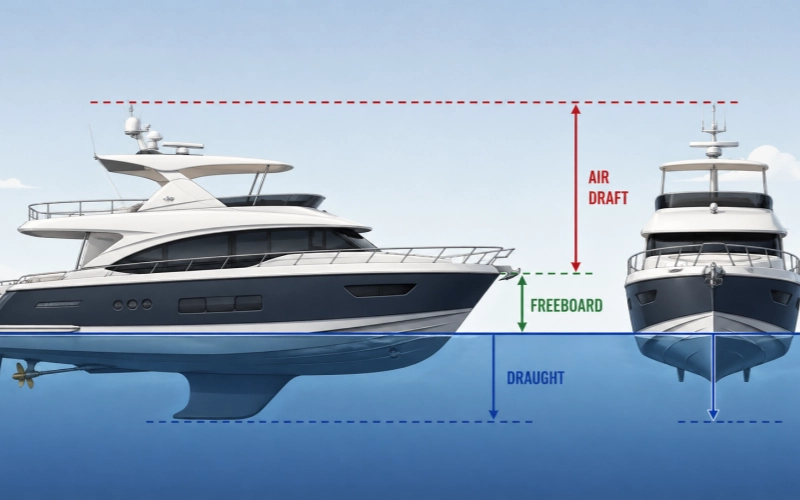
Draught refers to the vertical distance between the waterline and the lowest point of a boat when it is floating at rest.
This lowest point may include:
- The keel (common on sailboats and deep-V hulls)
- Propellers or propeller shafts (common on motor yachts)
- Rudders, sonar devices, or bow thrusters
Difference Between Related Terms (Avoid Confusion)
| Term | Meaning | Practical Impact |
|---|---|---|
| Draught (Draft) | Depth of the boat below the waterline | Determines shallow water access and grounding risk |
| Air Draught | Height from waterline to highest point | Determines bridge clearance and overhead restrictions |
| Freeboard | Height from waterline to deck | Affects seaworthiness and onboard comfort in waves |
2. Why Draught Matters So Much for Boat Owners
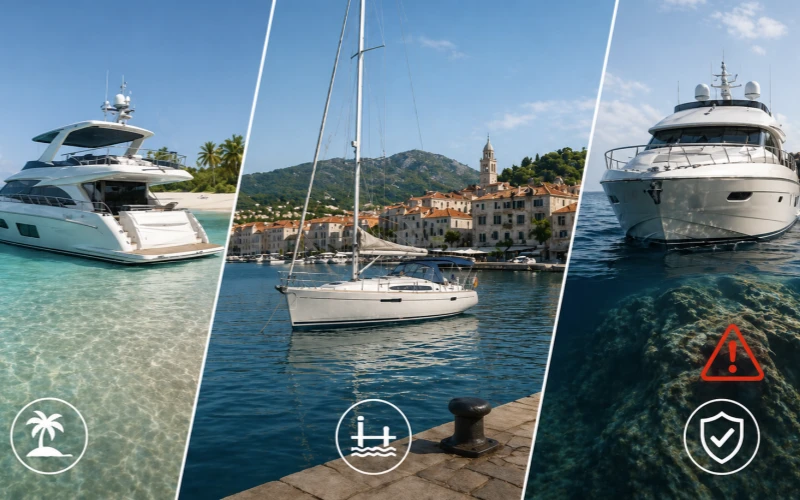
I've seen many buyers realize too late that they underestimated draught. In practice, it determines three key things: where you can go, where you can dock, and how safely you can operate.
2.1 Access to Shallow Waters — Where You Can Go
If you plan to cruise in destinations such as:- The Bahamas sandbanks
- Maldives lagoons
- Caribbean shallow bays
I've personally seen clients miss the best anchoring spots of their entire trip due to excessive draught.
2.2 Marina and Port Restrictions — Where You Can Dock
Many historic Mediterranean ports in Croatia, Greece, and Italy have shallow entrances. During peak season, deeper draft yachts are often denied entry or forced to wait for tide conditions (although Mediterranean tide variations are minimal).I once worked with a client who purchased a beautiful 52ft sailing yacht with a 2.4m draught. While planning to cruise the Greek Islands, he discovered that several charming old harbors had entrances of only around 1.8m. He had no choice but to anchor offshore and use a tender every time.
2.3 Navigation Safety and Grounding Risk
The most common grounding incidents I've seen among new yacht owners usually come down to:- Underestimating actual draught
- Ignoring tidal variations
- Not leaving sufficient safety clearance
Draught is not just a number — it defines whether your voyage remains safe and stress-free.
3. Boat Draught Types: Shallow vs. Deep vs. Variable
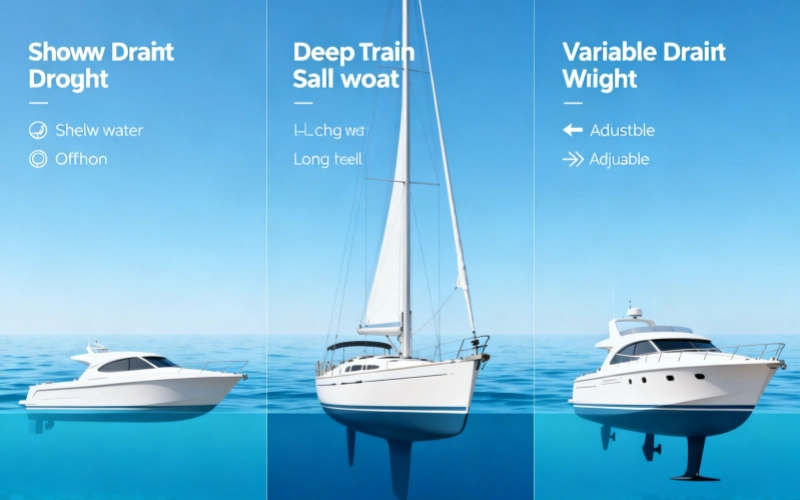
When buying a yacht, different types of draft correspond to entirely different usage scenarios and performance priorities. When I compare yachts with clients, I usually simplify draft into three practical categories rather than technical definitions.
| Type | Shallow Draft | Deep Draft | Variable Draft |
|---|---|---|---|
| Typical Range | < 1.5–2.0m (some as low as 1.2m) | > 2.2–2.5m | Adjustable ~1.3–3.0m |
| Common Boats | Motor yachts, catamarans | Sailing yachts, performance yachts | Explorer yachts, superyachts |
| Shallow Water Access | Excellent | Limited | Flexible |
| Offshore Stability | Moderate | Excellent | Depends on configuration |
| Marina Access | Very flexible | Restricted in some ports | Highly flexible |
| Maintenance Complexity | Low | Medium | High |
How to Choose Based on Usage
- Shallow cruising / island hopping → shallow draft (≤1.5m)
- Offshore sailing / performance focus → deep draft (≥1.8m)
- Multi-region cruising → variable draft system
4. How Draught Affects Cruising Experience by Region
The same draft for the same ship may work well in one area but cause problems in another.| Region | Recommended Draught | Key Considerations |
|---|---|---|
| Mediterranean | 1.2 – 1.5m | Shallow historic ports, minimal tides |
| Florida & Bahamas | < 1.2m | Extensive shallow sandbanks |
| Southeast Asia | 1.0 – 1.3m | Strong tides, shallow mangrove channels |
| Northern Europe | 1.5 – 2.2m | Strong tides, deeper channels |
| Pacific Islands | < 1.5m | Coral reefs and lagoon entrances |
When choosing a boat, it's advisable to follow the Pareto Principle, also known as the 80/20 rule: first determine where you'll be cruising 80% of the time, then use that area to work backward and determine the draft you'll need.
Don't buy a deep-draft boat for the Bahamas just because you like its specs on paper—that 20% of deep-water performance will be useless during the 80% of time you'll spend in the Bahamas' shallow waters.
5. Common Draught Mistakes First-Time Buyers Make
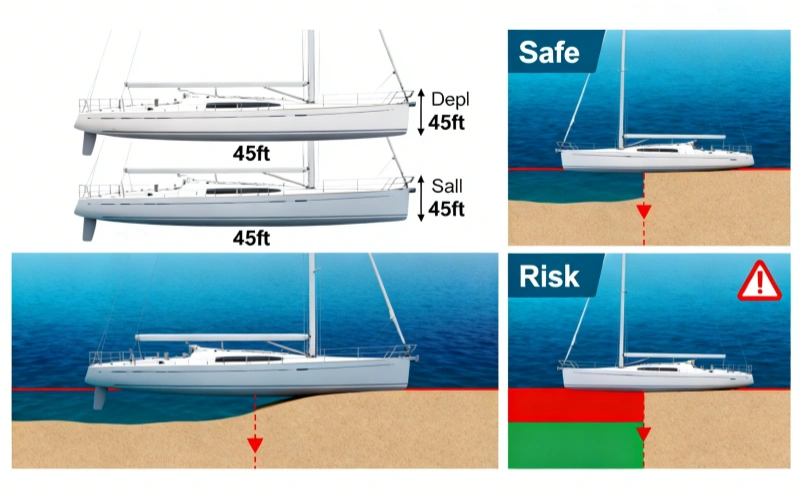
For first-time boat buyers, draught is often overlooked or misjudged, but these details can quickly become significant issues in actual use, directly affecting range and safety.
Mistake 1: Focusing Only on Length
Many buyers tend to judge a boat's capabilities based on its length in feet, but draft is often the key factor in determining its navigable range.
For example, two 45ft sailboats are the same model doesn't necessarily mean they perform the same:
- A 45-foot performance sailboat typically has a draft of 2.2–2.4 meters
- A 45-foot cruising sailboat may have a draft of only 1.5–1.7 meters
✔ Tip: Before viewing a boat or taking it for a test sail, prioritize confirming the actual draft range rather than relying solely on dimensional specifications.
Mistake 2: Confusing Light Load vs Real Operating Draught
Manufacturer specifications often reflect lightship condition. Real cruising increases draught due to:
- Fuel: +3–5 cm
- Water tanks: +2–3 cm
- Equipment & provisions: +5–8 cm
✔ Tip: Be sure to ask for the draft data for both half-load and full-load conditions, and use actual operating conditions as a reference.
Mistake 3: Ignoring the True Lowest Point
Many buyers focus solely on the stated draft, without realizing that the propeller, rudder, or transducer may be positioned lower than the keel.
I once inspected a luxury yacht where the keel draught was 1.5m, but the propeller risked grounding at 1.3m.
✔ Tip: Check the hull lines plan or contact your dealer directly to confirm the deepest point.
Mistake 4: Ignoring Cruising Region Compatibility
I once had a client who test-sailed a used yacht for sale in Shenzhen Port. He loved it so much that he bought it on the spot. He then had the boat shipped to the Bahamas. It turned out that the new boat couldn't access the vast majority of the anchorages he wanted to visit.
✔ Tip: First determine your primary cruising areas, then work backward to find the appropriate draft—not the other way around.
Mistake 5: Underestimating Safety Clearance
Even if the chart indicates sufficient water depth, you should still allow for under-keel clearance. My personal rule of thumb is:
- Allow at least 10–20% of your draft as a safety margin
- Allow for even more clearance in areas with waves or soft bottoms
✔ Tip: Avoid navigating in water that is “just deep enough”; always leave a safety margin.
6. How to Choose the Right Draught for Your Boat
After more than 15 years in yacht brokerage, I've learned that most buyers overestimate performance needs and underestimate accessibility.Step 1: Define Your Main Cruising Area
| Cruising Type | Recommended Draught |
|---|---|
| Bahamas / Maldives / Thailand | < 1.3m |
| Mediterranean Mixed Cruising | 1.2 – 1.5m |
| Coastal + Occasional Offshore | 1.5 – 1.8m |
| Global Offshore Cruising | > 1.8m or variable draft |
Step 2: Confirm Technical Specs Before Purchase
Whether you are buying a new boat or a used one, during the test sail or quotation phase, I recommend verifying the following information directly rather than relying solely on promotional data:
- Full load draught
- Lowest underwater point (prop/rudder)
- Hull lines plan
- Grounding or shallow-water history
You can try them out first before deciding whether to buy. I often show these tools to my clients:
- Navionics: Allows you to enter draft parameters and automatically highlights restricted shallow-water areas
- Aqua Map: Combines tide data to display the actual navigable range
- SavvyNavvy: Supports route planning and draft filtering
Key Logic
- Shallow draft → maximum freedom
- Medium draft → balanced versatility
- Deep draft → offshore performance
7. Quick Draught Selection Guide for Buyers
From my experience working with yacht buyers, many people don't want to analyze too much technical detail at the beginning stage. They usually just want a quick reference to understand what draught they should be looking for based on their cruising plans.The table below can help you quickly narrow down your options.
| Use Case | Recommended Draught |
|---|---|
| Bahamas | < 1.3m |
| Mediterranean | 1.2 – 1.5m |
| Offshore | 1.8m+ |
8. Best Yachts Based on Draught (Buying Guide)
When choosing a yacht, draught should directly influence your final purchase decision. Instead of only comparing size or luxury features, it is more practical to group yachts based on where they can actually operate.8.1 Best Shallow Draft Yachts for Bahamas & Maldives
- Draft: < 1.3m
- Ideal for: island hopping, lagoons, beach anchoring, coral waters
8.2 Best Medium Draft Yachts for Mediterranean Cruising
- Draft: 1.2 – 1.5m
- Ideal for: Mediterranean island cruising, coastal hopping, mixed itineraries
8.3 Best Deep Draft Yachts for Offshore Sailing
- Draft: 1.8m+
- Ideal for: ocean passages, offshore cruising, long-distance sailing
9. Variable Draft Systems: Lifting Keels and Pod Drives
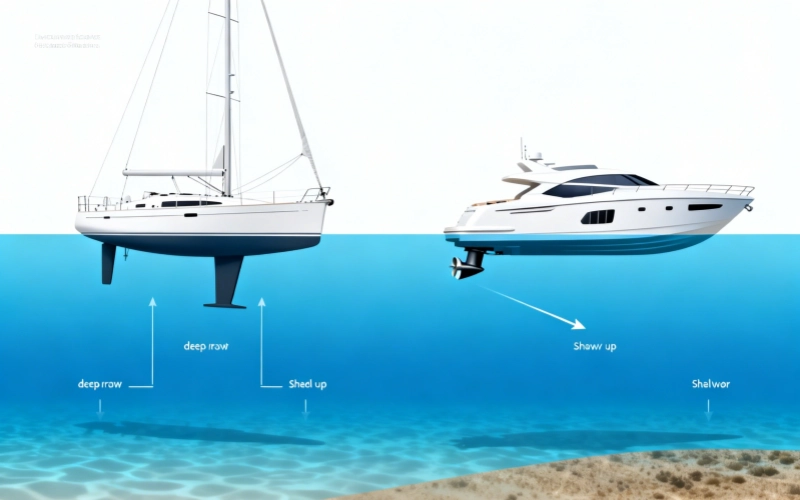
I will recommend adjustable-draft boats when a client needs a vessel that can handle a variety of completely different water conditions.
9.1 Lifting / Swing Keels
This type of design is common in high-performance sailing yachts; it uses a mechanical mechanism to adjust the position of the keel, thereby changing the draft to suit different sailing conditions.Typical Range:
- Keel Down: Approx. 2.0–2.5 meters (ocean-going mode)
- Keel Up: Approx. 0.9–1.3 meters (shallow-water mode)
Advantages:
- Dual-purpose capability
- Access to shallow anchorages
- Strong resale value in multi-region markets
- Higher maintenance complexity
- Reduced stability when raised
- Higher purchase cost (+15–25%)
9.2 Pod Drives
Pod drives are commonly found on power yachts; modern pod drive systems, such as the Volvo Penta IPS, can reduce draft by adjusting the position of the drive unit.Benefits:
- Draft can be reduced by approximately 20–40 centimeters
- Greater maneuverability when docking or navigating shallow waters
- Generally improved handling and fuel efficiency
- Cannot completely replace shallow-draft designs
- System maintenance requires specialized technical support
- Certain requirements for hull structure design
10. Conclusion: Why Draught Is a Core Buying Decision
From my experience as a yacht broker, draught is not just a technical measurement — it defines your cruising boundaries.Choosing incorrectly can lead to:
- Restricted navigation routes
- Inaccessible marinas and anchorages
- Reduced overall enjoyment
- Greater cruising freedom
- More anchoring options
- Long-term satisfaction
👉 Request Yacht Recommendations Based on Your Cruising Area
About the Author
Luna Rossi is a senior yacht broker with over 15 years of experience in yacht sales, evaluation, and global cruising advisory. She helps clients make informed decisions balancing performance, value, and real-world cruising experience.
Disclaimer
This article is based on professional experience and is intended for general informational purposes only. Actual draught may vary depending on load, configuration, and water conditions. Always refer to official yacht manuals and certified professionals before making purchasing or navigation decisions.
FAQ
Q1: Does draught affect fuel consumption?
A: Yes, but only slightly. Hydrodynamic design matters more than draught itself. Differences are typically under 5%.
Q2: Is deeper draught always safer in rough seas?
A: Not necessarily. Stability depends on hull shape and ballast distribution, not only draught depth.
Q3: Can I increase draught after purchasing a boat?
A: In practice, it is extremely difficult. Modifications require major structural changes and may affect stability certification.