



Quick Answer
A power catamaran is worth considering if you prioritise usable space, stability, shallow draft and comfortable family cruising over lower purchase and berthing costs. Its twin-hull design can improve space, efficiency and close-quarters manoeuvrability, but buyers should budget for two engines, wider marina berths and possible bridge-deck slamming in short, steep seas. It is particularly well suited to island hopping, extended stays aboard and cruising with family or friends.
Key Takeaways
- Best for: Families, island hopping, entertaining and extended stays aboard.
- Main advantages: Space, stability, shallow draft and twin-engine handling.
- Main disadvantages: Purchase price, wider berths and higher system complexity.
- Before buying: Confirm marina availability, real fuel burn and sea-trial performance.
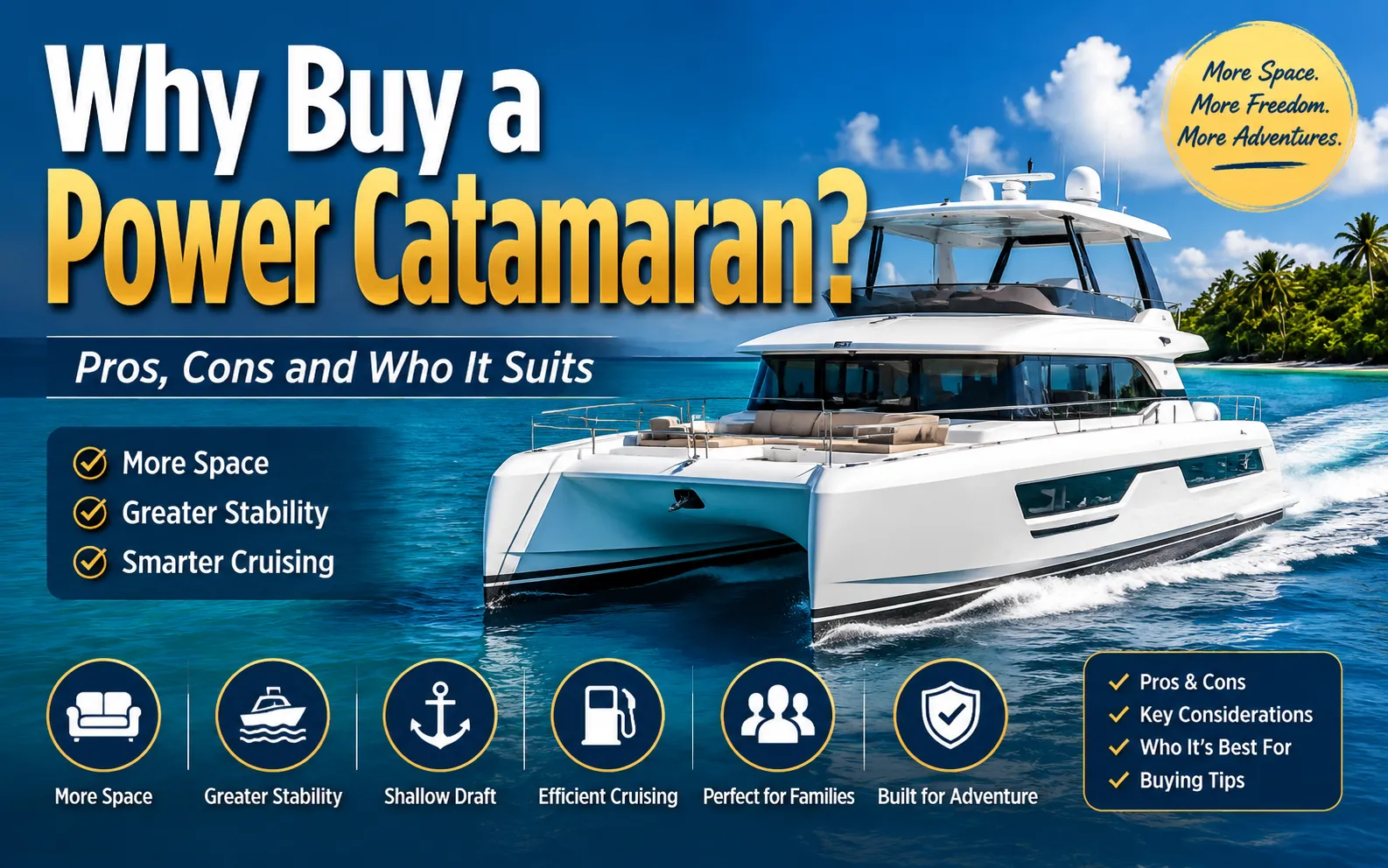
Why buy a power catamaran instead of a conventional motor yacht or sailing catamaran? For many buyers, the answer is a combination of space, stability, shallow draft and efficient cruising. A power catamaran can provide the usable living area of a much longer monohull while remaining comfortable for family cruising and extended stays aboard.
However, these advantages come with trade-offs. Wider marina berths, twin-engine maintenance, higher purchase prices and bridge-deck behaviour in rough seas all need to be evaluated before buying. This guide examines the practical pros and cons so that you can decide whether a power catamaran matches your cruising plans and ownership budget.
What Is a Power Catamaran?
A power catamaran is a motor-powered boat built with two parallel hulls connected by a central structure. Unlike a sailing catamaran, which relies primarily on wind power with auxiliary engines, a power catamaran uses engines as its main source of propulsion.
The twin-hull design creates several important differences compared with traditional monohulls. The two hulls provide a wider platform, increased stability and more interior volume, while the slender underwater sections can reduce resistance at appropriate cruising speeds.
Power catamarans are commonly used for:
- Family coastal cruising
- Island hopping
- Offshore leisure travel
- Long stays aboard
- Fishing and diving trips
- Luxury yacht ownership
Popular power catamaran brands include models from builders such as Aquila Power Catamarans, Fountaine Pajot and Leopard Catamarans, although the actual performance depends heavily on the specific hull design, displacement, engine configuration and intended use.
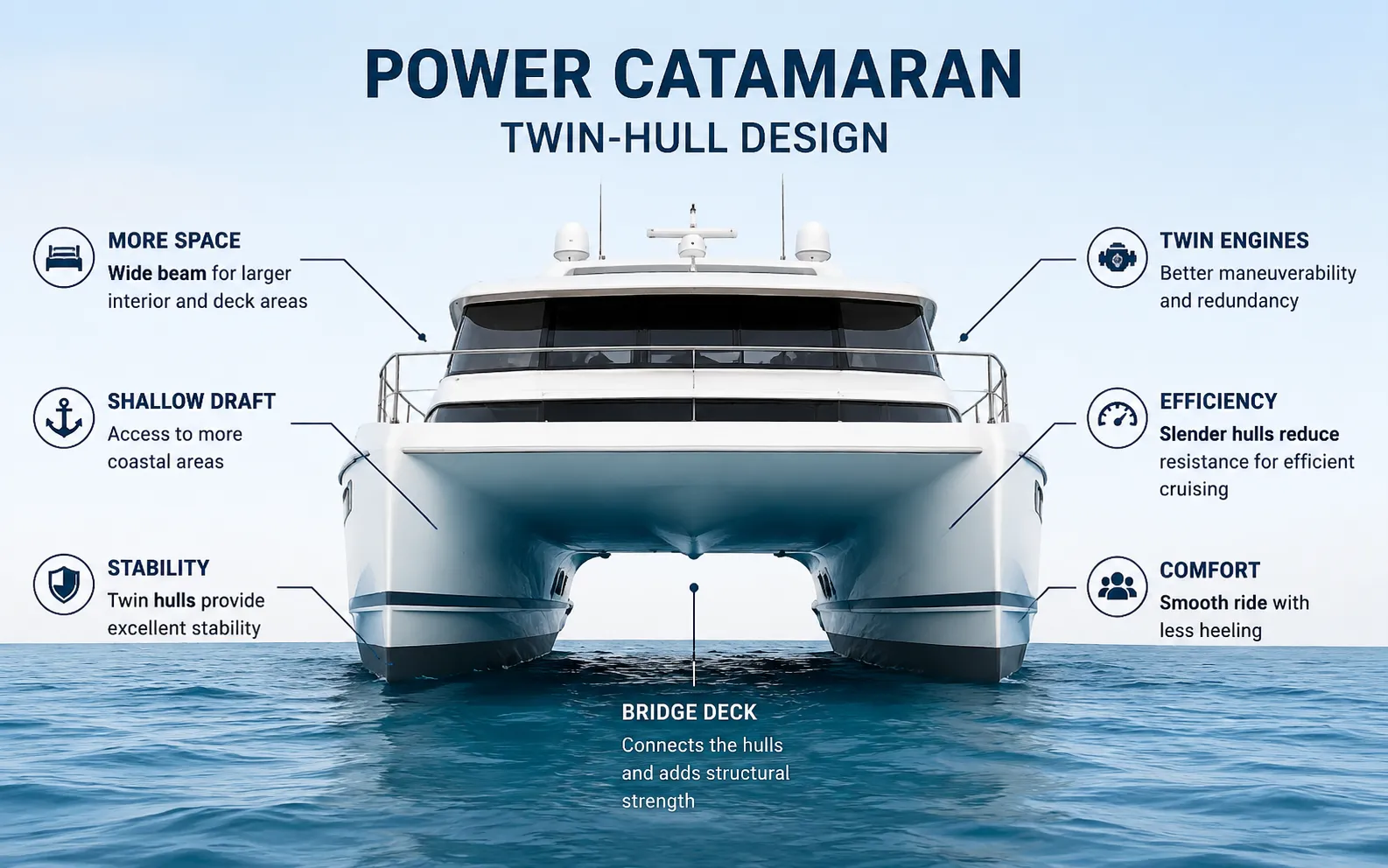
Power Catamaran Pros and Cons at a Glance
| Factor | Main Advantage | Main Drawback |
|---|---|---|
| Space | More usable deck and interior space for the same length | Wider beam requires more marina space |
| Stability | Less heeling and good stability at rest | Motion can feel different in certain wave conditions |
| Draft | Can access shallower anchorages | Actual draft still varies by model |
| Efficiency | Slender hulls can reduce resistance at suitable speeds | Fuel consumption rises rapidly when driven hard |
| Handling | Widely spaced twin engines improve close-quarters control | High sides can create windage |
| Safety | Separate propulsion systems provide redundancy | Two engines and more systems require maintenance |
| Ownership | Excellent for families and long stays | Higher purchase, berthing and service costs |
These characteristics explain why many experienced boat buyers consider a power catamaran, but they also show why this type of vessel is not automatically the right choice for every owner.
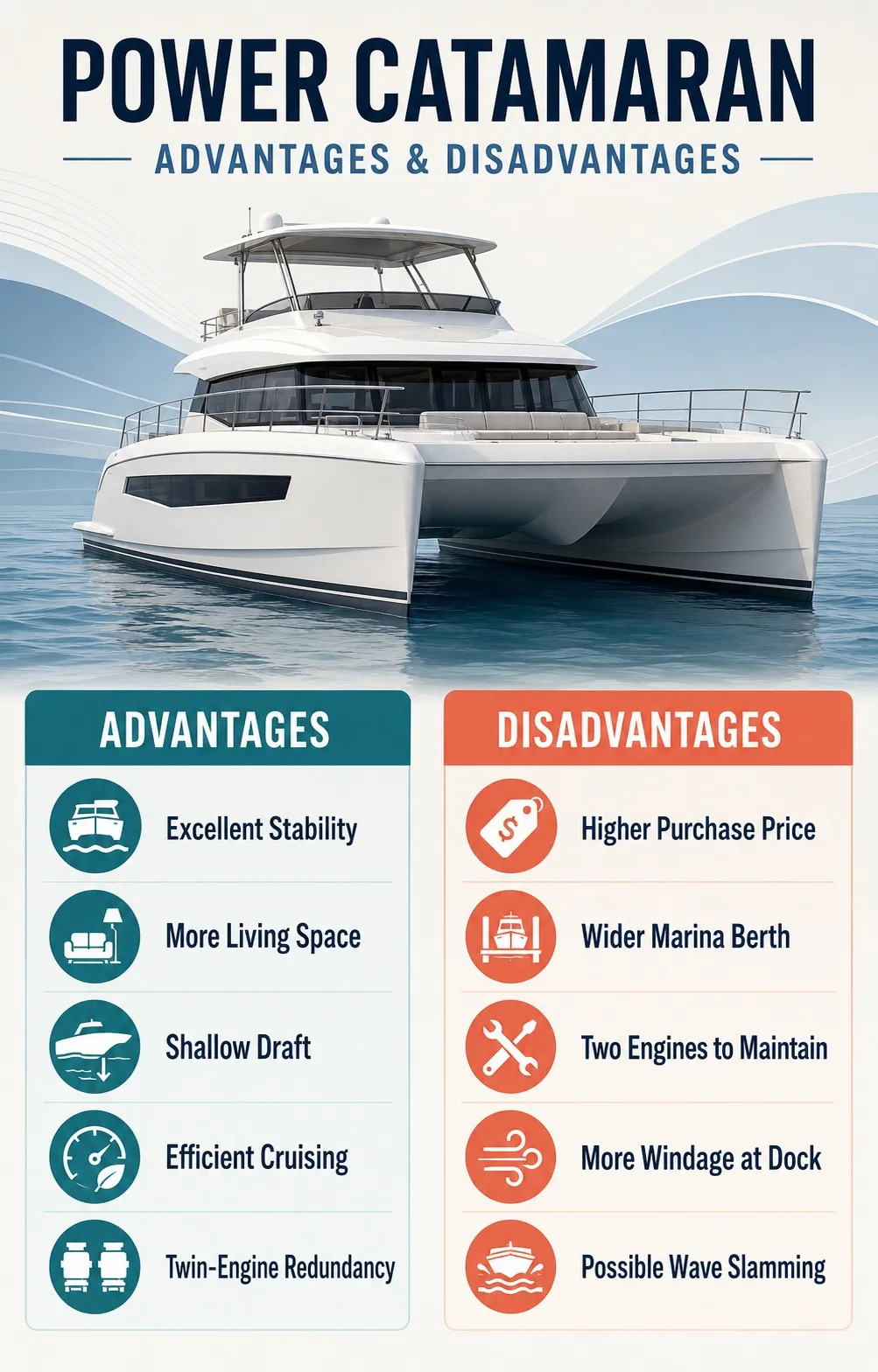
8 Advantages of Buying a Power Catamaran
A power catamaran combines space, stability and efficient cruising characteristics, making it popular among families, island cruisers and owners who value comfort. However, the real advantages depend on the vessel design, cruising plans and ownership expectations.
More Usable Living Space
One of the main reasons buyers choose a power catamaran is its efficient use of space.
The wide beam and twin-hull layout create larger salons, cabins, outdoor areas and storage spaces compared with many monohulls of similar length.
Separate hulls can also improve privacy by allowing different cabin arrangements, making power cats especially attractive for families and owners who regularly host guests.
However, buyers should compare actual interior volume rather than length alone, as beam, displacement and layout strongly influence usable space.
Greater Stability and Less Heeling
Power catamarans are known for their stable platform.
The two widely separated hulls reduce rolling motion and provide a more comfortable experience when anchored, cruising slowly or moving around onboard.
Unlike sailing monohulls, they normally do not heel significantly during powered cruising.
This makes them popular among families, older passengers and guests who prefer a steadier ride. However, rough-water performance still depends on hull design, bridge-deck clearance, loading and sea conditions.
Shallow Draft for Coastal and Island Cruising
Many power catamarans have a shallow draft, allowing access to more coastal areas and anchorages.
This is particularly useful for:
- Island hopping
- Shallow bays
- Beach access
- Protected anchorages
A shallow draft can increase cruising flexibility, but actual capability varies by model. Buyers should always check the manufacturer's specifications before assuming a vessel can access specific waters.
Efficient Cruising at the Right Speed
The slender twin hulls of a power catamaran can reduce resistance at economical cruising speeds.
Some models therefore achieve efficient fuel consumption when operated within their intended range.
However, fuel efficiency depends on many factors, including hull design, displacement, engines, loading and speed.
Buyers should compare fuel consumption per nautical mile rather than assuming all power cats are more economical than monohulls.
Excellent Twin-Engine Maneuverability
Most power catamarans use twin engines positioned separately in each hull.
This allows differential thrust, improving low-speed control and helping with:
- Marina manoeuvres
- Tight turns
- Docking adjustments
However, their wider beam and larger windage area can still create challenges in strong winds, so handling should always be evaluated during a sea trial.
Propulsion Redundancy
Twin engines provide an additional level of operational flexibility.
If one engine experiences a failure, the remaining engine may allow the vessel to continue at reduced speed depending on the situation.
This advantage comes from separate propulsion systems, not from the assumption that two hulls eliminate safety risks. Proper maintenance and emergency planning remain essential.
Faster Point-to-Point Cruising
Compared with sailing catamarans, power catamarans offer more predictable travel times because they rely on engines rather than wind conditions.
They are well suited for:
- Weekend trips
- Island routes
- Short cruising schedules
Actual speed depends on hull design, engine power, vessel weight and sea conditions.
Practical Layouts for Families and Long Stays
For many owners, the biggest advantage of a power catamaran is lifestyle comfort.
The wide platform provides:
- Larger social areas
- Better cabin privacy
- More storage
- Comfortable living space
These features make power catamarans particularly suitable for family cruising, entertaining guests and extended stays aboard.
7 Disadvantages of Power Catamarans
Although power catamarans offer excellent space, stability and cruising comfort, they also have several trade-offs. Buyers should understand these limitations before making a purchase decision.
Higher Purchase Price
Power catamarans are often more expensive than comparable monohulls because they require:
- Two hull structures
- Wider construction
- Twin propulsion systems
- Larger living areas
However, length alone is not a fair comparison. A power catamaran may provide significantly more usable space, so buyers should consider layout, volume, equipment and intended use.
Two Engines and More Systems to Maintain
The twin-engine configuration provides redundancy but also increases maintenance requirements.
Owners must typically manage:
- Two engines
- Additional mechanical systems
- More pumps and electrical equipment
Maintenance costs depend on system complexity, accessibility and service history.
Wider and More Expensive Marina Berths
The wide beam that creates more interior space can also make berthing more difficult.
Before buying, owners should confirm:
- Home marina suitability
- Multihull berth availability
- Docking costs
- Destination marina options
In some areas, wider berths may be limited or more expensive.
Bridge-Deck Slamming in Certain Sea Conditions
Bridge-deck slamming occurs when waves strike the underside of the structure between the two hulls.
Its severity depends on:
- Bridge-deck clearance
- Hull design
- Loading
- Speed
- Sea conditions
Not every power catamaran experiences this significantly, but buyers should evaluate ride comfort during a sea trial.
Greater Windage When Docking
Power catamarans usually have a larger beam and higher profile, which can increase wind effects at low speed.
Twin engines improve manoeuvrability, but strong crosswinds can still make docking challenging.
A sea trial in realistic conditions is the best way to evaluate handling.
Different Turning and Rolling Sensations
Power catamarans provide a different motion compared with monohulls.
They generally:
- Heel less during turns
- Feel more stable
- Have different movement patterns at anchor
Some owners prefer this stability, while others prefer the traditional feel of a monohull.
Fuel Costs Can Rise Quickly at Speed
Power catamarans can be efficient at economical cruising speeds, but fuel consumption increases quickly at higher speeds.
Actual fuel use depends on:
- Hull design
- Engine size
- Weight
- Cruising speed
- Sea conditions
Buyers should compare fuel consumption per nautical mile rather than relying only on hourly fuel burn.
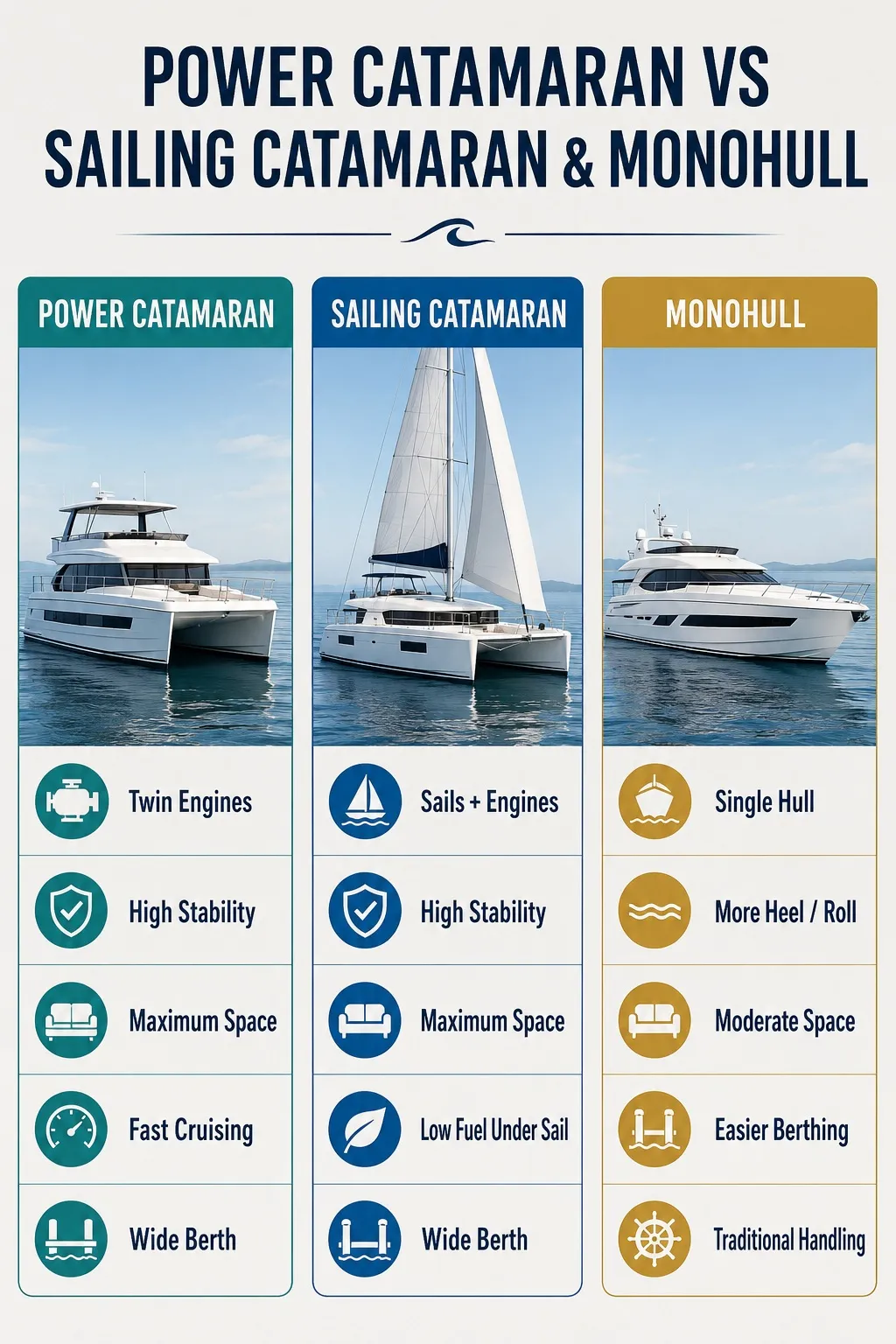
Power Catamaran vs Sailing Catamaran vs Monohull
Choosing between these three vessel types depends heavily on cruising style, budget and ownership expectations.
| Factor | Power Catamaran | Sailing Catamaran | Power Monohull |
|---|---|---|---|
| Primary propulsion | Engines | Sails with auxiliary engines | Engines |
| Typical speed | Higher than most sailing cats | Lower and wind-dependent | Varies widely |
| Fuel use | Moderate to high depending on speed | Lowest when sailing | Depends on hull and speed |
| Interior space | Excellent | Excellent | Usually narrower for the same length |
| Heeling | Minimal | Minimal | Can roll more noticeably |
| Draft | Usually shallow | Usually shallow | Often deeper |
| Marina berth | Wide and sometimes expensive | Wide and sometimes expensive | Easier to accommodate |
| Maintenance | Twin engines and large systems | Rigging, sails and engines | Usually one or two engines |
| Best suited to | Fast family cruising and island hopping | Long-range, low-fuel cruising | Conventional motor-yacht use |
These are general characteristics rather than guarantees. Hull design, displacement, loading and build quality can make two power catamarans perform very differently.
How Much Does a Power Catamaran Cost to Own?
Buying a power catamaran involves much more than the initial purchase price.
Many first-time buyers focus mainly on the acquisition cost, but long-term ownership expenses often determine whether the boat remains enjoyable and financially sustainable.
The total cost of ownership usually includes:
| Cost Category | What Buyers Should Consider |
|---|---|
| Purchase price | New or used market value, equipment level and condition |
| Pre-purchase survey | Hull inspection, systems inspection and professional evaluation |
| Tax and registration | Depends on flag state, location and ownership structure |
| Delivery | Transport, fuel, crew delivery and relocation costs |
| Insurance | Depends on vessel value, cruising area, owner experience and coverage |
| Marina berth | Beam requirements can significantly affect availability and pricing |
| Engine servicing | Two engines generally mean additional maintenance planning |
| Generator and onboard systems | Air conditioning, watermakers, electronics and pumps require servicing |
| Fuel | Depends heavily on cruising speed and usage pattern |
| Haul-out and storage | Antifouling, repairs and seasonal storage |
| Repairs and contingency reserve | Unexpected maintenance should always be budgeted |
A realistic ownership plan should include both predictable expenses and an emergency reserve.
For buyers comparing different vessel sizes and market segments, understanding the full ownership picture is essential.
For current price ranges by size and condition, see our complete guide to how much a catamaran costs in 2026.
What to Check During a Power Catamaran Sea Trial
□ Cold-start both engines and compare smoke, vibration and temperature□ Test acceleration at different RPM levels
□ Record actual fuel burn at economical and normal cruising speeds
□ Listen for bridge-deck impact in suitable sea conditions
□ Test head-sea, beam-sea and following-sea behaviour where safely possible
□ Perform slow-speed turns and close-quarters manoeuvres
□ Test docking response in crosswind conditions
□ Check cabin noise and vibration
□ Inspect engine-room access while systems are operating
□ Test the generator, air conditioning, pumps and navigation equipment
□ Confirm the vessel’s passenger, fuel and water load during the test
A sea trial does not replace an independent pre-purchase survey. Buyers should use a qualified marine surveyor and, where appropriate, an engine specialist.
Who Should Buy a Power Catamaran?
A power catamaran is best suited for buyers who value space, stability, flexibility and comfortable cruising. It is particularly attractive for:
Families Needing More Stable and Usable Living Space
Families benefit from larger living areas, better cabin privacy and a more stable platform for children and guests.
Buyers Planning Island-Hopping Itineraries
The combination of shallow draft, comfortable accommodation and predictable speed makes power cats ideal for coastal and island cruising.
Owners Who Frequently Entertain Guests
The wide beam and open layouts provide excellent social spaces for family gatherings and onboard entertaining.
Buyers Prioritising Shallow Draft
Owners exploring shallow bays, islands and coastal areas can benefit from greater anchoring flexibility.
Cruisers Wanting Predictable Engine-Powered Travel
Power catamarans suit owners who prefer reliable schedules without depending on wind conditions.
Owners Planning Longer Stays Aboard
The spacious layouts make power cats practical for extended cruising, seasonal use and liveaboard lifestyles.
Who May Be Better Off With Another Boat?
Although power catamarans offer many advantages, they are not the ideal choice for every owner. Buyers with the following priorities may prefer another type of boat:
Buyers With Limited Acquisition or Maintenance Budget
A monohull or smaller vessel may provide a lower entry cost and simpler ownership experience.
Owners Based in Marinas With Limited Multihull Berths
Buyers should confirm berth availability, width requirements and additional marina costs before purchasing.
Sailors Prioritising Minimal Fuel Consumption
Those focused on wind-powered cruising, lower operating costs and long-range efficiency may prefer a sailing catamaran.
Buyers Who Prefer Traditional Monohull Handling
Owners who enjoy classic monohull motion and handling characteristics may not prefer the different feel of a power catamaran.
Owners Who Rarely Need Additional Space
For short day trips or limited onboard use, the extra volume of a power catamaran may not provide enough value.
Buyers Unwilling to Maintain Twin Propulsion Systems
Owners seeking simpler mechanical systems may find a smaller monohull or single-engine boat easier to manage.
Used Power Catamaran Buying Checklist
When buying a used power catamaran, buyers should evaluate condition, maintenance history and ownership practicality — not just appearance.
Before purchase, check:
Hull and Structure
□ Hull condition and previous repairs
□ Signs of impact damage or structural issues
□ Bridge-deck and underwater areas
Engines and Systems
□ Engine hours and service records
□ Transmission and cooling systems
□ Generator, electrical systems and onboard equipment
Interior and Layout
□ Cabin layout suitability
□ Storage capacity
□ Engine-room access
□ Overall match with your cruising plans
Ownership Considerations
□ Marina availability and berth requirements
□ Insurance requirements
□ Local maintenance support
□ Transport and storage options
A professional pre-purchase survey is strongly recommended, especially for larger or more complex power catamarans.
Power Catamarans Currently Available
The power catamaran market currently includes a wide range of models, from compact family cruisers to large luxury multihulls. Available options vary significantly in size, layout, range and intended use, allowing buyers to choose a vessel that matches their cruising style and ownership goals.Some well-known models of powered catamarans currently available on the market include:
| Model | Approximate Size | Best Suited For |
|---|---|---|
| Aquila 42 Yacht | 42 ft | Family cruising, coastal trips and first-time power catamaran owners |
| Leopard 46 Powercat | 46 ft | Island hopping, charter-style cruising and family use |
| Fountaine Pajot MY6 | 46 ft | Comfortable cruising and premium family ownership |
| Sunreef 70 Power | 70 ft | High-end ownership and long-range luxury cruising |
| Horizon PC74 | 74 ft | Large-volume cruising and motor yacht alternatives |

2024 Aquila 42 Yacht
- Build Year2024
- Length41 ft
- Cabins3
- Top speed22 kn
- TypeCatamaran yacht
The 2024 Aquila 42 Yacht is a nearly new luxury power catamaran that delivers impressive stability, efficient cruising performance, and premium onboard comfort in a highly versatile package. With only 97 engine hours, this vessel remains in bristol condition and is fully equipped for immediate delivery, making it an outstanding opportunity for buyers seeking a turnkey cruising yacht without the wait associated with new builds.
2023 Leopard 46 Powercat
- Build Year2023
- Length46.33 ft
- Cabins3
- Top speed25 kn
- TypeCatamaran yacht
The 2023 Leopard 46 Powercat “Better Now” is a nearly new luxury power catamaran built for owners seeking long-range cruising capability, premium comfort, and true turnkey convenience. Featuring upgraded twin 370HP Yanmar diesel engines with only 325 hours, this US Duty Paid vessel combines impressive performance with modern efficiency and reliability. Designed with the highly desirable Maestro layout, the yacht offers three spacious queen cabins and three private ensuite heads, creating a comfortable environment for extended cruising or entertaining guests.

2026 Fountaine Pajot MY 6
- Length45 ft
- Cabins3
- Top speed28 kn
- TypeCatamaran yacht
The 2026 Fountaine Pajot MY 6 is a luxurious power catamaran that redefines space and comfort in a compact 45-foot package, designed for discerning owners who refuse to compromise between performance and elegance. Engineered for extended coastal cruising, island hopping, or entertaining guests in style, this vessel delivers the stability and spaciousness of a much larger yacht.
Sunreef 70 NEXT
- Length70 ft
- Cabins4
- Top speed13 kn
- TypeSailboat
The Sunreef 70 NEXT is a luxury catamaran with advanced composite construction and customizable layouts, offering stability and comfort. It measures 70 ft by 35 ft 7 in and has twin 175 hp John Deere engines. The flexible interior features 4–6 cabins and entertainment areas, with large fuel and water tanks, ideal for long voyages and social gatherings.
Horizon PC74
- Length73.10 ft
- TypeCatamaran yacht
The all-new Horizon PC74, extending to 74 feet (approximately 22 meters), combines luxurious interiors and spaciousness rarely seen in the catamaran market. Designed by the renowned designer Angelo Lavranos, who also created the PC60 model, the hull is complemented by the spacious and luxurious interiors planned by J.C. Espinosa. A special feature includes locating the master bedroom and master bathroom on the same deck, thereby enhancing the space in the lower deck hull. The hull design itself has been optimized for both functionality and comfort, making it another excellent choice for owners who enjoy sailing in shallow bays and appreciate ample space.
When comparing currently available power catamarans, buyers should evaluate more than size and price. Important factors include:
- Hull design
- Interior layout
- Cruising range
- Engine configuration
- Maintenance requirements
- Intended cruising area
Disclaimer
The information in this article is for general informational purposes only and should not be considered professional yacht, financial, legal or purchasing advice. Boat specifications, prices, operating costs and suitability may vary depending on the model, condition, location and individual requirements. Buyers should conduct their own research and consult qualified professionals, including yacht brokers and marine surveyors, before making any purchase decision.
FAQ
Q1: Is a power catamaran worth buying?
A: A power catamaran can be worth buying for owners who prioritise space, stability, shallow draft and predictable engine-powered cruising. It may be less suitable for buyers with limited maintenance budgets or restricted access to wide marina berths.
Q2: What are the main disadvantages of a power catamaran?
A: The main disadvantages are a higher purchase price, twin-engine maintenance, wider and potentially more expensive marina berths, greater windage and possible bridge-deck slamming in certain sea conditions.
Q3: Are power catamarans more fuel-efficient than monohulls?
A: They can be more efficient at suitable displacement or economical cruising speeds because their slender hulls create less resistance. Actual fuel efficiency depends on hull design, weight, engines, loading, speed and sea conditions.
Q4: How do power catamarans handle rough seas?
A: A well-designed power catamaran can provide good stability and reduced heeling, but performance varies considerably by model. Bridge-deck clearance, hull shape, loading, speed and wave direction all affect comfort in rough conditions.
Q5: Is a power catamaran better than a sailing catamaran?
A: A power catamaran is generally faster and provides more predictable journey times, while a sailing catamaran can offer lower fuel consumption and a more traditional sailing experience. The better choice depends on itinerary, budget and preferred cruising style.
Q6: Do power catamarans cost more to berth?
A: They often do because their wider beam may require a multihull berth or additional marina space. Buyers should confirm berth availability and pricing at their home marina before purchasing.