Quick Answer:
The yacht registration certificate is the core document establishing a yacht's legal identity, determining whether you can legally berth, obtain insurance, engage in cross-border voyages, or resell the vessel. The application process requires proof of the vessel's identity, ownership, and intended use, along with selecting the appropriate registration type. The most common cause of delays isn't the complexity of the process, but rather inconsistencies in submitted materials or mismatches between the chosen registration type and the vessel's actual purpose. Conducting a comprehensive self-check beforehand significantly reduces the risk of document requests and delays.
After purchasing a yacht, many first-time yacht buyers assume they can simply take possession and start cruising. However, when attempting to secure insurance, dock at ports, or engage in cross-border voyages, they discover that the Yacht Registration Certificate is the essential “permit for vessel operation.”
Next, I will guide you through the necessity of registration, required documentation, common registration types, and critical overlooked points in the process. This will help you complete registration correctly on the first attempt, avoiding rejections and delays.
1. Basic Concepts of Yacht Registration Certificates and Their Necessity for Owners
A yacht registration certificate essentially serves as the legal identity document for a yacht. Its function is analogous to a vehicle registration certificate, confirming the yacht's ownership, registration details, and legal navigation status. If you plan to sell your yacht in the future, the registration certificate is the first document buyers will scrutinize.
A yacht without registration is often regarded as having “incomplete legal status,” which directly impacts its subsequent use.
Numarine Insight notes that the registration certificate serves not only as the vessel's “passport,” proving its lawful registration, but also determines which nation's laws govern the vessel in international waters.
From a practical standpoint, the yacht registration certificate is the foundational requirement for owners to operate their vessels normally. Whether for daily mooring, port entry/exit, purchasing insurance, or future resale, transfer of ownership, or cross-regional navigation, relevant authorities will prioritize verifying whether registration information is complete, authentic, and traceable.
Many new yacht owners initially underestimate the importance of registration, assuming that as long as the vessel was legally purchased, it can be used. However, when arranging insurance, undergoing inspections, or selling the vessel, they discover that missing registration certificates trigger a series of passive issues, and the cost of remedying these problems often far exceeds the expense of proper initial registration.
2. Application Requirements and Documentation for Yacht Registration Certificates
The core logic behind yacht registration is straightforward: essentially, it involves clearly communicating three key points to the registration authority—who owns the vessel, what the vessel is, and what purpose it serves.
Provided these three pieces of information are accurate, complete, and consistent, the registration process typically proceeds smoothly.
Vessel Identification and Ownership Requirements
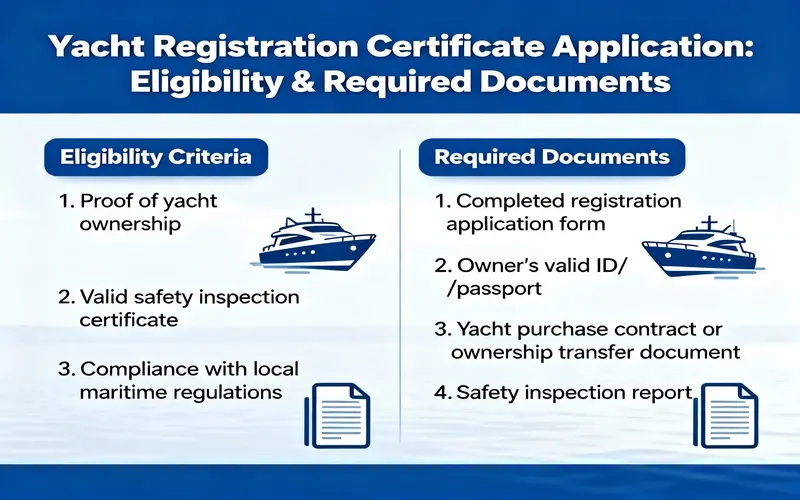
The yacht must possess verifiable vessel identification details, including: Hull Identification Number (HIN/VIN), year of construction, dimensions, propulsion system, etc. Additionally, the owner must provide documentation proving ownership, such as the purchase contract, invoice, or transfer documents.
Legitimacy and Traceability of the Registrant
The registrant can be an individual, company, or trust. Regardless of the entity type, valid identification and legal registration details must be provided. For corporate registrations, additional documents like the company registration certificate and a letter of authorization from the legal representative are required.
The critical aspect here is the “traceability of the registrant,” meaning authorities must be able to confirm the ultimate beneficial owner (UBO) and determine whether any disputes or encumbrances exist.
The core purpose of this requirement is to ensure clear registration entities and well-defined rights and responsibilities, thereby preventing subsequent ownership disputes or compliance risks.
Common Documentation Checklist for Practical Processing
Under most registration systems, the following materials are the most fundamental and easiest to prepare in advance (self-check):
□Vessel Basic Information: Hull identification number, year of construction, dimensions, engine specifications
□Proof of vessel origin: Purchase contract, invoice, import customs declaration (if applicable)
□Proof of ownership: Transfer documents, ownership assignment agreement
□Shipowner identification: ID card/passport, proof of address
□Supplementary documents: Company registration certificate, letter of authorization from legal representative, power of attorney, etc. (if registering under a company or trust)
Overall, the registration process itself is not complex. What truly prolongs the timeline is often inadequate documentation or inconsistent information.
It's also worth noting that registration requirements vary by flag state and jurisdiction.
While the core principles of yacht registration remain consistent worldwide—verifying ownership, vessel identity, and intended use—the specific documentation, timelines, and compliance standards can differ depending on whether the yacht is registered in the United States, the European Union, or under an offshore flag.
For this reason, owners planning international cruising or future resale should confirm jurisdiction-specific requirements before selecting a registration type, as assumptions based on one system may not apply elsewhere.
3. Common Types of Yacht Registration Certificates and Their Applicable Scenarios
After understanding the registration process, yacht owners must address an equally important question: Which registration type truly aligns with their usage needs?
The chosen registration type directly impacts whether a yacht can be legally operated, insured, and used for cross-border voyages. While incorrect registration may not immediately reveal issues, limitations or compliance risks often surface during insurance processing, port access, international navigation, or future resale. Common registration types and their applicable scenarios are outlined below:
| Registration Type | Applicable Entities | Typical Use Cases | Key Features | Key Reminders |
| Private/Non-Commercial Registration | Personal Use | Weekend offshore trips, coastal cruising | Relatively simple requirements, lower costs | If you plan to lease or engage in cross-border operations in the future, plan ahead. |
| Commercial/Operational Registration | Leasing, Chartering | Commercial charters, corporate hospitality | Higher safety and personnel requirements | Private registration must not be used for disguised commercial operations, as this poses compliance risks. |
| Temporary/Transit Registration | Short-Term Use | Transit stops, transitional periods | Clear time constraints | Not suitable for long-term residency purposes. |
| Flag State/Offshore Registration | Company/Trust Ownership | Cross-border voyages, tax planning | High flexibility, stricter compliance requirements | Select based on intended navigation zones. |
| Special Purpose Registration | Specific Projects | Scientific research, filming, training | Requires additional permits | Registration requirements are more specific. |
Choosing the right registration type ensures smoother yacht operations throughout its entire lifecycle; selecting the wrong type often leads to higher adjustment costs later on.
4. Six Key Points Often Overlooked by Owners During Yacht Registration
In practice, many owners of a newly purchased yacht still face document rejections, review delays, or even the need to reapply due to minor oversights. Below are the most common “easily overlooked details” that significantly prolong the registration timeline.
1) Discrepancies between vessel name, hull identification number (HIN/VIN), and documentation
Many owners change a vessel's name post-purchase but fail to update related certificates or contract information during registration. When authorities detect inconsistencies, they require supplementary name change proof or resubmission of materials.
Recommendation: Before submission, verify that the vessel name and HIN match across the hull plate, contract, invoice, and registration application form.
2) Discrepancies between owner information and identity documents (including address)
Submitting materials using different addresses, passports, or ID information, or registering under a company name without providing a letter of authorization, will be deemed “incomplete registration entity information.”
Recommendation: Ensure the owner's name, ID/passport number, and address exactly match the supporting documents. Prepare a company authorization letter or power of attorney when necessary.
3) Discrepancies between the Ship Purchase Contract and Invoice Information
Many shipowners discover inconsistencies in contract amounts, dates, or party details compared to invoices. This directly impacts the validity of the “Proof of Ownership,” leading to requests for supplementary documentation during registration.
Recommendation: Ensure absolute consistency between the contract and invoice regarding amounts, dates, and buyer/seller information—particularly the shipowner's name and address.
4) Mismatch between chosen registration type and actual usage
Some owners assume “private registration suffices,” but using the vessel for charter, commercial activities, or cross-border voyages will be deemed non-compliant. This can later cause issues with insurance, port formalities, or inspections.
Recommendation: Confirm future usage (chartering, cross-border operations, corporate ownership) before applying and select the appropriate registration type.
5) Failure to update after “change of vessel purpose”
During operation, a yacht may transition from private use to chartering, event operations, or change ownership. Failure to update registration details promptly may be detected during insurance underwriting, surveys, or port inspections.
Recommendation: Contact the registry authority or agent immediately to amend registration details upon any change in vessel purpose.
6) Ignoring Registration Applicability for Cross-Border Voyages
Certain registration types impose usage restrictions in specific waters or countries.
Recommendation: Verify the registration's scope of validity well in advance of any cross-border or long-distance voyages.
Experience Sharing:
I once encountered a shipowner who was required to resubmit all documentation due to “last-minute name changes combined with international voyages,” a process that took nearly a month.
Therefore, I recommend shipowners conduct a “full-process self-check” before submission, verifying each of the six points listed above. This significantly reduces the risk of document requests and shortens the registration cycle.
5. Conclusion
Delays in registration often stem not from procedural complexity, but from inconsistent information or misjudged purposes. Conducting a “full-process self-check” before submission—ensuring vessel name, HIN, and owner details match contracts and invoices while selecting the correct registration type—can substantially lower the risk of document requests. This ensures smooth issuance of the yacht registration certificate, simplifying subsequent usage, insurance, and cross-border voyages.
About the Author
Andrew Rogers is a yacht broker with extensive experience in yacht registration, ownership transfer, and resale. He helps owners avoid common paperwork pitfalls that delay insurance, berthing, or cross-border sailing, and provides practical guidance for smooth transactions.
Disclaimer:
The content herein is provided for general informational purposes only and does not constitute legal, tax, or professional advice. Yacht registration policies, procedures, and requirements vary by country/region, vessel type, and intendorities or professional agents. For specific operational guidance, please consult qualified professionals.ed use. Actual registration should be conducted in accordance with the requirements of local registration auth
FAQ
Q1: What is a Yacht Registration Certificate?
A: It serves as the yacht's “legal ID,” verifying ownership and lawful navigation status. This essential document is required for mooring, insurance, and cross-border voyages.
Q2: What core materials are needed to apply for a Yacht Registration Certificate?
A: Hull identification number, construction details, purchase contract, invoice, and proof of identity. For corporate registration, a power of attorney is also required.
Q3: How to ensure approval on the first attempt?
A: Self-check before submission: Verify consistency between vessel name and HIN, match document details, ensure contract and invoice align, and select the correct registration type.
Q4: What impact does the registration certificate have on the sale of the vessel?
A: It is the buyer's primary verification document. A complete registration proves legal status and clear ownership, directly influencing transaction success.
Q5: What happens without a registration certificate?
A: You cannot obtain insurance, dock at ports, or engage in cross-border voyages. Resale becomes difficult later, and the cost of obtaining a replacement far exceeds normal registration fees.