Worth considering. The Azuree 46 is a performance‑cruise sailboat that balances sailing performance, living space and blue‑water cruising capability. It suits owners planning family cruising, medium‑to‑long‑distance voyages or ocean‑going trips. If you prioritize extra‑large space, low‑operation barriers or mostly short‑distance recreational sailing, it is recommended to also compare catamarans and other cruising yachts.
What is the positioning of the Azuree 46?
The Azuree 46 is the flagship model in the Azuree range, built by Turkey‑based Sirena Marine, with hull design by Rob Humphreys. According to current official Azuree documentation, the 33C, 41 and 46 are still listed as models in the series. Sirena Marine positions the Azuree line as a combination of comfortable cruising and high sailing performance.
In terms of market positioning, the Azuree 46 is neither a traditional offshore cruising yacht that prioritizes sturdiness, slow speeds and maximum onboard comfort, nor a dedicated racing sailboat that sacrifices living space for competition purposes. It falls more into the Performance Cruiser category. When introducing this project, Rob Humphreys Yacht Design explicitly stated that the Azuree 46 carries forward certain design philosophies developed from projects such as the Open 60, Volvo 70 and Class 40, while also meeting private owners’ demands for comfort and cruising capability.
| Item | Azuree 46 Specifications |
| LOA (Overall Length) | 13.99 m |
| LWL (Waterline Length) | Approx. 12.99 m |
| Maximum Beam | 4.25 m |
| Maximum Draft | 2.60 m |
| Displacement | Approx. 10,700 kg |
| Engine | Volvo Penta 55 hp |
| Fuel Capacity | Approx. 215 L |
| Fresh Water Capacity | Approx. 370 L |
| Standard Layout | 3 cabins, 2 heads |
| Hull Design | Rob Humphreys |
| Builder | Sirena Marine |
The above data is sourced from Azuree documentation, designer‑supplied materials and professional boat test reports. Vessels of different years, configurations and refitted boats may have discrepancies. Therefore, the actual parameters of second‑hand boats shall be subject to the specific vessel documents and shipyard nameplates.
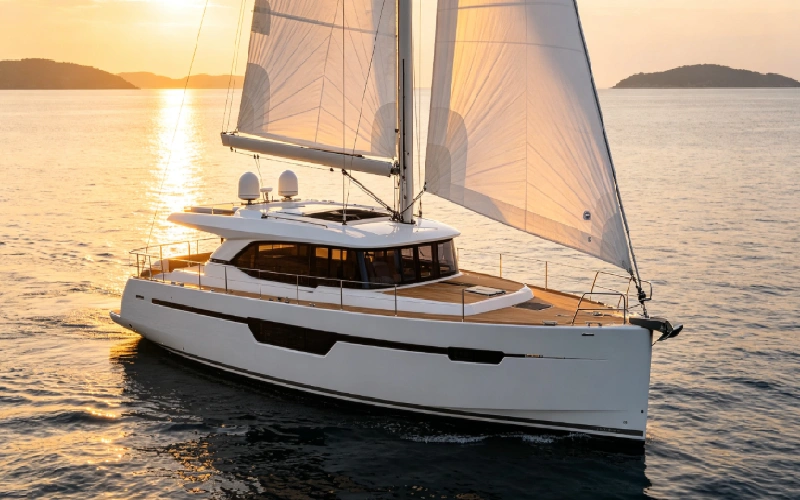
How is the sailing performance of the Azuree 46?
Judging by paper‑specifications alone, it is difficult to fully understand why the Azuree 46 draws attention from performance‑cruising sailors. Its real appeal lies in the well‑rounded performance logic created by the interplay of hull design, long waterline, broad aft‑hull and twin‑rudder system. Professional test data shows that the Azuree 46 features a relatively broad hull with hard‑chine geometry, intended to increase waterline length and effective beam while keeping wetted surface area low.
Cruising World conducted a sea trial of the Azuree 46. During testing in Narragansett Bay, with on‑site wind speeds below 10 knots, the Azuree 46 still achieved a speed over ground of approximately 7 knots. The test report specifically praised the responsive handling delivered by the Jefa steering system and twin rudders. It should be noted that these results reflect performance under specific test conditions and should not be interpreted to mean the Azuree 46 can attain identical speeds under all wind conditions and load states.
Sailboat speed is affected by numerous factors including true wind speed and direction, sea state, loading, sail plan, hull‑bottom condition and crew handling. What truly matters is whether the Azuree 46 possesses adequate performance reserves to deliver speed for owners during normal cruising, without requiring excessive compromises in comfort for the sake of speed — and this is precisely where its value resides.
Why is the twin‑rudder design noteworthy?
The Azuree 46 adopts a twin‑rudder configuration not merely for a sporty appearance. In its official design brief, Rob Humphreys Yacht Design explicitly describes the Azuree series as following the design philosophy of twin-ruddered Open-style boats, and emphasizes the balance among beam, waterline length and low wetted surface area.
Another practical advantage lies in sailing visibility. The Azuree 46 features a dual‑helm layout. The helmsman can choose the more suitable side position according to the current heading, while gaining better views of the sails, sea surface and surrounding vessels. For boat owners who frequently undertake long‑distance voyages, such ergonomic design is often more practical than simply adding a certain luxury feature.
Is the Azuree 46’s space‑layout practical?
Many people fall into a common misconception when choosing a sailboat: that greater beam and larger interior area equal greater comfort. In reality, what truly shapes long‑term user experience is how the space is organized. One of the strengths of the Azuree 46 is that it translates its substantial beam into ample cockpit and indoor living space. Sea‑trial reports from Cruising World note that the boat features a beam of nearly 14 feet, and its furniture layout avoids large stretches of unused empty space.
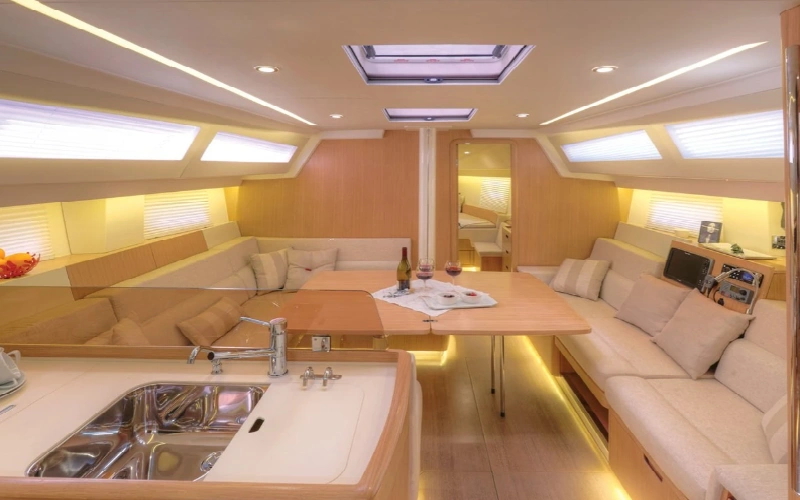
What family users actually care about is rarely "how many square meters there are", but rather whether sleeping conditions are comfortable at night, whether the galley functions properly, if there are sufficient heads, whether children can have their own private space, and whether there is adequate storage for all kinds of gear while sailing. Therefore, the Azuree 46’s three‑cabin, two‑head layout and spacious cockpit make it well‑suited for family cruising requirements.
Cockpit: A Standout Feature of the Azuree 46
The Azuree 46 features a generously sized cockpit with a central dining table, helm positions on both sides, and ample storage space. Professional tests confirm some seats can be converted into lounging areas, while under‑deck storage stows gear such as mooring lines and fenders.
For family users, the cockpit frequently serves as the main zone for dining, socialising and resting, making its practicality more important than extra interior volume alone.
Three Cabins, Two Heads: Well‑Suited for Family and Group Cruising
The Azuree 46 commonly comes with three double cabins and two heads. Additional sleeping space can be arranged within the saloon and navigation area depending on configuration.
For family boating requirements, this layout accommodates couples, families of four and group trips. It preserves private sleeping quarters while preventing overcrowding on board.
Galley & Storage: Functional, Yet Evaluate Carefully for Long‑Distance Cruising
The Azuree 46 galley is fitted with twin sinks, fridge‑freezer units, stovetop and lockers. Real‑world testing by Cruising World notes the galley is fully functional but has limited countertop space.
Based on my boat‑survey experience, long‑range cruising depends on more than just basic galley equipment. Food storage capacity, battery bank output, generator, water‑maker and refrigeration systems must match your planned voyage duration.
How Capable Is the Azuree 46 for Offshore Cruising?
When assessing offshore capability, it should not be reduced simply to “how far the boat can sail”. True offshore performance is a combination of hull structure, stability, handling, propulsion, fuel and fresh‑water reserves, navigation‑communication hardware, safety gear, crew competency and voyage planning.
World Sailing’s Offshore Special Regulations set out safety standards covering structural attributes, vessel equipment, personal gear and crew training for offshore racing. The 2026‑2027 edition entered force on 1 January 2026. This illustrates that professional offshore safety assessment relies on a complete system rather than isolated hull specifications.
Accordingly, I characterise the Azuree 46 as a performance cruiser with solid offshore potential, rather than promising it is ready for circumnavigation out‑of‑the‑box. Its suitability for trans‑ocean passages ultimately hinges on individual boat configuration, condition, refits, crew skill and route conditions.
Who Should Buy the Azuree 46? Real‑World Performance for Different Use Cases
From a boat‑buying perspective, the Azuree 46 best suits buyers who have a clear understanding of why they need a 46‑foot sailboat.
The first group consists of family cruisers. They want day trips along the coast on weekends as well as several longer voyages each year, with reasonable expectations for onboard sleeping, sanitary facilities and living space. Its three‑cabin, two‑head layout and spacious cockpit satisfy these requirements.
The second group are boat owners planning medium‑to‑long‑distance passages. They are not content with short outings from the marina and aim for multi‑day coastal cruising, or even trans‑sea routes in the future. As a performance‑oriented cruiser with well‑rounded living accommodations, the Azuree 46 is better suited for such missions than a pure racing boat.
The third group are sailors who value responsive handling without compromising onboard comfort. These buyers pay close attention to twin‑rudder set‑ups, sail inventory, hull feedback and sailing feel, while also expecting comfortable cooking, sleeping and resting once anchored for the night. The Azuree 46 sits right at the intersection of these two sets of priorities.
Is the Azuree 46 Worth Buying? A Combined Review of Performance, Space and Offshore Capability
If I had to sum up the purchase value of the Azuree 46 in one sentence: it is worth buying, provided your requirements call for a 46‑foot sailboat that balances performance, cruising ability and live‑aboard comfort.
| Evaluation Criteria | Azuree 46 Performance | Purchase Recommendation |
| Sailing Performance | Strong, clear sport‑cruiser positioning | High |
| Twin‑Rudder Handling | Agile with good sailing visibility | High |
| Family‑Oriented Space | 3 cabins, 2 heads | Medium‑High |
| Cockpit | Spacious and multi‑functional | High |
| Blue‑Water Potential | Solid, subject to specific configurations | Medium‑High |
| Beginner‑Friendliness | Requires certain sailing experience | Medium |
| Pure Racing Capability | Racing‑inspired, yet not a dedicated race boat | Medium‑High |
| Oversized Living Quarters | Not optimized for maximum interior volume in its size class | Medium |
The full set of basic conditions required for on‑board living. Cruising World rates it as a performance cruiser that balances sailing enjoyment with onboard comfort, which largely aligns with designer Rob Humphreys’ philosophy of being “fast and agile while retaining cruising practicality”.
Key Configurations to Inspect Before Buying the Azuree 46
When purchasing a pre‑owned Azuree 46, do not focus merely on interior finishes and cosmetic appearance. For performance‑cruiser sailboats, hull structure, rudder assembly, rigging, engine and electrical equipment have a far‑more direct impact on long‑term operating costs. A comprehensive assessment based on a professional survey report and service history is recommended.
Hull, Keel and Twin‑Rudder System
Pay close attention to cracks, water intrusion or structural defects on the hull. Inspect the keel connections, rudder blades, rudder shafts, bearings and the Jefa steering system for abnormal play or looseness.Mast, Rigging and Sails
Check wear on the mast, standing rigging, blocks, sails and deck hardware. For boats exposed to heavy‑wind sailing or race participation, verify rigging service age and replacement records.Engine and Electrical Systems
The Azuree 46 is commonly fitted with a 55 hp Volvo Penta diesel engine. For second‑hand purchases, confirm the engine model, running hours and maintenance logs, and inspect cooling, exhaust, power‑generation and battery systems.Navigation and Offshore‑Safety Equipment
For offshore‑cruising plans, inspect the autopilot, AIS, VHF radio, radar, chart‑plotter, satellite communications, life raft, EPIRB/PLB and fire‑safety gear. As stated in World Sailing’s Offshore Special Regulations, offshore safety relies on the combined readiness of vessel structure, on‑board equipment and crew training.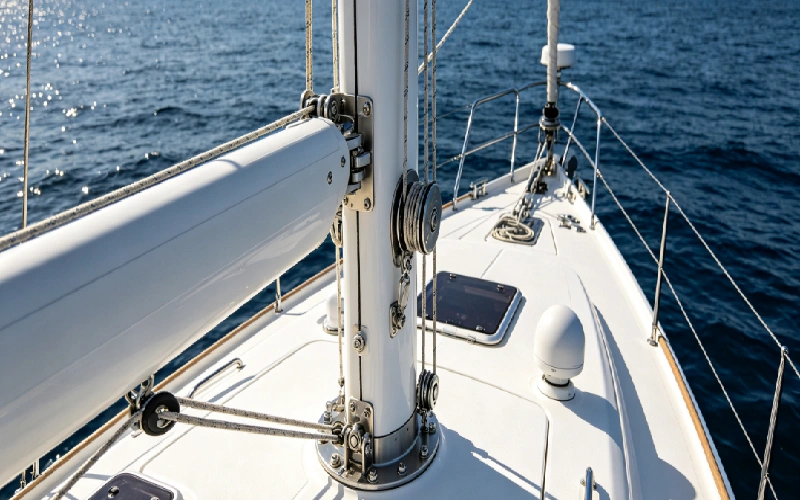
Conclusion
Combining sailing performance, layout and offshore‑cruising capability, the core strength of the Azuree 46 lies in its balanced mix of performance, comfort and cruising potential. It suits boat owners with solid sailing experience who plan family outings or medium‑to‑long‑distance passages and value responsive sail‑handling feedback.
If your priorities lean toward maximum interior volume, shallow draft or straightforward operation, you are advised to compare alternative brands before making your final decision.👉 Planning to buy an Azuree 46? Get professional boat‑selection advice, compare new and pre‑owned inventory, and evaluate your purchase budget plus long‑term ownership costs in advance.
Disclaimer
The information provided in this article is for general yacht research and purchasing reference only and does not constitute investment, purchase, or brokerage advice. This article has not been sponsored by any shipyard, financial institution, or yacht brand, and the author has not participated in any brokerage transaction involving the vessels mentioned. Yacht specifications and related information are based on publicly available sources as of 2026. Actual specifications may vary depending on the model year, optional equipment, and vessel condition. Specific details should be verified against the shipyard’s documentation and vessel certificates. Before purchasing, buyers are advised to hire an independent marine surveyor with no affiliation to the seller to conduct a thorough inspection and sea trial and verify all relevant certificates. The author and this platform are not responsible for any losses resulting from reliance on the information provided in this article. Regulations, fees, and market conditions may change, so readers should always refer to the latest official requirements.
About the Author
Andrew Rogers is a content writer specializing in yacht, sailing, and marine market research. He closely follows yacht design, vessel performance, onboard layouts, offshore cruising capabilities, and industry trends. By reviewing shipyard specifications, professional media tests, and publicly available industry information, he provides objective and accessible yacht analysis and purchasing insights, helping readers better understand the characteristics and suitable uses of different yachts.
FAQ
Q1: Is the Azuree 46 suitable for beginners?
A: Although the Azuree 46 features excellent twin-rudder handling and ergonomic design, it is, after all, a performance cruiser approaching 46 feet in length, which still requires a certain level of skill in sail handling, docking, and navigating in challenging sea conditions. For beginners with absolutely no sailing experience, it is recommended to first undergo systematic training before gradually progressing to this size class. The RYA cruising training system also divides basic sailing, coastal cruising, and offshore sailing into distinct training stages.
Q2: Is the Azuree 46 suitable for round-the-world sailing?
A: The Azuree 46 has the potential for performance cruising and blue-water cruising, but one cannot assume that any given Azuree 46 is suitable for round-the-world sailing based solely on its model name. A specific assessment must take into account the hull’s condition, the keel and rudder system, rigging, navigation and communication equipment, safety gear, energy and fresh water systems, as well as the crew’s experience. World Sailing also emphasizes that safety at sea requires a combination of the vessel, equipment, and crew training.
Q3: What is the Azuree 46’s greatest strength?
A: Its greatest strength lies in the balance between performance and cruising comfort. It combines twin rudders, a sporty hull, and strong sailing performance with three cabins, two bathrooms, and a spacious cockpit, making it suitable for both family cruising and performance sailing.
Q4: What is the difference between the Azuree 46 and the Azuree 41?
A: The Azuree 46 is the flagship model of the Azuree series; it is larger, offers more living space, and is better suited for long-distance cruising and sailing with a larger crew. The Azuree 41, on the other hand, is better suited for owners who prefer a smaller hull size and lower operational demands and costs. Azuree currently lists the 33C, 41, and 46 as its main series models.
Q5: What should you check first when buying a used Azuree 46?
A: Prioritize inspecting the hull and keel, twin rudders and steering system, mast and rigging, sails, engine, electrical system, navigation equipment, and maintenance records. If you plan to use the boat for offshore sailing, you should also conduct specialized inspections of lifesaving equipment, communication systems, power systems, and autopilot systems. It is recommended that a professional surveyor conduct inspections of the structure and critical equipment, rather than relying solely on the seller’s verbal description.