When choosing a performance cruising sailboat, speed alone should not be your priority. A more sensible evaluation approach is to examine sailing performance, handling difficulty, onboard comfort and actual cruising requirements simultaneously. Azuree’s design philosophy perfectly embodies this balance: the Azuree 41 delivers a mix of agility and performance, while the Azuree 46 further boosts space, load capacity and long-range cruising capability.
What Core Parameters Should You Check When Choosing a Performance Cruising Sailboat?
When shopping for a performance cruising sailboat, you should not only focus on appearance, overall length or the top speed advertised by manufacturers. To strike a balance between sailing speed, handling feel and practical onboard living, you need to understand key parameters related to hull form, stability, sail plan and hardware. Below is a breakdown of the critical indicators to prioritize during selection.
Hull Design & Waterline Length
Waterline length directly affects a hull’s sailing efficiency and potential speed, yet it cannot be used as a standalone metric. The Azuree 46 features a longer waterline and a wide aft hull, paired with reduced wetted surface area to cut drag — a core foundation of its performance cruising positioning. Publicly available data also outlines the design relationship among long waterlines, wide hulls and low wetted surface area.Sail Area & Hull Weight
Sail area determines a sailboat’s potential wind-driven power, while displacement impacts acceleration, inertia and performance across varying wind conditions. Test data for the Azuree 46 from Sailing Today shows the vessel has a design displacement of approximately 10,450 kilograms and a sail area of around 120.8 square meters.Twin Rudders & Steering System
Twin rudders are a signature feature of Azuree’s performance cruising design. When the boat heels, the rudders fitted on both sides of the hull maintain a favorable immersion angle to preserve responsive handling.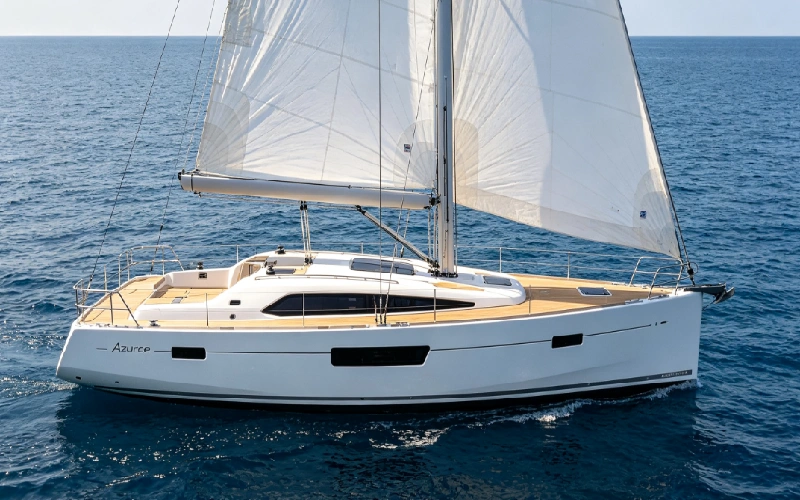
Azuree 41 vs Azuree 46: What Are the Differences in Speed and Sailing Performance?
Designed by Rob Humphreys, both the Azuree 41 and Azuree 46 fall into the category of performance cruising sailboats. However, they differ notably in hull dimensions, waterline design and handling characteristics. Their speed capabilities are tailored for different wind conditions and sailing scenarios. The performance distinctions between the two models are broken down below.
Azuree 41: Prioritizes Agility and Responsiveness
The Azuree 41 is designed by Rob Humphreys Yacht Design. Official materials define it as a high-performance Performance Cruising Yacht, highlighting its hull’s sensitivity in light winds and form stability as wind strength picks up.
From a yacht design perspective, the 41-foot model benefits from its manageable size. For crews of 2 to 4 people, it delivers direct sailing feedback without the extra equipment and handling workload associated with larger yachts.
Azuree 46: Greater Potential for High-Speed Cruising
The Azuree 46 is a more refined large performance cruising platform. According to Rob Humphreys, its design balances downwind high-speed sailing, upwind power and performance in light air.
Independent sea trials offer valuable supporting data. When Cruising World tested the Azuree 46 on Narragansett Bay with wind speeds below 10 knots, the boat still achieved roughly 7 knots SOG, with positive feedback on its handling and twin-rudder setup.
Trials by Sailing Today recorded speeds of around 8–9 knots downwind. Testers also noted the precise, effortless Jefa steering system. It is important to stress that these figures were recorded under specific test conditions and do not represent fixed speeds across all sailing environments.
Speed Is Not the Sole Criterion
If your sailing is mostly coastal trips and weekend cruising, the Azuree 41 delivers ample performance. For frequent crewed cruising or medium-to-long-distance passages, the Azuree 46’s size and performance platform hold clear advantages.
What Are the Advantages of Azuree’s Twin-Rudder Design? How to Evaluate Handling and Safety?
Twin rudders are a common configuration on modern performance cruising sailboats, yet many yacht buyers confuse the practical differences between twin-rudder and single-rudder setups. More than just an aesthetic feature, twin rudders directly impact control when sailing at significant heel angles, steering response, and safety redundancy for coastal and offshore voyages. Below we break down their practical value and evaluation criteria based on the characteristics of Azuree yachts.
Why Are Twin Rudders Suitable for Performance Cruising Sailboats?
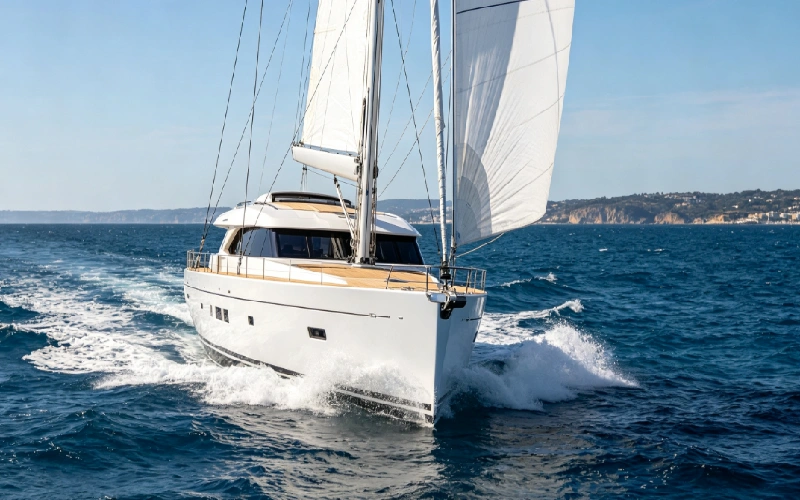
One core benefit of twin rudders is that when a sailboat sails with substantial heel, the leeward rudder remains effectively submerged. This enhances directional control during high-speed sailing. In the design documentation for the Azuree 46, Rob Humphreys explicitly outlined the series’ twin-rudder Open-style design approach, noting that the concept draws inspiration from projects such as the Open 60, Volvo 70 and Class 40. During its on-water testing, Cruising World also highlighted the sightlines from dual steering stations and the handling feel delivered by the Jefa steering system.
Twin Rudders Do Not Equal "Automatically Safer"
This is a critical point for buyers of performance sailboats. While twin rudders improve handling, offshore safety still hinges on hull structure, keel, rudder assembly, rigging, navigation gear and crew competency. The World Sailing 2026–2027 Offshore Special Regulations include structural integrity, keel and rudder inspections, stability, communications, GPS, radar, AIS and EPIRBs among safety requirements for offshore racing events.
How to Choose a Performance Cruising Sailboat? Should Family Cruising Prioritize Speed or Comfort?
This is a typical long-tail search query. In truth, there is no universal answer — the decision depends on the owner’s intended usage scenarios.
Coastal Cruising for 2–4 People: Prioritize Handling and Operating Costs
If your outings mainly consist of weekend trips for couples or small families, a 41-foot vessel generally delivers sufficient space while remaining manageable to handle. From my yacht research perspective, buyers in this group should focus on berth availability, sail handling, maintenance expenses and frequency of use, rather than blindly chasing more cabins.Family Cruising with Larger Crews: Space Becomes Far More Important
If you regularly sail with groups of 4–6 people, cockpit volume, cabins, heads and storage become key priorities. The Azuree 46 holds clear advantages in these areas. When covering the Azuree 46, Cruising World noted its spacious cockpit, convertible sun loungers, and 3-cabin, 2-head layout, which is distinctly engineered for family and group cruising.Medium and Long-Distance Voyages: Balance Speed and Comfort
When trips extend from a few hours to days or even weeks, comfort rapidly grows in importance. Galley facilities, refrigeration, freshwater supply, power systems, storage and autopilot may matter more than marginal gains in top speed. My recommendation is that if you plan long-distance cruising in the future, use a comprehensive evaluation framework covering “performance + load capacity + living systems”, instead of only comparing maximum sailing speeds.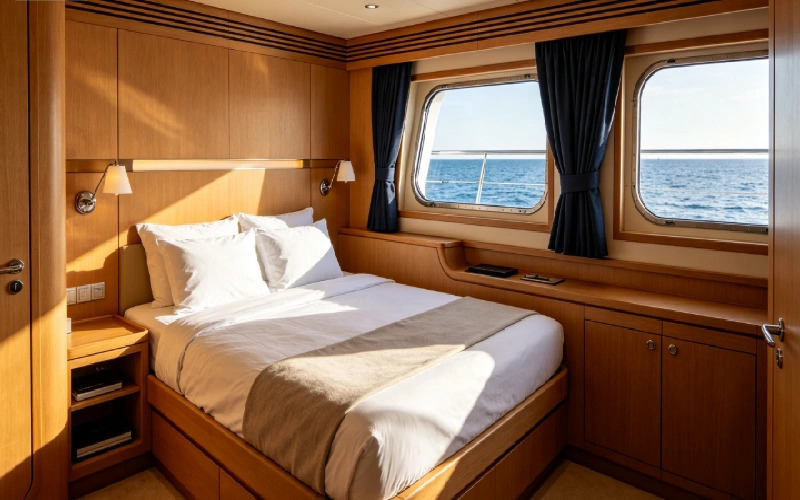
Performance Cruising Sailboat Purchase Decision: How to Determine Budget, Crew Size and Sailing Routes?
When selecting a performance cruising sailboat, you should not only focus on vessel specifications. Budget cap, regular crew size and primary sailing waters are three core prerequisites that determine boat size, subsequent operating costs and actual on-water experience. The judging logic is broken down below.
When to Choose a 41-Foot Vessel?
A 41-foot boat is generally sufficient if your main use is coastal cruising for 2–4 people, weekend sails and occasional medium-distance passages. Its smaller size also makes berthing, maintenance and sail handling relatively manageable on a daily basis.When Is It Worth Upgrading to a 46-Foot Vessel?
Upgrading to a 46-foot yacht brings significant extra value if you need more cabins, a larger cockpit and greater load capacity, and plan group cruising or medium-to-long-distance voyages.New vs Used Sailboats: What to Assess?
For pre-owned performance cruising sailboats, the listed price alone is far from enough. You need to inspect the hull, keel, rudder assembly, mast, rigging, sails, engine, electrical systems and navigation equipment, as well as verify service and refit records.Drawing on my yacht research and content analysis experience, the true total cost of owning a performance cruising yacht extends well beyond the purchase price. It also covers berthing fees, insurance, maintenance, sails, engine upkeep, electrical systems and offshore gear. Therefore, your budget should be calculated based on the total cost of ownership.
Key Configurations to Inspect Before Buying a Performance Cruising Sailboat
Hull, Keel and Rudder Assembly
Mast, Rigging and Sails
Inspect the mast, cables, blocks, sails and deck hardware. It is especially important to confirm the age of the rigging and its historical maintenance records.Engine and Electrical Systems
Check the engine model, running hours, service history, cooling system, exhaust system, batteries, power generation equipment and wiring condition.Navigation and Offshore Safety Equipment
If offshore sailing is planned, further inspect the autopilot, AIS, VHF radio, radar, GPS, EPIRB, life raft and fire-fighting equipment. The World Sailing 2026–2027 OSR also identifies structure, stability, navigation & communication gear and EPIRBs as vital parts of the offshore safety framework.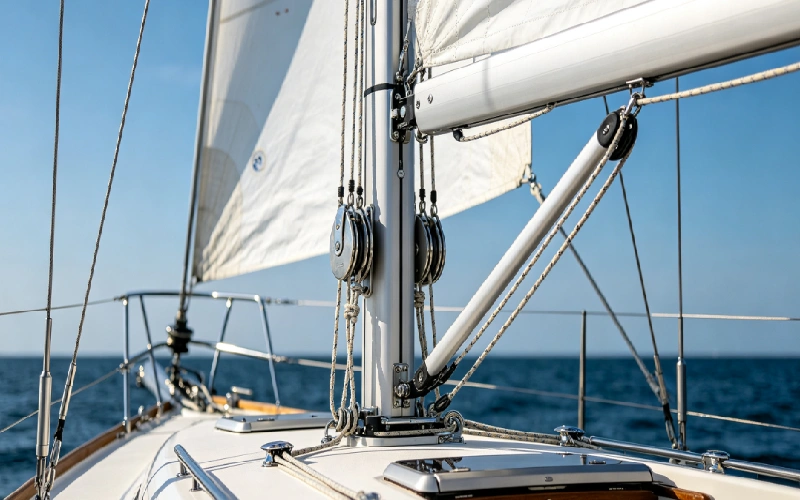
How to choose an Azuree performance cruising sailboat?
You may use the table below to quickly sort out core evaluation criteria and narrow down suitable yacht options based on your own needs:
| Judgement Dimension | Key Questions to Prioritize | Recommended Choice |
| Sailing Performance | Do you often pursue the fun of sailing? | Azuree |
| Handling | Do you need a vessel that is easy to manage? | 41ft |
| Family Space | Do you regularly sail with 4–6 people? | 46ft |
| Long-distance Voyage | Do you plan multi-day or offshore passages? | 46ft |
| Usage Frequency | Will it mainly be used for weekend sailing? | 41ft |
| Onboard Living Needs | Do you intend to live aboard long-term? | 46ft or larger |
| Space Priority | Is interior volume your top consideration? | Catamarans such as Lagoon |
| Established Cruising Lineup | Do you value brand heritage and complete product ranges? | Beneteau / Jeanneau |
From my perspective of yacht research, the final selection can be boiled down to four questions: who will sail it, how many people will use it, where it will go, and how much carrying cost one is willing to bear. Once these four answers are determined, the choice of performance cruising sailboats often becomes much clearer.
Conclusion
Choosing a performance cruising sailboat is essentially not a binary trade-off between "speed" and "comfort", but about finding your ideal balance among speed, handling, space and cruising capability. This balance lies at the core of Azuree’s design philosophy. Rob Humphreys’ design documentation for the Azuree 41 and 46 also reflects the vision of prioritizing both performance sailing and onboard cruising life.
For mainly coastal and weekend cruising, manageable performance cruising sailboats such as the Azuree 41 are well worth considering. If you regularly sail with more people, require greater living space and a more capable long-distance cruising platform, the Azuree 46 will be more appealing.👉 Compare Azuree with peer performance cruising sailboats and get professional yacht selection advice.
Disclaimer
This content is for reference only in yacht selection and vessel research and does not constitute investment or purchasing advice. Information herein is based on publicly available data up to 2026. Actual configurations and vessel conditions may vary. Please refer to the manufacturer’s documentation and ship certificates for definitive details. It is recommended to engage an independent marine surveyor for inspection and sea trials prior to purchase. Regulations, costs and market information are subject to change; always follow the latest official requirements.About the Author
Andrew Rogers is a content writer specializing in yacht and sailboat market research. His focus includes vessel design, sailing performance, interior layout and offshore cruising capability. Drawing on public records, professional sea trials and industry insights, he provides objective vessel analysis and yacht-buying guidance for readers.FAQ
Q1: What is a Performance Cruising Sailboat?
A: A performance cruising sailboat is a boat design that strikes a balance between sailing speed, handling performance, and onboard comfort. It is ideal for enjoying the thrill of sailing while also meeting the needs of family cruising and multi-day voyages.
Q2: Is the Azuree a good choice for beginners?
A: The Azuree is better suited for sailors who already have some sailing experience and wish to further explore performance sailing. Beginners are advised to undergo professional training and take a test sail before purchasing.
Q3: How should I choose between the Azuree 41 and the Azuree 46?
A: The Azuree 41 is better suited for small families, inshore sailing, and flexible sailing needs, while the Azuree 46 is better suited for cruising with a larger group, medium- to long-distance voyages, and users who require more living space.
Q4: Are performance cruising sailboats suitable for ocean voyages?
A: Some performance cruising sailboats have the potential for ocean voyages, but their actual capability must be assessed comprehensively based on the hull structure, keel and rudder systems, rigging, navigation equipment, safety gear, and the crew’s experience.
Q5: What should you focus on most when purchasing a performance cruiser?
A: Beyond speed and appearance, you should pay closer attention to the hull structure, rudder system, rigging, engine, electrical system, and navigation equipment, and confirm the boat’s actual condition through an independent survey.