For many owner-operated ocean passages, yachts between 45 and 55 feet offer a practical balance of seaworthiness, accommodation, storage capacity and operating costs. However, the right size still depends on crew experience, yacht type, route and onboard systems.This size offers a good balance between safety, comfort, storage capacity and running costs.
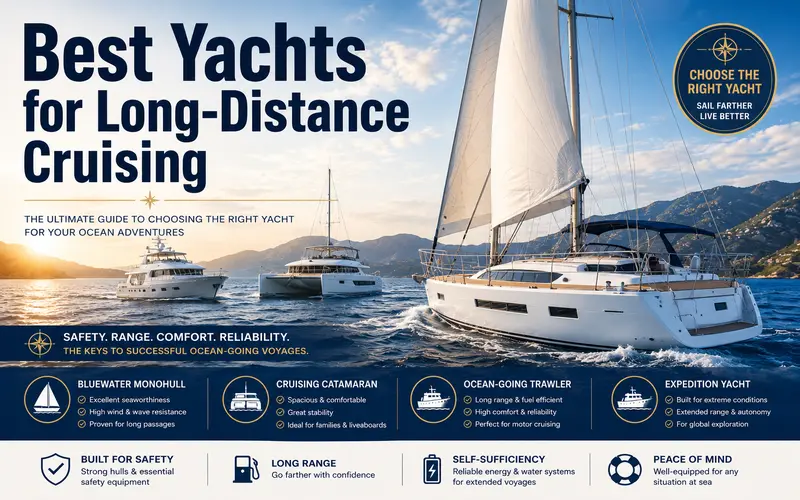
In terms of boat types, blue-water monohull sailboats, cruising catamarans, blue-water trawler yachts and expedition yachts are currently the most popular choices for blue-water cruising. Among these, monohull sailboats place greater emphasis on seaworthiness, catamarans offer more living space, whilst trawler yachts and expedition yachts are better suited to those who prefer motorised cruising.
Regardless of the type chosen, a robust hull structure, ample range, a reliable energy system and comprehensive safety equipment are essential requirements for any ocean-going yacht.
The Most Suitable Yacht Types for Ocean Voyages
There is no single ‘correct’ choice of yacht type for ocean voyages. Different types of yachts each have their own advantages in terms of sailing performance, comfort, range and maintenance costs. For owners planning transoceanic voyages, long-term life aboard, or round-the-world trips, understanding the characteristics of various hull types can help you find the right ocean-going vessel for your needs more quickly.
| Yacht Type | Main Advantages | Main Disadvantages | Suitable for |
| Bluewater Monohull | Proven offshore handling and positive stability on many designs, excellent self-righting ability, long history of ocean voyages | Limited interior space, noticeable rolling | Traditional ocean-going sailors, round-the-world sailing enthusiasts |
| Cruising Catamaran | Spacious, good stability, shallow draught | Higher mooring costs, offshore performance varies significantly by design, loading and construction; some catamarans require more careful heavy-weather management. | Families, long-term live-aboard owners |
| Trawler Yacht | High comfort, long range, fuel-efficient | Relatively slow speed, reliant on fuel | Retired boat owners, long-term cruisers |
| Expedition Yacht | Extremely long range, robust construction, suited to harsh sea conditions | Expensive, high running costs | High-end users, global expedition sailors |
Bluewater Monohull
Bluewater monohulls are among the most classic ocean-going designs and the first choice for many round-the-world sailors. These yachts typically prioritise structural strength, stability, reliable steering, secure deck hardware and practical systems for extended offshore passage, offering excellent self-righting ability and resistance to wind and waves, ensuring a high level of safety even in challenging sea conditions.
For those planning to cross the Atlantic or Pacific, or undertake a round-the-world voyage, a tried-and-tested monohull remains the most reliable choice.
Cruising Catamaran
Cruising catamarans have become one of the fastest-growing categories in the offshore market in recent years. Compared to monohulls of the same size, catamarans offer more living space, greater stability and a more comfortable living experience on board. For families or those living on board long-term, catamarans often significantly enhance the quality of life during extended voyages, making them particularly popular in popular cruising regions such as the Caribbean and the South Pacific.
Prospective buyers of catamarans should not only consider space and layout but also focus on assessing the hull structure, load-carrying capacity, energy systems and long-term maintenance costs. In fact, when researching ‘what should you look for before buying a catamaran yacht?’, many buyers often find that ocean-going capability and long-term living comfort are more important than luxury fittings.
Ocean-going Trawler Yacht
A trawler yacht is a type of yacht specifically designed for long-distance motor cruising. It is characterised by a displacement hull, which enables an exceptionally long range whilst maintaining low fuel consumption. Many ocean-going trawler yachts can travel 1,500 to 3,000 nautical miles or more on a single tank of fuel, making them ideal for owners who prefer not to rely on wind power. Their spacious interiors and almost home-like layouts are also key reasons for their popularity.
Expedition Yacht
Expedition yachts represent the high-end option amongst ocean-going motor yachts, typically featuring a more robust hull structure, larger fuel reserves and a longer range. Many models are capable of comfortably circumnavigating the globe and are suited to high-latitude waters and even polar expedition environments. Although the purchase price and running costs are higher, for owners seeking the ultimate in long-distance cruising capability, expedition yachts are often the ultimate goal.
What size yacht should you choose for ocean-going voyages?
Yacht size is one of the key concerns for many buyers. However, there is no such thing as a ‘best size’ for ocean-going voyages, as different sizes correspond to different cruising requirements and budget levels.
For experienced solo sailors, a yacht measuring between 35 and 45 feet is sufficient to complete a round-the-world voyage. In fact, many famous round-the-world sailing records in history were set by vessels within this size range. A smaller size means lower maintenance costs, simpler equipment and easier handling, making it particularly attractive to owners on a limited budget.
For most families, 45 to 55 feet is generally considered the sweet spot for ocean cruising. This size offers separate bedrooms, a comfortable galley and ample storage space, without significantly increasing running costs due to an overly large hull. Many of the world’s best-selling ocean-going cruisers fall within this range.
Yachts exceeding 60 feet offer a significant boost in comfort. Larger fuel tanks, fresh water tanks and storage space support longer periods at sea. However, increased size also means a corresponding rise in purchase price, maintenance costs, mooring fees and insurance premiums. Many owners find, in practice, that an overly large yacht actually reduces the frequency of use, as each voyage requires a greater investment of time and effort.
Consequently, for the vast majority of owners planning long-term cruising, the 45 to 55-foot range remains the most worthwhile option to prioritise.
What sort of ocean-going yacht can you buy on different budgets?
The ocean-going yacht market covers an extremely wide range, from second-hand cruising yachts costing a few hundred thousand US dollars to expedition yachts worth tens of millions of US dollars. Therefore, before beginning the selection process, defining your budget is often more important than researching brands.
Before finalising their budget, many buyers also research ‘where to buy a boat’, as there are often significant differences in the number of boats available, prices and after-sales service across different regions and sales channels.
The following ranges are broad market-planning estimates rather than guarantees. Actual purchase prices and cruising ranges vary significantly by model, age, engine configuration, condition, location and required refit work.
Budget of US$200,000 to US$500,000
This budget range is dominated by the second-hand yacht market and serves as the entry point for many first-time blue-water sailors. Buyers can typically find blue-water monohull sailboats aged between 10 and 20 years, or some older cruising catamarans. Although these vessels are older, many classic blue-water models still possess excellent structural integrity and seagoing capabilities.
Within this budget range, owners usually need to set aside additional funds for upgrades and refurbishments, such as replacing navigation equipment, updating energy systems and improving safety features. For buyers willing to invest time in maintaining and upgrading their yacht, this budget still makes the dream of transoceanic sailing a reality.
Budget of US$500,000 to US$1 million
This budget places buyers firmly within the mainstream market for modern ocean-going cruising yachts. Buyers can not only choose from newer blue-water monohull sailboats, but also have access to a range of medium-sized cruising catamarans and long-range motor cruisers.
Yachts in this price range typically feature more comprehensive living facilities, more advanced navigation equipment and more efficient energy management systems. For most family owners, this budget strikes a good balance between performance, comfort and long-term maintenance costs, and it is also one of the most active price ranges in the current global blue-water cruising market.
Budget of US$1 million to US$3 million
Once the budget exceeds US$1 million, the range of available yacht types and configurations expands significantly. Many high-end ocean-going catamarans, luxury blue-water cruisers and certain expedition-class motor yachts come into consideration.
Yachts in this category are typically equipped with large-scale solar power systems, lithium-ion battery storage systems, seawater desalination units and high-specification navigation and communication systems, enabling a truly long-term offshore lifestyle. At the same time, the interior finishes and living comfort approach those of high-end residential properties, making them ideal for owners planning round-the-world voyages or long-term life aboard.
Budget of US$3 million or more
This budget range enters the realm of super ocean-going yachts and expedition yachts. Buyers may find selected long-range motor yachts designed for multi-thousand-nautical-mile passages, although verified range must be assessed for each model and operating speed.
Many high-end expedition yachts can effortlessly undertake round-the-world voyages, high-latitude expeditions and even polar cruises. Although their purchase and operating costs are extremely high, for owners seeking ultimate freedom and global cruising capability, these yachts offer virtually limitless sailing possibilities.
New and Used Ocean-Going Cruisers to Consider in 2026
Different boat types suit different sailing plans and lifestyles. Below are several blue-water cruising yachts to watch out for in 2026, each representing an excellent choice within their respective categories on the current market.
| Yacht Model | Type | Length | Suitable For |
| Bavaria C42 | Blue-water monohull | 42 feet | First-time blue-water cruisers, couples |
| Beneteau Oceanis 48 | Blue-water monohull | 48 feet | Families undertaking long-term cruising |
| Outremer 52 | Cruising catamaran | 52 feet | Owners prioritising speed and comfort |
| Lagoon 51 | Cruising catamaran | 51 feet | Families living aboard |
| Nordhavn 51 | Ocean-going motor yacht | 51 feet | Those who prefer motorised cruising |
| Selene 60 Ocean Explorer | Exploration yacht | 60 feet | Long-distance explorers |
Blue-water monohull sailboat recommendations: Bavaria C42 and Beneteau Oceanis 48
For owners wishing to enter the world of ocean cruising on a reasonable budget, the Bavaria C42 is a modern cruising sailboat well worth considering. Featuring a wide-stern design, this yacht maximises interior space whilst maintaining excellent sailing performance. At 42 feet, it is relatively easy to handle, making it ideal for couples or small families undertaking long-distance cruising.
👉 See Bavaria C42

Bavaria C42
- Length42.30 ft
- Cabins3
- TypeMonohull sailboat
The BAVARIA C42 is a logical advancement in the BAVARIA C series, yet it has its own unique characteristics. The modern and innovative hull shape and V-shaped bow developed by BAVARIA YACHTS ensure the best sailing performance and an unusually large space below deck. BAVARIA YACHTS is renowned for its ingenious details both above and below deck, and these have been further refined in the BAVARIA C
The Beneteau Oceanis 48 is a well-established used-market cruising yacht rather than a current-generation new model. As a classic model in the Oceanis range, this yacht boasts spacious interiors, ample storage capacity and a tried-and-tested, reliable cruising design. For families planning transoceanic voyages or long-term life aboard, the 48-foot size strikes a good balance between comfort and running costs.
👉 Browse the Beneteau Oceanis 48 yacht
Beneteau Oceanis 48
- Length47.10 ft
- TypeMonohull sailboat
The Oceanis 48 showcases near-perfect hull proportions with its charming, graceful silhouette and a deck layout meticulously designed for long voyages. Its interior spatial arrangement not only significantly enhances the sense of space but also flawlessly integrates ergonomic design concepts, making it stand out among numerous sailboats. This sailboat inspires you to embark on brave long-distance nautical adventures, to deeply experience the leisurely life at sea and every thrilling moment of mooring along the way.
Recommended cruising catamarans: Outremer 52 and Lagoon 51
For owners seeking space and comfort, cruising catamarans have become the most popular choice for ocean-going voyages in recent years. The Outremer 52 is renowned for its excellent sailing performance; compared to many catamarans that prioritise living space, it offers faster cruising speeds and superior ocean-going capabilities, making it a favourite amongst experienced sailors.
If living space is a top priority, the Lagoon 51 is one of the most sought-after models on the market. Its spacious saloon, large flybridge and multiple private cabins make it an ideal platform for long-term living on board and family cruising. For families sailing with children or planning to live on board long-term, the Lagoon series has consistently enjoyed high popularity and a strong resale value.
👉 View Lagoon 51 for sale
Lagoon 51
- Length50.40 ft
- TypeSailboat
The flybridge of Lagoon 51 is truly innovative, featuring modular spaces, clever and ergonomically designed layouts, as well as spacious and comfortable living areas.
Recommended Ocean-going Motor Yachts: Nordhavn 51
Nordhavn has a long-established reputation for ocean passagemaking, while the Nordhavn 51 is a newer model designed to bring that long-range philosophy into a more manageable owner-operated platform.
Recommended Expedition Yacht: Selene 60 Ocean Explorer
If your goal is not merely transoceanic cruising, but exploring remote waters or even high-latitude regions, then an expedition yacht would be a more suitable choice.
The Serena 60 Ocean Explorer boasts a robust hull structure, ample fuel reserves, and exceptional long-range capabilities. With proper design, equipment, certification, and operation, an expedition yacht that meets its intended conditions may also be suitable for high-latitude or polar routes.
In addition to its outstanding ocean-going performance, the yacht offers spacious and comfortable living quarters and a comprehensive range of onboard systems. Although the purchase and running costs are relatively high, its safety and ability to sail independently offer clear advantages for owners wishing to undertake global exploration cruises.
The 8 Most Important Features of an Ocean-Going Yacht
Whether a sailing yacht or a motor yacht, it is not the luxurious fittings that truly determine ocean-going capability, but rather safety, endurance and the ability to sustain long-term life at sea. A yacht suitable for ocean voyages typically needs to possess the following eight core features.
| Feature | Importance | Function |
| Robust hull structure | ★★★★★ | Enhances safety and enables the yacht to cope with rough sea conditions |
| Large-capacity fuel system | ★★★★★ | Increases range and reduces the frequency of refuelling |
| Large-capacity fresh water system | ★★★★★ | Supports long-term life at sea |
| Self-sufficient energy system | ★★★★★ | Meets electrical requirements for both navigation and daily living |
| Navigation and communication equipment | ★★★★★ | Enhances navigational safety and positioning capabilities |
| Safety and emergency equipment | ★★★★★ | Deals with unexpected situations at sea |
| Ample storage space | ★★★★☆ | Stores provisions and spare supplies |
| Low-maintenance mechanical systems | ★★★★☆ | Reduces the risk of breakdowns and the complexity of repairs |
Robust Hull Structure
The hull structure is the most crucial foundation of an ocean-going yacht.
Compared to inshore cruising, blue-water sailing involves prolonged exposure to heavy seas, strong winds and complex sea conditions; therefore, the hull must possess sufficient strength and reliability.
A high-quality fibreglass structure, reinforced keel and robust bulkhead design can effectively enhance the yacht’s safety and durability, and are also key criteria for assessing whether a yacht is capable of blue-water sailing.
High-Capacity Fuel and Fresh Water Systems
Ocean-going voyages mean that resupply may not be available for days or even weeks, so ample fuel and fresh water reserves are crucial. For motor yachts, fuel capacity directly affects cruising range; for sailing yachts, fuel is essential for power generation and auxiliary propulsion. At the same time, sufficient fresh water reserves ensure the crew’s daily needs are met, enhancing comfort and independence during long-term cruising.
Self-Sufficient Energy Systems
Modern ocean-going yachts rely increasingly on electrical systems, making a stable energy supply vital. A combination of solar panels, lithium-ion battery banks, wind turbines and generators has become standard equipment on many ocean-going cruisers. A well-designed energy system not only supports lighting and domestic appliances but also ensures the continuous operation of navigation, communication and safety equipment.
Navigation and Communication Equipment
Reliable navigation and communication equipment is vital for safety during ocean voyages. GPS navigators, the Automatic Identification System (AIS), radar and electronic charts help the crew monitor their surroundings, whilst satellite communication equipment maintains contact with the outside world when far from shore-based networks. With technological advancements, these devices have become an indispensable part of modern ocean-going yachts.
Safety and Emergency Equipment
Even experienced crew members cannot entirely avoid unexpected incidents at sea. Therefore, ocean-going yachts must be equipped with comprehensive emergency equipment, including liferafts, EPIRBs (Emergency Position-Indicating Radio Beacons), fire-fighting systems and first-aid kits. Although this equipment is rarely used in normal circumstances, it can often ensure the safety of the crew—and even save lives—at critical moments.
Ample Storage Space
Long-term cruising requires carrying large quantities of food, drinking water, repair tools, spare parts and personal toiletries; consequently, storage space is far more important than many novice owners realise. Well-designed storage areas not only maximise space utilisation but also help keep the cabin tidy and organised, thereby enhancing the long-term living experience on board.
Easy-to-Maintain Mechanical Systems
During ocean voyages, access to professional maintenance services is often limited; therefore, the reliability of equipment and ease of maintenance are of paramount importance. Mature and stable engines, generators and electrical systems are generally preferred by offshore yacht owners over complex new technologies that are difficult to repair. Simple, reliable designs reduce the likelihood of breakdowns and lower long-term maintenance costs.
Comfortable living spaces
Offshore cruising is not merely a journey; it is a long-term way of life. A sensible cabin layout, comfortable bedrooms, a practical galley and good ventilation can all significantly enhance the crew’s quality of life. For those planning to live on board long-term or undertake a round-the-world voyage, comfort is equally an important criterion when assessing an ocean-going yacht.
The Most Common Mistakes Made When Purchasing an Ocean-Going Yacht
When purchasing an ocean-going yacht, one must consider not only budget and brand but, more importantly, actual sailing requirements. Many novice owners tend to overlook key factors during the selection process, which ultimately affects the user experience and may even increase costs down the line. The following are some of the most common mistakes.
Focusing Solely on Brand and Luxury Features
Many buyers are drawn to well-known brands or luxurious interiors, but ocean-going capability does not depend entirely on these factors. Compared to interior design and entertainment facilities, the hull structure, range, safety features and mechanical reliability are far more important considerations for ocean voyages. A well-designed ocean-going cruiser is often better suited to long-distance sailing than a coastal yacht with a luxurious exterior.
Assuming that bigger is always better
Larger yachts usually offer more spacious interiors and greater cargo capacity, but this also translates to higher purchase costs, maintenance expenses and greater difficulty in handling. For most family users, a yacht between 45 and 55 feet is more than sufficient for offshore cruising. Choosing a size that suits your sailing plans and crew size is often more important than simply pursuing a larger vessel.
Underestimating Long-Term Costs
In addition to the purchase price, offshore yachts involve ongoing expenses such as upgrades and refits, insurance, mooring fees, fuel and maintenance. Many owners only realise after purchasing a yacht that the actual costs far exceed their expectations. Therefore, when drawing up a budget, it is advisable to set aside sufficient funds for operation and maintenance to avoid disrupting future usage plans. Before finalising a purchase, using a professional yacht cost calculator to estimate the holding costs over the coming years can usually help buyers draw up a more reasonable long-term budget plan.
Neglecting Professional Surveys and Sea Trials
Whether purchasing a new or second-hand yacht, professional surveys and sea trials are essential steps. A survey can identify potential structural or equipment issues, whilst a sea trial verifies the yacht’s performance under actual sailing conditions. Investing in these costs upfront can often prevent higher repair costs and operational risks in the future.
Summary
There is no single standard for the ‘best’ yacht for ocean-going voyages; the key lies in selecting a model that suits your sailing plans, budget and lifestyle. For most owners, a yacht between 45 and 55 feet is generally the ideal size for ocean cruising, striking a good balance between safety, comfort and operating costs.
When purchasing a yacht, it is advisable to choose the size and configuration rationally based on your actual needs, whilst giving full consideration to future maintenance and operating costs. Only by finding a yacht that truly suits you can offshore cruising become safer, more comfortable and more enjoyable.
About the Editorial Review
This guide was prepared by the YachtTrading editorial team and reviewed against publicly available brokerage listings, yacht valuation references, brand model information and common ownership-cost benchmarks. Because yacht prices vary by condition, location, engine hours, specification and market demand, all price ranges should be treated as general guidance rather than fixed offers.
Disclaimer
The content herein is for informational purposes only and is intended to share the author's personal experiences and perspectives. It does not constitute legal, tax, or investment advice. Yacht transactions involve complex legal, financial, and technical matters. Actual purchasing processes may vary due to regional regulations, vessel type differences, or individual circumstances.
Before making any yacht purchase decisions, readers are advised to consult licensed professionals (such as attorneys, tax advisors, licensed yacht brokers, or surveyors) for personalized guidance tailored to their specific situation. Neither the author nor the publisher shall be liable for any direct or indirect losses arising from reliance on the information provided herein.
FAQ
Q1: What is the minimum size of a yacht required for ocean-going voyages?
A: In theory, a yacht of 30 feet or more is capable of undertaking transoceanic voyages; however, in terms of safety, comfort and provisioning capacity, a vessel of between 40 and 50 feet is generally better suited to long-term ocean cruising. For families, a yacht of between 45 and 55 feet is often the ideal choice.
Q2: Are catamarans suitable for round-the-world voyages?
A: Yes, they are. Modern cruising catamarans have become an integral part of the round-the-world sailing market. Many families and long-term live-aboard sailors choose catamarans for round-the-world voyages, primarily due to their greater space, improved stability and shallower draught. However, in extreme sea conditions, there are still differences in performance between catamarans and monohulls, so the choice should be based on the planned route.
Q3: What range is required for an ocean-going yacht?
A: For motor yachts, a range of at least 1,000 nautical miles is generally recommended. If you plan to undertake transoceanic voyages, a range of 1,500 to 3,000 nautical miles would be more ideal. As for sailing yachts, although they rely primarily on wind power, they still require sufficient fuel reserves to support the engine, generator and emergency operations.
Q4: What are the annual maintenance costs for an ocean-going yacht?
A: It is generally accepted within the industry that the annual running costs for an ocean-going yacht amount to approximately 8% to 15% of the vessel’s purchase price. Specific costs are influenced by factors such as the yacht’s size, age, mooring location and frequency of use. Generally speaking, the larger the yacht and the more complex its specifications, the higher the maintenance costs will be.
Q5: Is it worth buying a second-hand ocean-going yacht?
A: For buyers on a limited budget, second-hand yachts often offer excellent value for money. Many classic ocean-going cruisers, when properly maintained, are still capable of safely completing transoceanic voyages. However, a professional survey and sea trial must be carried out before purchase, and a budget should be set aside for equipment upgrades and system maintenance.