Quick Answer
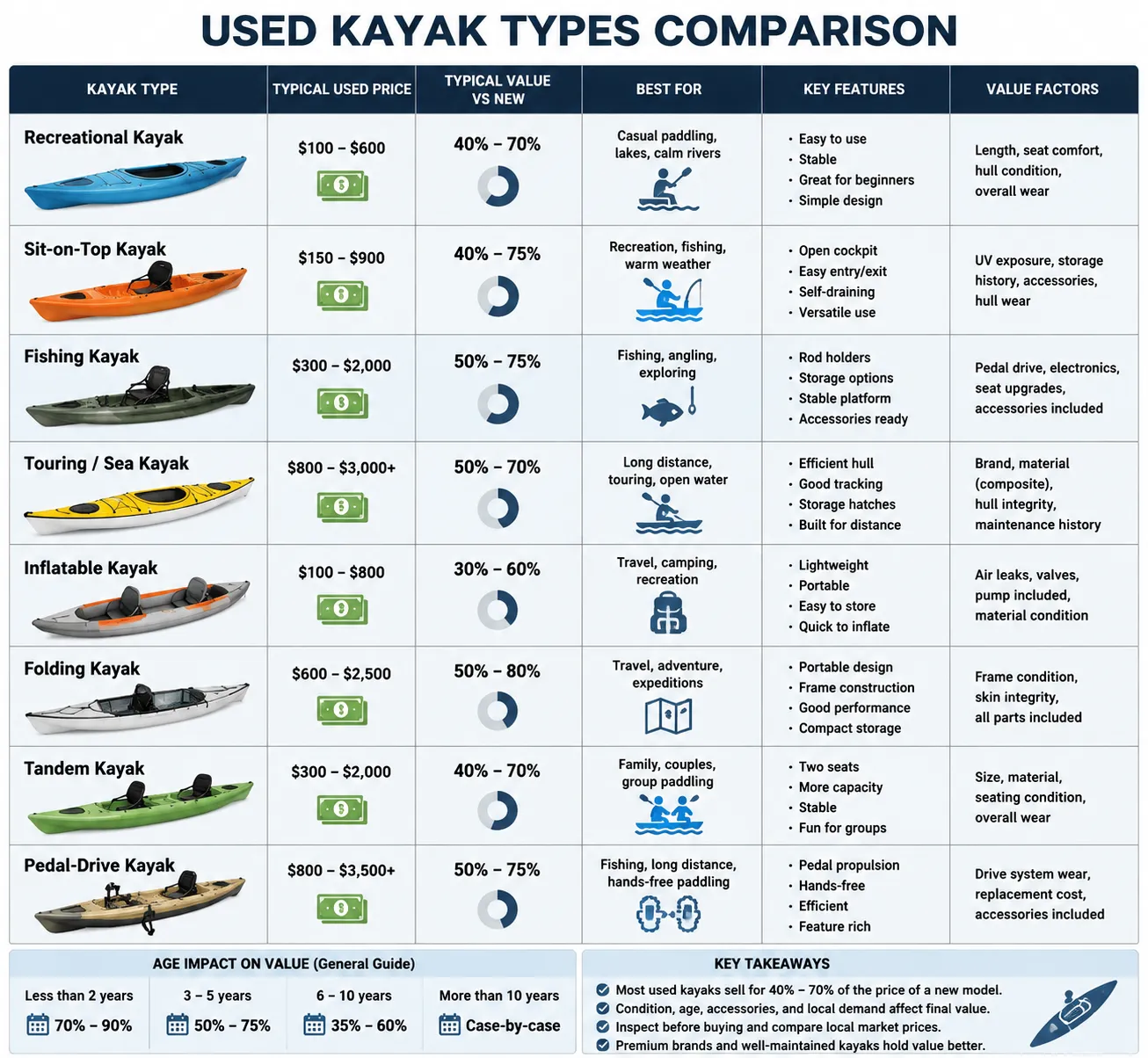
Most used recreational kayaks sell for approximately 40%–70% of the current price of a comparable new model. Basic used kayaks may cost around $100–$600, while premium touring, fishing, pedal-drive and composite kayaks can sell for $800–$3,000 or more. The final value depends on the model, age, hull material, condition, accessories and local demand.
Used Kayak Price Overview (Quick Reference Table)
| Used Kayak Type | Typical Used Price | Typical Value vs New | Main Value Factors |
|---|---|---|---|
| Recreational kayak | $100–$600 | 40%–70% | Length, seat, hull condition |
| Sit-on-top kayak | $150–$900 | 40%–75% | UV exposure, storage history, accessories |
| Fishing kayak | $300–$2,000 | 50%–75% | Pedal drive, electronics, seat upgrades |
| Touring / sea kayak | $800–$3,000+ | 50%–70% | Brand, material, hull integrity |
| Inflatable kayak | $100–$800 | 30%–60% | Air leaks, valves, pump included |
| Folding kayak | $600–$2,500 | 50%–80% | Frame condition, skin integrity |
| Tandem kayak | $300–$2,000 | 40%–70% | Size, material, seating condition |
| Pedal-drive kayak | $800–$3,500 | 50%–75% | Drive system wear, replacement cost |
Pricing Methodology: Prices in this guide are editorial estimates based on comparable new retail prices and a review of recent used listings. Asking prices may be higher than final selling prices, and local availability can significantly affect value.

How Much Do Different Types of Used Kayaks Cost?
The price of a used kayak varies largely depending on the type and age of the original boat. Generally speaking it is reasonable to be able to get a deal for 40-60% of the original purchase price. Of course, the depreciation curve for different types of kayaks varies.
Used Pedal-Drive Kayaks: $800–$3,500
Used pedal-drive kayaks are premium models powered by foot-operated propulsion systems. They are commonly used for fishing and long-distance paddling, and tend to retain strong resale value.
Used prices typically range from $800 to $3,500+, depending on brand, drive condition, and included accessories. Well-maintained models usually sell for 50%–75% of their original price.
Key value factors include the condition of the pedal-drive system, hull wear, and whether accessories such as seats or fish-finder mounts are included.
Used Inflatable Kayaks: $100 – $800
Inflatable kayaks are more sensitive to wear and tear. Pricing depends on air-tightness, valve condition, and whether the original pump and repair kit are included.
Entry-level inflatables depreciate quickly, while premium expedition-grade inflatables maintain better resale value.
Used Folding Kayaks: $600 – $2,500
Folding kayaks remain relatively high in value due to their portability and engineering complexity.
The key pricing factor is the condition of the frame system and skin material. Brands with modular designs often retain stronger resale demand.
Used Sit-on-Top Kayaks: $150–$900
Sit-on-top kayaks are among the most popular used options due to their stability, ease of use, and versatility for recreational paddling and light fishing.
Basic used models typically sell for $150–$400, mid-range kayaks range from $400–$700, and higher-end fishing or offshore sit-on-top kayaks can reach $800–$900+ depending on condition and accessories.
Key factors affecting value include hull wear (especially UV exposure), seat comfort, storage condition, and included accessories such as paddles or rod holders.
Used Recreational Kayaks: $100 – $600
Recreational kayaks are the most common entry-level option. Basic polyethylene models can be found at the lower end of the range, while well-known brands in good condition often sell closer to $400–$600.
These kayaks are popular due to their simplicity, but they also depreciate faster because of heavy usage and sun exposure.
Used Touring / Sea Kayak: $800–$3,000+
Touring and sea kayaks are built for distance and performance, which helps them retain value longer than recreational models.
Composite materials (fiberglass, carbon fiber) and premium brands generally hold the highest resale prices, especially if hull integrity is well preserved.
Used Fishing Kayaks: $300-$2,000
Fishing kayaks have one of the widest price ranges in the used market. Entry-level models are relatively affordable, but pedal-drive systems and electronics significantly increase resale value.
High-end fishing kayaks with stable hull designs and full rigging systems can still command strong prices even after years of use.
Used Tandem Kayaks: $300-$2,000
Tandem kayaks vary significantly based on material and seating configuration. Lightweight inflatable models are cheaper, while composite or performance tandems retain higher value.
Condition of seats and balance stability plays a major role in pricing.
How Age Affects Used Kayak Value?
While condition is usually more important than age alone, the age of a kayak often reflects cumulative UV exposure, hull wear, outdated outfitting and overall depreciation. As a general guide, buyers can use the following ranges as a starting point when estimating resale value. Actual prices vary depending on brand, material, maintenance history and local market demand.
| Kayak Age | Typical Resale Value | What Buyers Should Check |
|---|---|---|
| Less than 2 years | Approximately 70%–90% of current new retail price | Remaining warranty (if transferable), cosmetic scratches, storage history |
| 3–5 years | Approximately 50%–75% | Hull deformation, seat wear, hatch seals, fittings and accessories |
| 6–10 years | Approximately 35%–60% | UV fading, hull integrity, deck rigging, replacement parts availability |
| More than 10 years | Case-by-case evaluation | Material fatigue, cracks, discontinued components, overall maintenance history |
These percentages are broad editorial estimates intended as a pricing reference rather than fixed depreciation rules. Actual resale values vary by kayak type, brand, construction material, condition and regional demand.
How to Estimate the Value of a Used Kayak?
If you're wondering "How much is my kayak worth?", a simple estimate is to compare it with a similar new model and adjust for age, condition, and included accessories.
Estimated Value = Comparable New Price × Age Factor × Condition Factor + Accessory Value
| Factor | Typical Range |
|---|---|
| Age Factor | 0.90 (under 2 years) • 0.70 (3–5 years) • 0.50 (6–10 years) • 0.30–0.45 (10+ years) |
| Condition Factor | 1.00 (Excellent) • 0.90 (Good) • 0.75 (Fair) • 0.50–0.65 (Poor) |
| Accessories | Add only their realistic resale value |
Illustrative examples
| Kayak | Estimated Value |
|---|---|
| Recreational kayak (new price $600) | ≈ $400–$450 |
| Fishing kayak (new price $1,800) | ≈ $1,300–$1,500 |
| Composite touring kayak (new price $3,800) | ≈ $2,000–$2,300 |
This is an illustrative method only. Actual resale value varies by brand, condition, local demand, and seasonal market trends.
What Should a Buyer Pay vs What Should a Seller List?
When looking at used kayaks, it is important to understand that the price buyers pay and the price sellers list are not the same. Listing prices are usually higher, while final selling prices are lower after negotiation.What Should a Buyer Pay?
If you are buying a used kayak, you should focus on the real market transaction price, not the asking price.- Check recent sold listings, not just active ads
- Expect to negotiate around 10%–25% off the asking price
- Deduct repair or replacement costs if needed
- Do not rely on original retail price as a reference
- Accessories should only be valued if they are actually useful
What Price Should a Seller List?
If you are selling a kayak, your listing price should leave room for negotiation.- Set a target selling price first
- List your kayak about 10%–20% higher than your target price
- Adjust price depending on condition and demand
- Well-maintained or popular models can be priced higher
- Local pickup markets often allow slightly higher listing prices
Why Buyer and Seller Prices Are Different
The difference exists because sellers and buyers evaluate value differently:- Sellers focus on original cost and upgrades
- Buyers focus on condition and repair risk
- Final price usually settles between both expectations
Which Kayak Brands Hold Their Value Best?
Kayak resale value is not only determined by brand popularity, but also by original retail price range, material construction, parts availability, model lifecycle, and local demand. Premium brands with stronger engineering, better accessories systems, or pedal-drive technology usually retain value significantly better than entry-level recreational brands.Below is a practical breakdown of major kayak brands in the used market:
Kayak Brand Value Retention Overview
| Brand | Typical New Price Range | Value Retention Level | Key Reasons Affecting Resale Value |
|---|---|---|---|
| Old Town | $800–$2,500 | High | Strong fishing lineup, widely available parts, durable hulls, pedal-drive models hold value best |
| Perception | $400–$1,200 | Medium | Very common entry-level brand, high supply lowers resale price, good demand in used market |
| Eddyline | $1,800–$3,500+ | High | Lightweight thermoformed construction, premium touring performance, strong long-term durability |
| Jackson Kayak | $1,000–$3,500+ | High (niche) | Strong fishing/whitewater focus, premium outfitting, pedal-drive and rigged models retain value better |
| Wilderness Systems | $900–$3,000 | High | Balanced touring performance, strong global reputation, good parts ecosystem and brand trust |
| Pelican | $250–$900 | Low–Medium | Entry-level mass-market brand, high supply and fast depreciation, best value only in near-new condition |
| Hobie | $1,500–$4,500+ | Very High | Premium pedal-drive system (MirageDrive), strong fishing demand, proprietary tech supports resale value |
Key Insight
Even within the same brand, resale value changes significantly depending on:- Material type: composite > thermoformed > polyethylene
- Drive system: pedal-drive models retain value better than paddle-only kayaks
- Model popularity: discontinued but popular models may hold stronger demand
- Parts availability: brands with active ecosystems maintain higher resale confidence
- Local demand: fishing vs touring demand varies by region
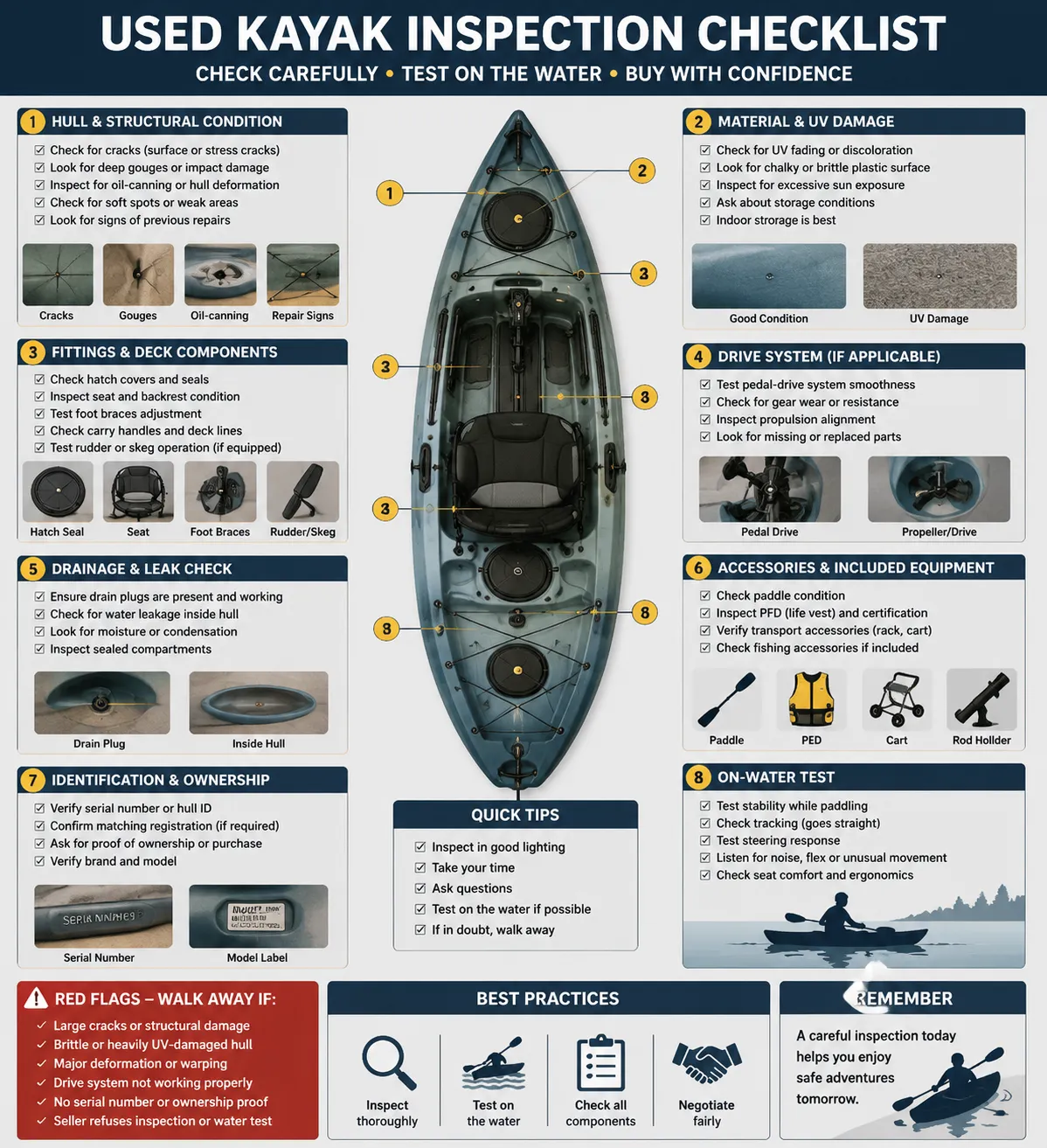
Used Kayak Inspection Checklist
When buying a used kayak, price is only half of the decision. The real risk lies in hidden damage that is not always visible in photos. A structured inspection helps you avoid costly repairs and unsafe boats.Below is a practical checklist used by experienced buyers and dealers when evaluating second-hand kayaks.
Hull & Structural Condition
- Hull cracks (surface or stress cracks)
- Deep gouges or impact damage
- Oil-canning (hull flex or deformation)
- Soft spots indicating structural weakness
- Signs of previous repairs or patching
Material & UV Damage
- UV fading or discoloration of hull
- Brittle or chalky plastic surface
- Excessive sun exposure history
- Storage conditions (indoor vs outdoor)
Fittings & Deck Components
- Hatch covers and seals (check for leaks or stiffness)
- Seat and backrest condition
- Foot braces adjustment function
- Carry handles and deck lines integrity
- Rudder or skeg operation (if equipped)
Drive System (if applicable)
- Pedal-drive system smoothness
- Gear wear or resistance issues
- Propulsion alignment
- Missing or replaced drive components
Drainage & Leak Check
- Drain plugs present and functional
- Water leakage signs inside hull
- Condensation or moisture buildup
- Sealed compartments integrity
Accessories & Included Equipment
- Paddle included and condition
- PFD (life vest) condition and certification
- Transport accessories (roof rack straps, carts)
- Rod holders or fishing mounts (if fishing kayak)
Identification & Ownership
- Serial number or hull ID visible
- Matching registration (if required locally)
- Proof of ownership or purchase history
- Brand/model verification
On-Water Test
- Stability during paddling
- Tracking performance (does it go straight?)
- Steering response (rudder/skeg function)
- Noise, flex, or unusual hull movement
- Comfort of seat and ergonomics during use
Where to Check Used Kayak Prices Near You?
If you're searching for used kayak for sale near me, the most accurate way to understand local pricing is to compare both online listings and real transaction data.Key places to check:
- Facebook Marketplace — Most common source for used kayaks by owner and local deals
- Craigslist — Good for Craigslist kayaks for sale and budget listings
- eBay — Check “Sold” listings to see real market prices
- Local paddling clubs — Members often sell well-kept used kayaks
- Kayak outfitters — Sometimes offer demo or rental fleet clearance deals
- Consignment stores — Pre-inspected used kayaks with more stable pricing
How Much Value Do Kayak Accessories Add?
Used kayak accessories can increase resale value, but they rarely retain full original price. In most cases, accessories add about 20%–60% of their original value, depending on condition, brand, and compatibility.Typical Value of Common Accessories
| Accessory | Typical Added Value |
|---|---|
| Pedal drive system | $300–$1,500+ |
| Trolling motor | $100–$600 |
| Fish finder | $50–$400 |
| Upgraded seat | $50–$250 |
| Paddle | $20–$100 |
| Roof rack | $50–$300 |
| Kayak cart | $30–$150 |
| Trailer | $300–$2,000+ |
| Rod holders | $10–$80 |
| Anchor system | $20–$150 |
Key Takeaway: Accessories usually add partial value, not full retail value. High-value items like pedal drives or trailers contribute the most, while basic items like paddles or rod holders add minimal resale impact.
When Is a Used Kayak Not Worth Buying?
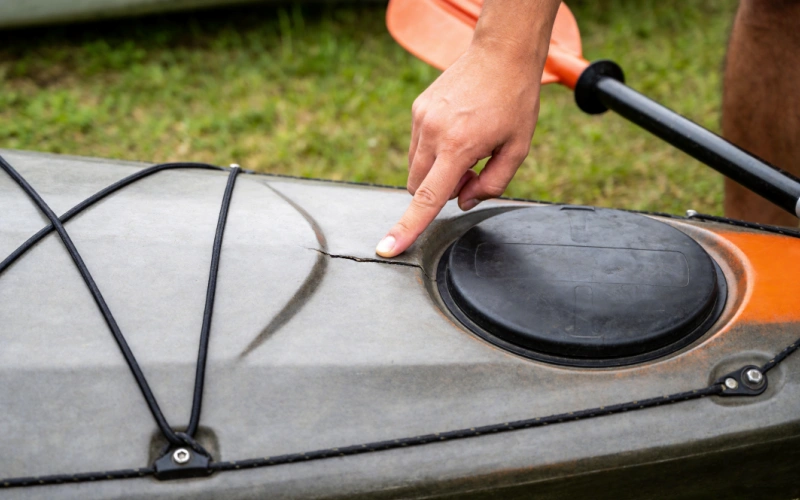
Not every used kayak is a good deal. In some cases, the repair cost, risk, or hidden damage can make a “cheap” kayak more expensive than buying new or nearly new. Here are situations where you should seriously reconsider the purchase.Price is too close to new kayak promotions
If the used price is only 10%–25% cheaper than a new model on sale, it is usually not worth the risk. New kayaks often come with warranty, updated design, and zero hidden damage.
Severe UV damage or brittle plastic
If the hull feels chalky, faded, or overly soft, the polyethylene has likely degraded from sun exposure. This can lead to cracking under pressure and is a long-term safety risk.
3. Noticeable hull deformation (oil-canning or warping)
A badly deformed hull affects tracking, stability, and speed. Minor oil-canning can be normal, but permanent structural warping is a red flag.
4. Expensive or risky pedal-drive repairs
For pedal-drive kayaks, transmission issues or missing components can cost hundreds or even thousands to repair. If the system is not smooth during testing, walk away.
5. Discontinued model with no spare parts
Some older or niche models may no longer have available hatches, rudders, or drive components. Even small failures can make the kayak unusable.
6. Seller refuses to provide serial number or history
No serial number, no ownership proof, or unclear history may indicate stolen or heavily damaged goods. This significantly increases legal and repair risk.
7. Unable to inspect or test paddle
If the seller refuses on-water testing or detailed inspection, you cannot verify stability, leaks, or tracking performance. This is one of the biggest risk signals.
8. Transport cost outweighs price difference
If shipping, pickup distance, or delivery cost removes most of the savings compared to buying locally or new, the deal loses its advantage.
A used kayak is only a good deal when it offers clear cost savings with manageable risk. If repair uncertainty, missing parts, or poor condition start to outweigh the price gap, it is often smarter to pass and look for a better option.
FAQ
Q1: How much should I pay for a used kayak?
A: Most used kayaks sell for about 40%–70% of new price. Expect $100–$600 for basic models and up to $3,000 for premium fishing or touring kayaks.
Q2: How much is a 10-year-old kayak worth?
A: A 10-year-old kayak is usually worth 30%–45% of its original price, depending on condition, material, and whether it has been well maintained or stored properly.
Q3: Do kayaks hold their value?
A: Kayaks lose value over time, typically 30%–60% in early years. However, premium brands and pedal-drive models tend to retain value better than entry-level kayaks.
Q4: Is $300 a good price for a used kayak?
A: $300 is a fair price for basic recreational kayaks in used condition. For fishing or premium models, it is usually a low-end bargain price, not standard value.
Q5: How do I find the resale value of my kayak?
A: Check similar listings on Facebook Marketplace, Craigslist, and eBay sold prices. Compare with new retail price and adjust for age, condition, and accessories.
Q6: Where can I find used kayaks for sale near me?
A: Search Facebook Marketplace, Craigslist, local paddling clubs, kayak shops, and consignment stores. Always compare multiple listings before deciding fair market value.