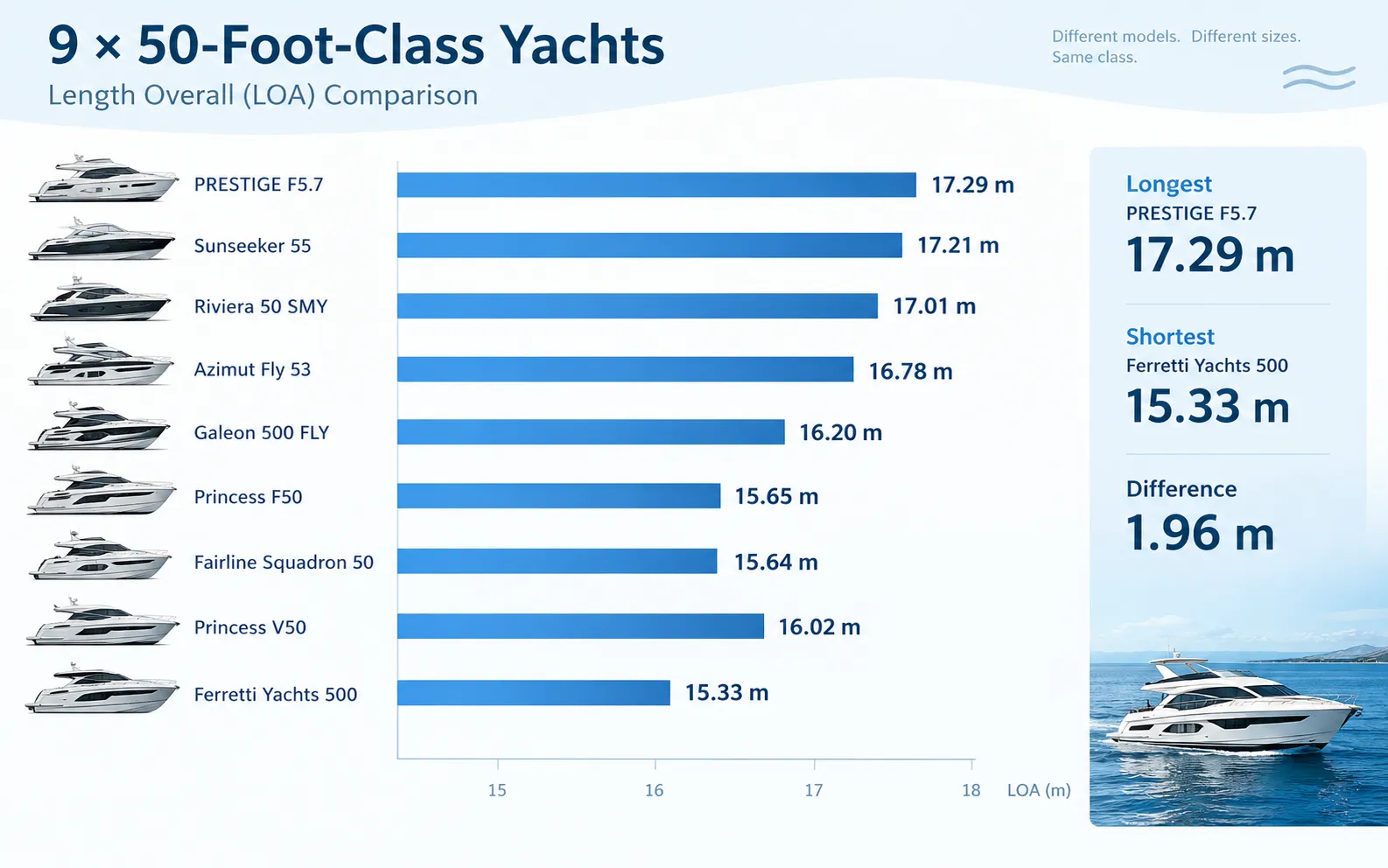
There is no single size standard for the term “50-foot-class yacht.” In this nine-model comparison, published LOA ranges from 15.33 to 17.29 m (about 50.3–56.7 ft), a difference of 1.96 m. Listed beam figures, excluding deployed balconies, range from 4.08 to 4.96 m.
For buyers, the model name is only a starting point. Compare the specific yacht’s overall length, beam configuration, draft measurement conditions and accommodation layout before assessing berth suitability. Cabin count, sleeping berths and persons capacity describe different aspects of the yacht and should not be used interchangeably.
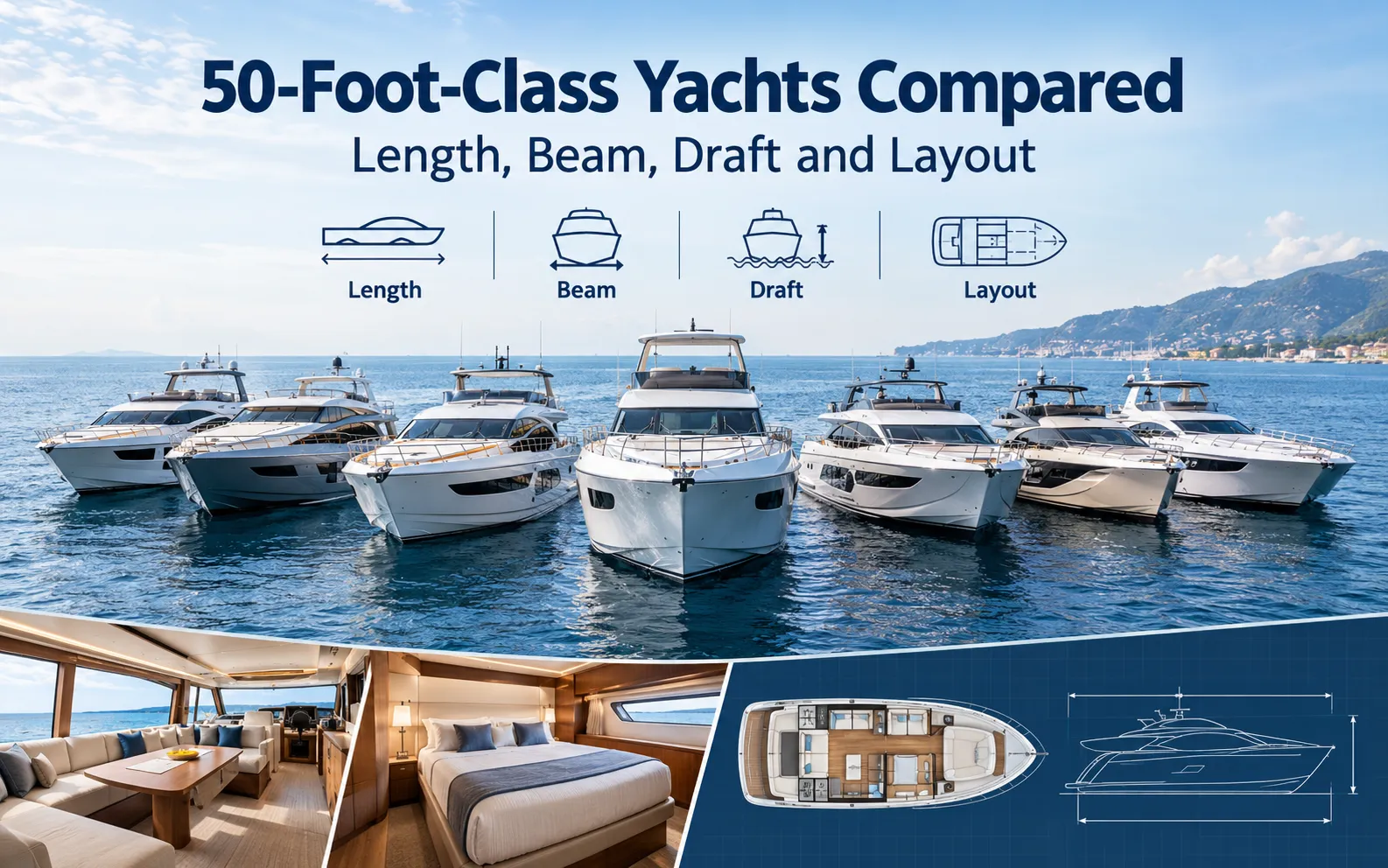
What Does “50-Foot-Class” Actually Mean?
In the yacht market, “50-foot-class” is commonly used to describe power yachts in a similar market segment rather than a formally defined size category.
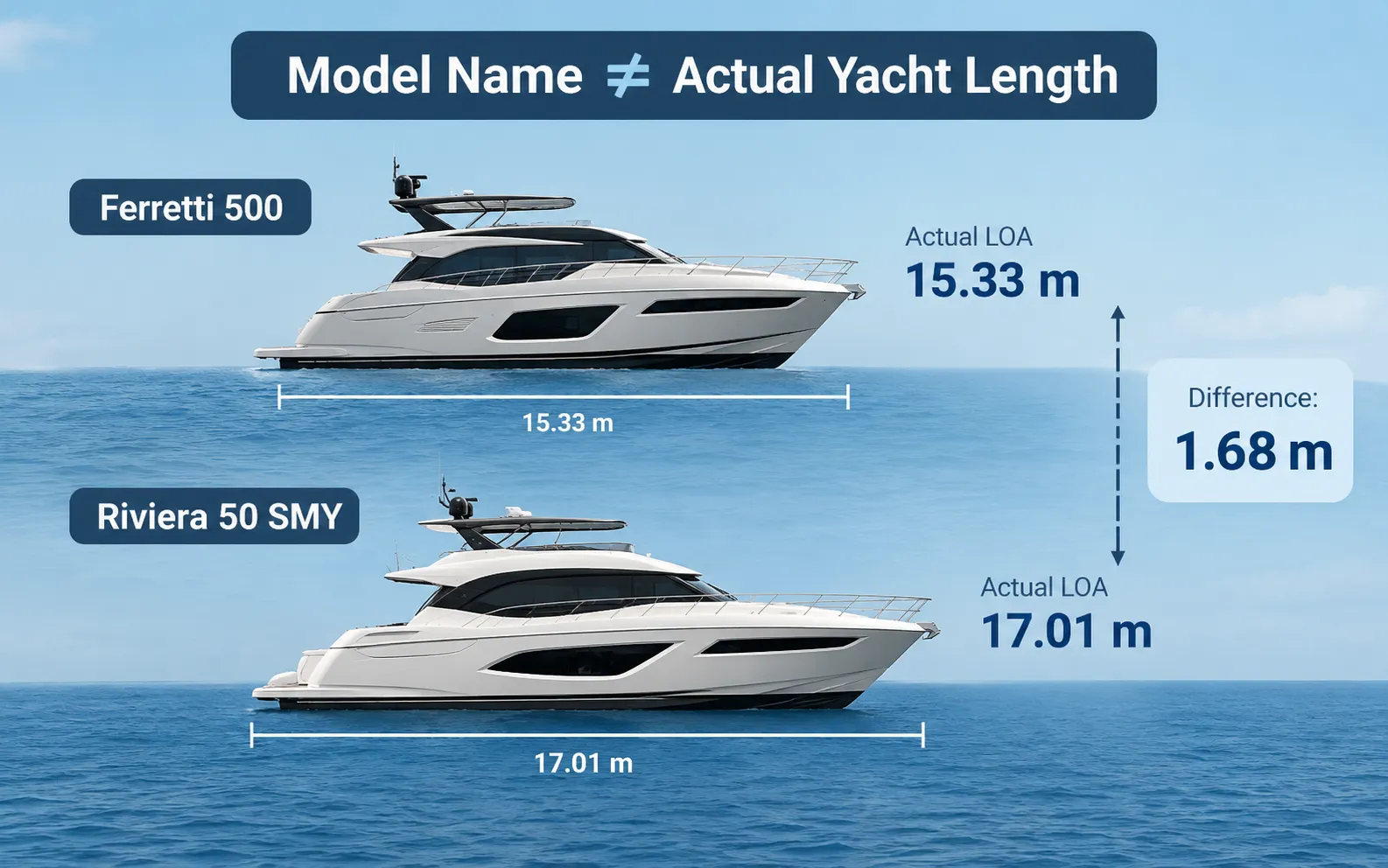
Model names such as Princess F50, Riviera 50 Sports Motor Yacht and Ferretti Yachts 500 should not be treated as a guarantee of an exact 50-foot LOA. Manufacturers may publish separate overall-length and hull-length figures, and their measurement definitions can differ.
For example, the Riviera 50 Sports Motor Yacht has a published LOA of 17.01 m and a hull length of 15.43 m. These figures describe different dimensions of the same yacht and should not be compared as though they use the same measurement definition.
The practical takeaway is that buyers should compare the manufacturer's published specifications rather than relying on the number in a model name.
Research Scope: How These 50-Foot-Class Yachts Were Compared
This comparison covers nine selected power yachts with published LOAs of 15.33–17.29 m, or approximately 50.3–56.7 ft. “50-foot-class” is used here as an editorial label for this comparison rather than a formal size category. The selection includes nearby models, not only yachts with “50” in their names.
The comparison focuses on manufacturer-published dimensions and accommodation information, using current model pages and publicly available technical documents where available.
| Comparison Item | Scope |
|---|---|
| Market segment | Selected 50-foot-class power yachts |
| Number of models | 9 |
| Exterior dimensions | Length overall (LOA), published beam and draft |
| Accommodation | Cabins, sleeping berths and crew accommodation |
| Intended use | Preliminary comparison and berth screening |
| Limitations | Not a substitute for vessel-specific technical verification |
Specifications checked: 13 October 2026. Sources include current manufacturer pages and archived brochures; this is not a uniform model-year dataset.
Manufacturers may use different definitions and measurement conditions. LOA may include a pulpit, bowsprit or swim platform; beam may include the gunwale or exclude expandable structures; and draft may refer to unloaded or loaded conditions, with or without propellers.
The figures below demonstrate the differences among the selected models. They should not be treated as final berth approval specifications.
50-Foot-Class Yacht Size Comparison: 9 Models Reviewed
Exterior Dimensions: LOA, Beam and Draft
The table uses manufacturer-published specifications. Measurement notes identify important differences where available. Values should be checked against the technical documentation for the exact model year and configuration.
| Brand and Model | Published LOA | Published Beam | Published Draft | Measurement Notes |
|---|---|---|---|---|
| Ferretti Yachts 500 | 15.33 m | 4.33 m | 1.23 m | Current manufacturer model-page figures |
| Princess V50 | 16.02 m | 4.08 m | 1.09 m (Deck Saloon) / 1.11 m (Open) | LOA includes pulpit |
| Fairline Squadron 50 | 15.64 m | 4.32 m | 1.17 m | LOA includes pulpit and fixed platform; beam includes gunwale; draft listed unloaded |
| Princess F50 | 15.65 m | 4.30 m | 1.39 m | LOA includes pulpit |
| Galeon 520 FLY | 17.20 m | 4.66 m; 6.66 m with balconies deployed | 1.04 (1.64) m* | Current website listing; confirm the draft definition and configuration with the builder |
| Azimut Fly 53 | 16.78 m | 4.95 m | 1.04 m | LOA includes pulpit; draft includes propellers at full load |
| Riviera 50 Sports Motor Yacht | 17.01 m | 4.96 m | 1.45 m | LOA includes swim platform and bowsprit; beam includes gunwale; maximum draft includes propellers |
| Sunseeker Manhattan 55 | 17.21 m | 4.87 m | 1.37 m | Figures from the manufacturer's 2021 brochure; verify model year and configuration |
| PRESTIGE F5.7 | 17.29 m | 4.69 m | 1.32 m | Official specification sheet; hardtop configuration |
The 4.08–4.96 m beam comparison uses the listed beam figures without deployed balconies. Galeon separately lists a maximum width of 6.66 m with its balconies open. Check the required configuration and side clearance with the marina.
Galeon’s current website displays draft as 1.04 (1.64) m without clearly identifying the measurement conditions. Verify the applicable figure against a dated technical sheet for the selected configuration before assessing depth suitability.
Layout Comparison: Cabins, Guest Berths and Crew Space
Cabin counts, sleeping berths and persons capacity are different measures. The following table reflects information available in the cited manufacturer pages or brochures. Optional layouts and model-year differences should be confirmed before purchase.
| Model | Number of Cabins | Guest Sleeping Berths | Crew Accommodation |
|---|---|---|---|
| Ferretti Yachts 500 | Standard 2 cabins; optional 3-cabin layout | Confirm for the selected configuration | Optional crew cabin on request |
| Princess V50 | 2 cabins in the published standard description; verify any third-cabin option against the relevant model year | 4 listed in the main specifications; confirm any alternative layout | Not specified on the cited model page |
| Princess F50 | 3 cabins | 6 berths | Not specified on the cited model page |
| Fairline Squadron 50 | Varies by layout | 4–7 berths | Confirm the selected configuration |
| Galeon 520 FLY | 3 cabins | 6 berths; confirm against the relevant layout documentation | Optional crew cabin or tender garage, depending on layout |
| Azimut Fly 53 | 3 cabins | 6 guest berths | 1 crew cabin |
| Riviera 50 Sports Motor Yacht | 3 cabins | Sleeps 6 people | Not specified in the cited source |
| Sunseeker Manhattan 55 | 3 guest cabins in the cited 2021 brochure layout | Up to 6 guests in that brochure | Accommodation for up to 1 crew member; verify the installed layout |
| PRESTIGE F5.7 | 3 cabins | 6 berths | Optional skipper cabin |
Reading the Data Correctly
The two tables describe different aspects of a yacht:- LOA, beam and draft help establish physical dimensions and preliminary berth compatibility.
- Cabins and sleeping berths help establish overnight accommodation.
- Persons capacity describes the figure published for the relevant model or configuration and is not interchangeable with sleeping capacity.
The general arrangement (GA) plan is essential for evaluating the allocation of cabins, saloon space, galley, bathrooms, storage and movement routes.
Where Do 50-Foot-Class Yachts Differ Most?
The nine selected models illustrate three important differences: overall length, published beam and draft measurement conditions. These differences affect berth selection and operational planning, but each measurement must be interpreted in the context of the manufacturer's definition.
LOA Difference: Why Similar Models Can Require Different Berths
Among the nine models, Ferretti Yachts 500 has the shortest published LOA at 15.33 m, while PRESTIGE F5.7 has the longest at 17.29 m. The difference is 1.96 m.
For yachts in this size range, a length difference of nearly 2 m can materially affect berth suitability.
Before selecting a berth, confirm:
| Item to Confirm | Why It Matters |
|---|---|
| Actual LOA | Establishes the published overall length of the specific yacht |
| Pulpit or bowsprit | May extend the overall length beyond the hull |
| Swim platform | May be included in one manufacturer's LOA but excluded by another |
| Mooring arrangement | Affects the space required at the berth |
| Marina restrictions | May specify maximum vessel length or additional clearance |
For example, the Princess V50's published LOA includes the pulpit. Riviera's published LOA includes the swim platform and bowsprit. These figures should not be compared with hull-length figures alone.
If you already have a fixed berth, ask the marina to confirm its usable dimensions and maximum permitted vessel length against the yacht's relevant technical specification. A model name alone is not enough to establish compatibility.
Beam Difference: Wider Does Not Automatically Mean Better
The narrowest listed beam in this comparison, excluding deployed balconies, is the Princess V50 at 4.08 m. The largest listed beam on the same basis is the Riviera 50 Sports Motor Yacht at 4.96 m, a difference of 0.88 m.
A beam difference approaching 1 m can affect:
- Berth width and side clearance;
- Docking and boarding arrangements;
- The available width of exterior deck areas.
However, beam alone does not establish usable interior space, navigation stability or overall comfort. Those characteristics also depend on hull design, displacement, center of gravity, deck arrangement and the distribution of interior and exterior spaces.
The Galeon 520 FLY illustrates why configuration matters: its listed beam is 4.66 m, while the manufacturer separately lists 6.66 m with the balconies deployed. Buyers must check the configuration relevant to marina access and mooring.
For buyers comparing wider models, the key is to confirm berth width and side clearance, then assess usable interior space separately from the general arrangement rather than inferring it from beam alone.
Draft Difference: Why Published Numbers Are Not Always Comparable
Published draft figures in this comparison are not measured on one uniform basis. Fairline lists 1.17 m unloaded, Azimut specifies 1.04 m including propellers at full load, and Riviera lists a maximum draft of 1.45 m including propellers. Galeon's current listing requires clarification, so the figures should not be used to rank these yachts by shallow-water suitability without checking the relevant technical documentation.Before comparing draft, confirm:
- Whether propellers and other underwater components are included;
- Whether the figure represents an unloaded or loaded condition;
- The installed propulsion system;
- The expected vessel load;
- The minimum water depth along the intended route and at the destination marina.
How Size Differences Affect Berth Selection
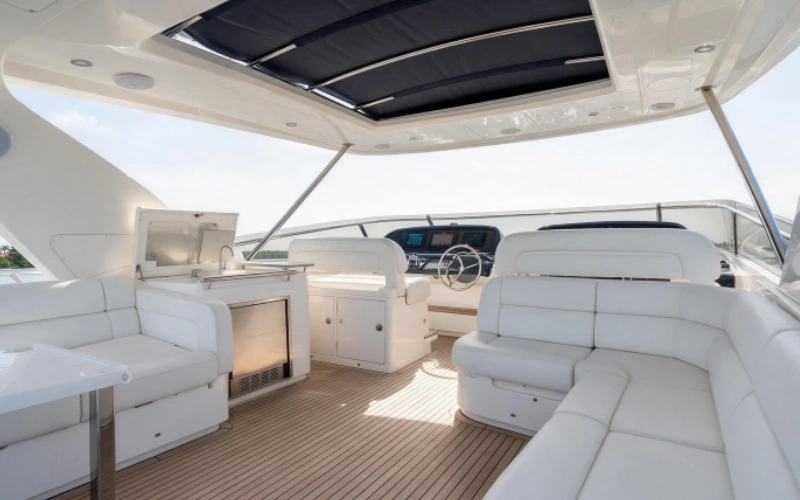
Before choosing a 50-foot-class yacht, check three practical requirements: usable berth length, available berth width and water depth.
| Verification Question | Data Required | Why It Matters |
|---|---|---|
| Is the berth long enough? | Usable berth length and permitted LOA | Prevents problems caused by external structures extending beyond limits |
| Is the berth wide enough? | Published beam, deployed structures and side clearance | Helps establish whether docking and boarding are practical |
| Is the water deep enough? | Actual draft, lowest expected depth and local requirements | Helps establish whether the yacht can safely access the berth and intended waters |
Berth Length
If you already own or have selected a berth, confirm its usable length and the marina's rules on maximum LOA. Check whether the published overall length includes the pulpit, bowsprit or swim platform.
Mooring arrangements and the required clearance may also affect whether a particular yacht is suitable for the berth.
Berth Width
Maximum beam establishes the yacht's published width, but practical berth requirements also depend on fenders, boarding access, neighboring yachts and marina rules.
For models with expandable balconies, verify both the stowed and deployed dimensions. Do not assume the standard beam alone covers every docking situation.
Water Depth
Published draft is a starting point rather than a guarantee of access. Underwater structures, propulsion configuration, loading and tidal changes can all affect the clearance available.
Before purchase, compare the yacht's technical specification with the marina's depth information and the conditions of the intended cruising area.
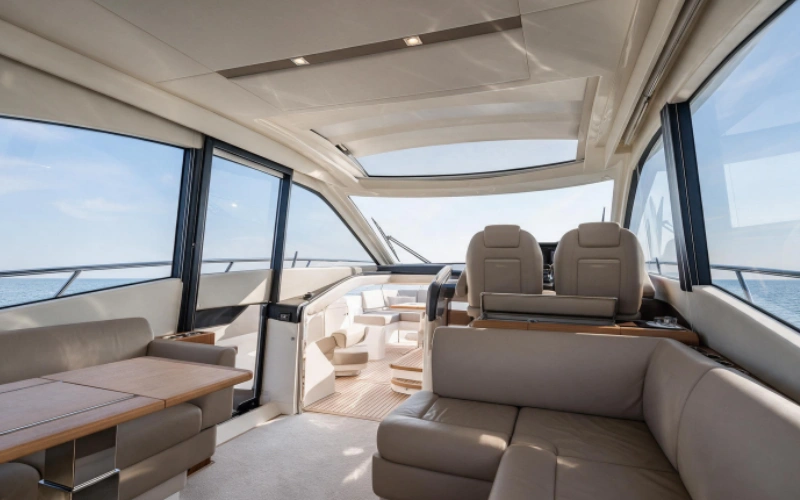
Why Similar-Sized Yachts Have Different Layouts?
Yachts with similar external dimensions can offer very different onboard arrangements. Their layouts reflect different priorities, including flybridge entertaining, sport-oriented handling, family cruising, guest accommodation and crew facilities.
External dimensions alone cannot show how much space is available for a saloon, galley, cabins, bathrooms or storage. Multiplying LOA by beam is not a reliable way to calculate usable living space.
The general arrangement (GA) plan provides a more useful basis for comparison.
Cabin Numbers and Sleeping Capacity Matter
Buyers should distinguish between the number of cabins, sleeping berths and the manufacturer's persons figure.
| Measure | What It Represents | What It Does Not Establish |
|---|---|---|
| Number of cabins | Number of separate sleeping rooms | The size or layout of each room |
| Sleeping berths | Published sleeping positions | Long-term comfort for the same number of people |
| Manufacturer-listed persons capacity | The persons figure published for the relevant configuration | Overnight berths or confirmed commercial passenger capacity |
For example, Fairline lists 4–7 berths and a persons capacity of 16 for the Squadron 50. This does not mean 16 overnight berths, and the listed persons figure should not be presented as a confirmed commercial passenger allowance without checking the specific vessel and operating requirements.
When verifying capacity, check whether the manufacturer's figure includes crew and which vessel configuration or use category it applies to. Do not treat “persons,” “guests” and “passengers” as interchangeable terms.
Flybridge Models: Space Allocation for Cruising and Entertaining
Flybridge yachts often prioritize outdoor social areas, family cruising and accommodation for longer stays. The way each model divides space between guest areas, cabins and crew facilities can nevertheless differ.
| Model | Published Layout Information | What Buyers Should Check |
|---|---|---|
| Azimut Fly 53 | 3 cabins and 1 crew cabin | Separation of guest and crew areas |
| Galeon 520 FLY | 3 cabins; optional crew cabin or tender garage depending on layout | Effect of the selected aft configuration on storage and accommodation |
| Ferretti Yachts 500 | Standard 2-cabin and optional 3-cabin layouts | Trade-off between guest cabins and shared space |
| Princess F50 | 3 cabins and 6 berths | Cabin dimensions, storage and movement routes |
| Fairline Squadron 50 | Multiple accommodation layouts | Which berth and cabin configuration is installed |
These differences are best assessed using the layout plan for the exact model year and configuration, rather than relying only on the number of cabins.
Sport Yacht Models: Assess the Layout, Not Just the Beam
Sport-oriented yachts typically place greater emphasis on the helm experience, outdoor connectivity and the relationship between the saloon and deck areas.
The Princess V50, with a published beam of 4.08 m, is the narrowest model in this comparison on the listed-beam basis. That measurement alone does not determine how effectively its interior space is used.
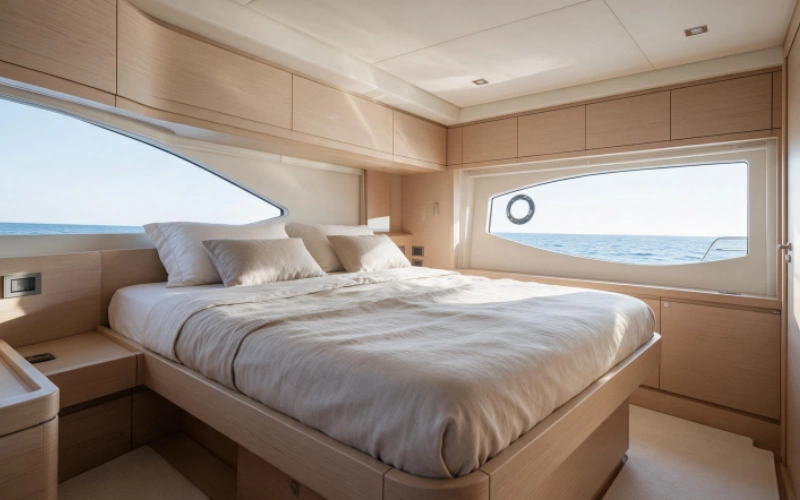
For buyers who mainly undertake short cruises or daytime outings, the connection between the helm, saloon and deck may be more important than maximizing beam. For overnight cruising, cabin dimensions, bathroom arrangements and storage may deserve greater weight.
How to Compare a 50-Foot-Class Yacht Before Buying
A practical shortlist should begin with fixed constraints, followed by accommodation needs and vessel-specific documentation.
Step 1: Confirm berth and waterway restrictions. Record the berth's usable length and width, the permitted LOA, minimum water depth and local clearance requirements. Confirm how the yacht's published dimensions treat external structures and expandable features.
Step 2: Define occupancy and overnight requirements. Separate the typical number of daytime occupants from overnight guests. Check the number of cabins, sleeping berths, bathrooms, storage areas and any crew accommodation.
Step 3: Verify the exact vessel specification. For a new yacht, confirm the model year, available options and current technical documents. For a pre-owned yacht, verify the build year, hull identification and installed configuration. Do not assume that specifications from a current model page apply to an older yacht with the same model name.
| Main Requirement | Specifications to Prioritize |
|---|---|
| Limited berth dimensions | LOA definition, beam configuration and side clearance |
| Shallow-water access | Actual draft, propulsion configuration, tides and local water depth |
| Family overnight cruising | Cabin arrangement, berths, bathrooms and storage |
| Daytime entertaining | Seating, shade, deck layout and indoor-outdoor flow |
| Crew assistance | Crew cabin, crew berth and access between working areas |
The goal is not to identify one universally superior yacht. It is to establish which models meet your fixed constraints and then compare their layouts, equipment and condition.
Once the size range is clear, buyers can review relevant yacht listings and compare the specifications of individual vessels before arranging an inspection.
Conclusion
The nine models compared here show why the “50-foot-class” label is only a starting point for yacht selection. Published LOA, beam configuration, draft definitions and accommodation layouts can vary substantially between models. Buyers should verify the specifications of the exact vessel and compare them with berth restrictions, intended cruising conditions and overnight requirements before making a purchase decision.
For a broader overview of yacht size classifications, see our yacht size guide. You can then compare specific yacht models against your preferred dimensions and layout.

Emery
Emery focuses on yacht specifications, market research, and ownership considerations. By analyzing manufacturer data and industry information, Emery provides practical comparisons of yacht dimensions, layouts, and selection factors to help readers better understand different yacht categories.
Last updated: October 2026
Disclaimer
Yacht specifications are based on publicly available manufacturer information and may vary by model year, configuration and measurement method. Verify the applicable technical documents, berth requirements and vessel-specific details before making purchase or ownership decisions.
Data Sources and Measurement Notes
Specifications checked: 13 October 2026The following manufacturer sources support the model data and layout information used in this comparison. Archived brochures describe the versions documented in those publications and should not be assumed to represent every model year.
-
Ferretti Yachts 500 — Current model specifications and official launch information and layout options (2020).
-
Princess V50 — Official model specifications.
-
Princess F50 — Official model specifications.
-
Azimut Fly 53 — Official model specifications.
-
Sunseeker Manhattan 55 — Official 2021 brochure.
-
PRESTIGE F5.7 — Layout and optional skipper-cabin information, and official technical brochure.
FAQ
Q1: What is the actual size of a 50-foot yacht?
A: A 50-foot-class yacht is usually around 15–17 meters LOA. Actual length varies by model, measurement method, and included structures.
Q2: Does a 50-foot yacht always need a 50-foot berth?
A: No. LOA may include bowsprits, swim platforms, or other extensions. Buyers should confirm the yacht’s actual overall length with the marina.
Q3: What is the average beam of a 50-foot yacht?
A: Most 50-foot-class yachts have a beam of about 4.1–5.0 meters. Wider models may offer more interior volume but require more berth space.
Q4: Which is better: a flybridge or sport yacht at 50 feet?
A: It depends on use. Flybridge models often prioritize social space and cruising, while sport yachts may focus on performance and outdoor connection.
Q5: What should I compare when choosing a 50-foot yacht?
A: Compare LOA, beam, draft, berth requirements, cabin layout, storage, and intended use rather than relying only on the model name.
Q6: Are all 50-foot yachts similar in size?
A: No. In this class, differences of nearly 2 meters in length and almost 1 meter in beam can significantly affect docking and onboard space.