Buying a yacht can become more cost-competitive than chartering when annual usage is high and consistent, but there is no universal break-even number of days. The result depends on the yacht's purchase and ownership costs, comparable charter rates, financing, major capital expenses and expected resale value.
A simple annual calculation can estimate an operating-cost break-even point, but a five-year model is more useful for a purchase decision because it accounts for acquisition costs, ownership expenses and net resale proceeds.
This guide separates purchase capital, annual operating costs, usage-related costs, financing, resale value and charter expenses. Illustrative figures are used only to demonstrate the calculation and should not be interpreted as market averages or yacht-specific quotations.
What Are You Actually Comparing?
Buying and chartering are different cost models. Chartering is a pay-for-use model, while ownership combines the cost of acquiring an asset with ongoing operating expenses.When comparing buying a yacht vs chartering, the key is to compare the cost of using a comparable yacht over the same period and usage level—not simply the yacht's purchase price against a charter rate.
Yacht Ownership vs Charter Cost: The Key Cost Components
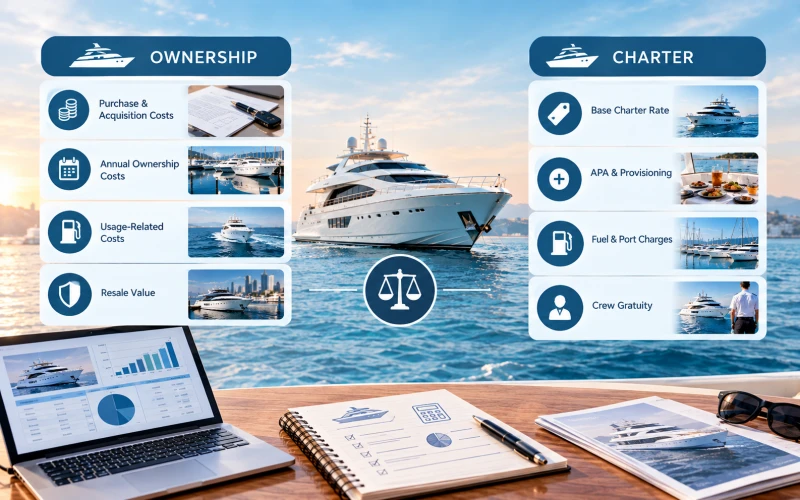
A useful buy-versus-charter comparison starts by separating the main cost components. Ownership and chartering have different cost structures, so each should be assessed using the costs that actually apply.
Purchase and Acquisition Costs
Buying a yacht requires upfront capital beyond the advertised purchase price. Depending on the transaction, this can include taxes, registration, legal fees, survey and sea trial costs, documentation, closing costs and initial work after purchase. Use our yacht closing costs checklist to identify transaction expenses that belong in the acquisition budget.Annual Ownership Costs
Owners may incur recurring costs such as:- Marina or berth fees
- Insurance
- Crew and crew-related expenses
- Maintenance and repairs
- Yacht management
- Fuel and consumables
- Registration and administrative costs
Usage-Related Costs
Some ownership costs increase with yacht usage. Fuel, consumables, transient berthing and certain maintenance or operational expenses can be higher when the yacht is used more frequently.Keeping these costs separate from relatively fixed annual expenses makes the later usage analysis more accurate.
Charter Costs
Chartering normally starts with a base charter rate, but the final cost may also include APA, fuel, provisioning, taxes, port or berth charges and crew gratuity, depending on the yacht and charter agreement.For comparison purposes, use an actual quotation for a comparable yacht and intended dates where possible rather than relying only on a published starting rate.
Resale Value
Unlike chartering, yacht ownership leaves the buyer with an asset that may be sold later. The yacht's future resale proceeds can therefore reduce the long-term economic cost of ownership.Resale value is uncertain and depends on factors such as the yacht's age, condition, maintenance history, builder, model, equipment and market conditions. It should be treated as an assumption in a long-term model rather than a guaranteed amount.
How to Calculate the Yacht Ownership vs Charter Break-Even
How many days per year would I need to use the yacht before the assumed annual ownership cost equals the cost of chartering a comparable yacht?Simplified Break-Even Formula
A simple break-even calculation can be used as a first-pass comparison when fixed annual ownership costs are separated from usage-related costs.Simplified Break-Even Formula
Break-Even Days = Annual Ownership Cost ÷ Comparable Charter Cost Per Day
This simplified calculation treats annual ownership costs as fixed and excludes costs that increase with yacht usage, such as fuel and consumables. It is therefore an illustration, not a complete operating-cost break-even analysis.
A more practical model is:
Annual Ownership Cost = F + v × D
Where:
- F = relatively fixed annual ownership costs
- v = additional ownership cost per day of use
- D = annual yacht usage in days
- C = comparable total charter cost per day
Break-Even Days = F ÷ (C − v)
This applies when F > 0 and C > v. Each cost should be counted only once.
Illustrative 60-Foot Yacht Example
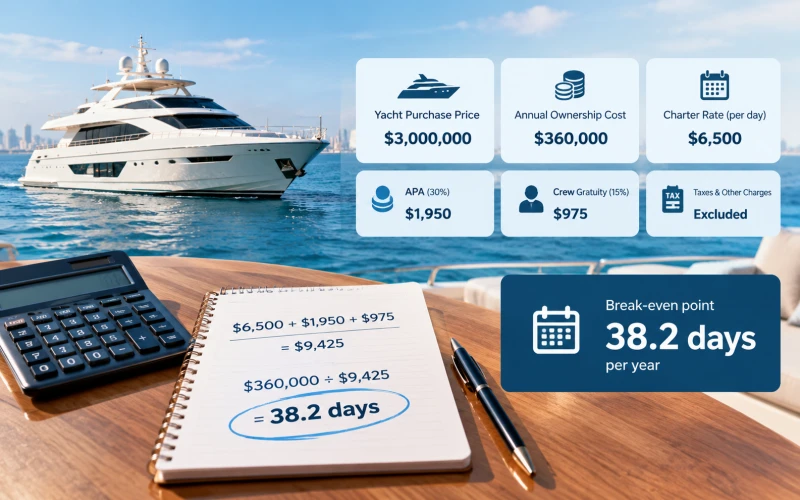
Assume the following illustrative figures for a 60-foot yacht:
- Yacht Purchase Price: $3,000,000
- Illustrative Fixed Annual Ownership Cost: $360,000
- Comparable Base Charter Rate: $6,500 per day
- Illustrative APA: $1,950 (30% of base rate)
- Illustrative Crew Gratuity: $975 (15% of base rate)
- Taxes and Other Location-Specific Charges: Excluded
The APA and gratuity percentages used here are illustrative assumptions, not universal market rules. Fraser advises budgeting around 30% of the base rate for APA, while crew gratuity is generally considered separately at around 15%–20% of the base rate. Actual APA spending and gratuity vary by yacht, itinerary and destination.
The illustrative charter calculation is:
$6,500 + $1,950 + $975 = $9,425
This example assumes that expenses funded through the APA total $1,950 per charter day. Fuel, provisioning and port charges paid from that allowance must not be added again. The $975 crew gratuity is a discretionary budgeting assumption. Taxes and any other charges not already included must be added separately where applicable.
Using the simplified operating-cost break-even model:
$360,000 ÷ $9,425 = 38.2 days
Under these illustrative assumptions, the operating-cost break-even point is approximately 38.2 days per year.
This does not represent a full economic break-even point because the calculation excludes acquisition costs, financing, opportunity cost, major capital expenditures and the yacht's eventual resale value.
Buying vs Chartering at Different Annual Usage Levels
Under the same assumptions, what would the cost be if I used the yacht for 10, 20, 30, or 50 days?| Annual Yacht Use | Estimated Charter Cost | Illustrative Annual Ownership Cost | Charter Cost − Ownership Cost |
|---|---|---|---|
| 10 Days | $94,250 | $360,000 | −$265,750 |
| 20 days | $188,500 | $360,000 | −$171,500 |
| 30 Days | $282,750 | $360,000 | −$77,250 |
| ≈38.2 Days | ≈$360,000 | $360,000 | ≈$0 |
| 40 Days | $377,000 | $360,000 | +$17,000 |
| 50 Days | $471,250 | $360,000 | +$111,250 |
| 60 Days | $565,500 | $360,000 | +$205,500 |
A positive difference means chartering costs more under these assumptions; a negative difference means chartering costs less.
At approximately 38.2 days per year, the assumed charter-related cost equals the recurring annual ownership and operating cost under this simplified model.
At 40 days, the modeled charter cost is approximately $17,000 higher than the assumed annual ownership cost. At 30 days, the modeled charter cost remains $77,250 lower.
This is an operating-cost break-even point, not a full economic break-even threshold. The result changes with the yacht, charter rate, ownership costs and other assumptions.
Why the Basic Break-Even Calculation Can Be Misleading
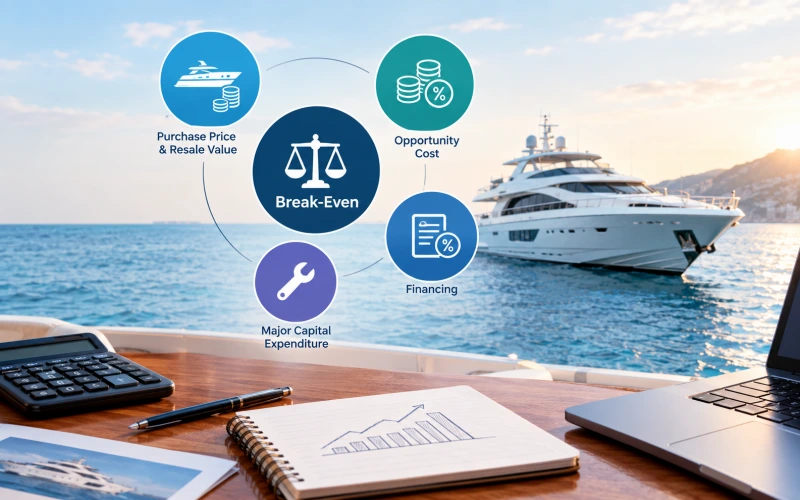
The basic break-even formula is useful for understanding how annual usage affects the comparison, but it does not capture every economic cost of yacht ownership.
Purchase Price, Resale Value and Depreciation
The purchase price is the initial capital outlay. The yacht's eventual resale value determines how much of that capital may be recovered.For a long-term ownership model, the economic cost associated with the yacht's value is reflected in the difference between the acquisition cost and the yacht's eventual net resale proceeds.
Because future resale value is uncertain, buyers should model several resale scenarios rather than rely on a single assumed figure. Age, condition, maintenance and refit history, and prevailing market conditions can all affect the eventual resale proceeds.
Our guide to boat depreciation and resale value explains the factors to review before setting a resale assumption.
Avoid double-counting depreciation: If the model already includes the purchase price and net resale proceeds, depreciation should not be added separately as another cost. It would represent the same loss in value twice.
Opportunity Cost
Buying a yacht also ties up capital that could otherwise be used for another purpose. This is the opportunity cost of the capital invested in the yacht.There is no single rate that applies to every buyer. If this factor is important to your decision, it should be modeled separately from the yacht's direct cash expenses.
Financing
If the yacht is financed, the analysis should account for the structure of the loan, including the down payment, interest, fees and repayment schedule.The treatment of principal repayment depends on what the model is measuring. A cash-flow model, an economic-cost model and a net-worth analysis will not necessarily treat financing in the same way.
Major Capital Expenditure
Routine maintenance is only part of the ownership budget. Over a multi-year ownership period, a yacht may also require significant capital work such as a major refit, equipment replacement or other substantial upgrades.These costs can occur irregularly rather than every year, so a five-year or longer ownership model should identify potential major expenditures separately rather than spreading them evenly without supporting assumptions.
A simple annual break-even calculation can therefore be useful as a first-pass estimate, but it should not be treated as the final answer.
For a serious purchase decision, the comparison should also consider acquisition cost, net resale proceeds, capital opportunity cost, financing and major capital expenditure.
The 5-Year Yacht Ownership vs Charter Cost Model
A five-year model provides a more realistic comparison because it captures both the ongoing cost of ownership and the yacht's value at the end of the ownership period.Five-Year Ownership Cost
A five-year ownership model should account for the yacht's purchase price and the costs incurred during the ownership period.A simplified long-term ownership model can be structured as:
Five-Year Net Ownership Cost = Purchase Price + Acquisition Costs + Five-Year Operating Costs + Major Capital Expenditure + Loan Interest and Financing Fees − Net Resale Proceeds
Where:
Net Resale Proceeds = Gross Sale Price − Selling Costs
Five-year operating costs should reflect expected annual usage. The model can separate relatively fixed costs (F) from usage-related costs (v × D) so that higher or lower annual use is reflected in the ownership budget.
Initial work on a used yacht, routine maintenance and major refit or equipment replacement should be classified separately and counted only once.
Because the full purchase price is already included, the model should not add the down payment or loan principal repayments separately. Financing costs here refer to loan interest and financing fees; detailed loan cash flows and repayment schedules can be modeled separately.
Depreciation should also not be added separately when the model already includes the purchase price and net resale proceeds.
This is a simplified, undiscounted direct-cost model. It does not include opportunity cost, which should be assessed separately when relevant.
For the full budget structure and a worked ownership example, see our guide to five-year yacht ownership costs.
Five-Year Charter Cost
For chartering, the basic calculation is:Five-Year Charter Cost = Comparable Charter Cost per Day × Annual Usage × 5 Years
For example, if a comparable charter costs $9,425 per day and the expected usage is 30 days per year:
$9,425 × 30 × 5 = $1,413,750
This is an illustrative calculation. Actual charter costs will vary by yacht, destination, season, contract terms and applicable additional expenses.
Compare the Two Models
Compare the five-year ownership and charter costs using the same yacht category, region and usage assumptions.Test multiple usage and resale scenarios rather than relying on one fixed assumption:
| Test | Variable Changed | Held Constant |
|---|---|---|
| Usage Sensitivity | 20 / 40 / 60 days per year | Base resale assumption |
| Resale Sensitivity | Conservative / Base / Higher | Base annual usage |
Testing these factors separately makes it easier to see how each assumption affects the five-year comparison.
Ownership Costs That Are Easy to Miss
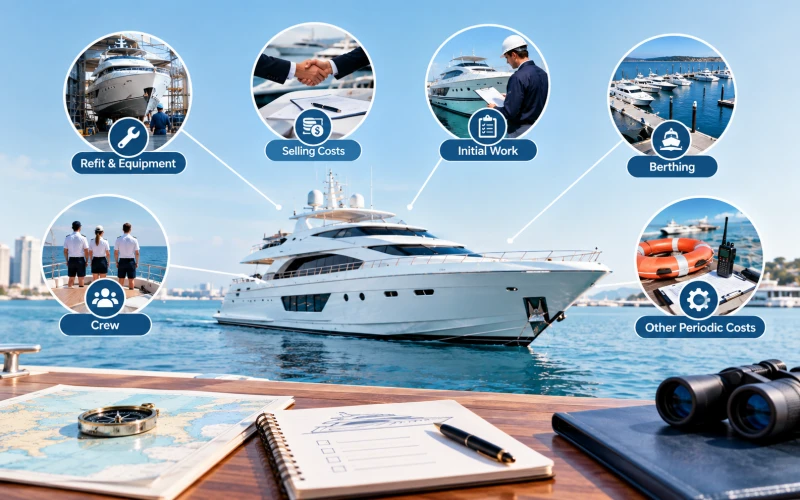
Some ownership costs are easy to overlook because they are irregular, situation-dependent or only arise at certain stages of ownership.
Major Refit and Equipment Replacement
Major refits, engine work and equipment replacement can create significant costs that do not occur every year. These should be modeled separately rather than treated as a fixed annual expense without supporting estimates.Selling Costs
Selling a yacht can involve brokerage commissions, marketing, documentation and other transaction costs. These should be deducted when estimating net resale proceeds.Initial Work on a Used Yacht
A used yacht may require repairs, upgrades, surveys or other work soon after purchase. Buyers should assess these costs before treating the purchase price as the full acquisition cost. Use a used yacht inspection checklist to identify items for professional assessment, then obtain repair estimates for the ownership model.Berthing
Berthing costs vary by yacht size, marina, location, season and contract terms. Use a specific berth quotation where possible.Crew
Crew costs depend on the yacht, operating area, flag, crew requirements and whether the yacht is privately operated or professionally managed. Obtain a realistic crew budget for the specific yacht.Other Periodic Costs
Other costs may include haul-outs, storage, safety equipment, communications, regulatory compliance and technical inspections. Include them when they are relevant to the yacht and operating plan.When Chartering May Fit the Usage Pattern
Chartering can fit certain usage patterns where annual demand is limited, uncertain or spread across different cruising regions.Limited Annual Usage
If you expect to use a yacht for relatively few days each year, chartering allows you to pay primarily for the periods when you actually use the yacht without taking on year-round ownership responsibilities.
Uncertain Usage
If your future travel schedule is difficult to predict, chartering allows you to adjust the number, duration and timing of yacht trips from year to year.
Changing Yacht Requirements
Your preferred yacht may change as your family, group size, cruising plans or onboard requirements change. Chartering allows you to select different yachts for different trips rather than remaining tied to one vessel.
Multiple Cruising Regions
If you regularly cruise in different regions, ownership can involve additional logistics such as yacht repositioning, berthing arrangements, crew management and transportation.
Chartering in different destinations can reduce some of these ownership-related logistics and allow you to select a yacht locally for each trip.
When Yacht Ownership May Fit the Usage Pattern
Yacht ownership can fit usage patterns where annual use is relatively high and consistent, the ownership horizon is longer, and the buyer has stable requirements for a particular yacht.High and Consistent Usage
If you expect to use the same yacht frequently and consistently each year, ownership provides ongoing access to a vessel configured around your requirements.
Longer Ownership Horizon
A longer planned ownership period can spread acquisition and other one-time costs across several years. It also provides more time to use the yacht and manage its maintenance and refit cycle.
Stable Yacht Requirements
If you already know the yacht size, layout, cruising capabilities and onboard features you want, owning a specific yacht provides consistency across your planned use.
Personal Control and Availability
Ownership gives the buyer greater control over the yacht's configuration, equipment, maintenance decisions and availability, subject to operational, regulatory and contractual requirements.
Can Chartering Out Your Yacht Offset Ownership Costs?
Chartering out a privately owned yacht can generate revenue that offsets part of the owner's annual costs. However, gross charter revenue is not the same as net contribution.The amount that actually reduces ownership costs may be affected by:
- Charter management fees
- Brokerage commissions
- Commercial insurance requirements
- Additional crew or crew costs
- Increased maintenance and wear
- Fuel and other operating expenses
- Regulatory and administrative requirements
- Taxes, where applicable
A simple approach is:
Net Charter Contribution = Gross Charter Revenue − Charter-Related Costs
This should only be included in an ownership model if the yacht is legally and commercially eligible for charter under its flag, registration, insurance and operating structure.
Actual charterability and applicable requirements depend on the yacht, flag, jurisdiction, commercial operating structure and management arrangement.
Fractional Yacht Ownership
Fractional yacht ownership is an alternative to both full ownership and chartering. Several owners share ownership of a yacht, with each owner receiving an agreed share of usage and responsibility for the associated costs.The structure can reduce the capital required from each individual owner, but the financial and operational terms vary significantly between programs.
Before entering a fractional ownership arrangement, buyers should review:
- Ownership percentage and purchase price
- Usage allocation and booking rules
- Annual management and maintenance costs
- Scheduling and peak-period access
- Maintenance and major repair responsibilities
- Transfer or resale rights
- Exit terms and restrictions
How to Build Your Own Yacht Buy-vs-Charter Model
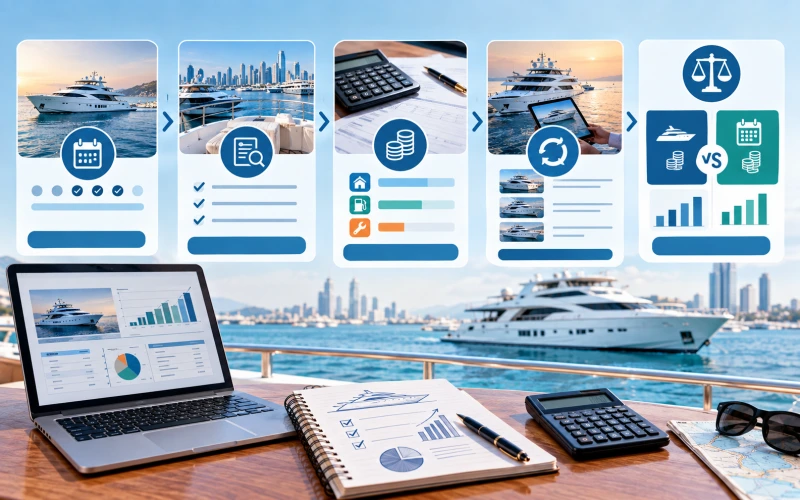
A practical buy-vs-charter analysis can be built using your actual usage, comparable charter quotes, ownership costs and resale assumptions.
Estimate Realistic Annual Usage
Start with your actual yacht usage over the past 12–24 months.Use actual historical usage where possible rather than assuming that ownership will automatically increase your yacht usage.
Model several usage levels, such as 20, 40 and 60 days per year, to see how the result changes.
Obtain Comparable Charter Quotes
Obtain charter quotes for yachts comparable in size, age, condition, equipment, service level and cruising region.Compare quotes on the same basis. A lower published day rate may not represent a lower total charter cost if additional expenses differ.
Build the Ownership Budget
Separate ownership costs into three groups:- Fixed or Relatively Predictable Costs — Berthing, insurance, crew, management, registration and administration
- Usage-Related Costs — Fuel, consumables, transient berthing and other operating expenses that vary with use
- Periodic or Significant Costs — Major maintenance, haul-outs, repairs, refit work and equipment replacement
Estimate Resale Scenarios
Estimate potential net resale proceeds under several scenarios rather than relying on one figure.Consider the yacht's age, condition, maintenance and refit history, equipment, builder and model, and market conditions. Account for expected selling costs when estimating net proceeds.
Use conservative, base and higher resale scenarios where appropriate. Comparable sales, broker valuations and available market evidence can help support these assumptions.
Compare Five-Year Costs
Once the ownership and charter assumptions have been established, compare the total cost of each option over the same five-year period.Five-Year Cost Difference = Five-Year Ownership Cost − Five-Year Charter Cost
A positive result means the modeled ownership cost is higher than the modeled charter cost. A negative result means the modeled ownership cost is lower.
Run the model again using different usage and resale assumptions to test how sensitive the result is to changes in the inputs.
How to Evaluate Yacht Ownership vs Chartering
There is no universal number of days at which buying a yacht becomes better than chartering. The result depends on the specific yacht, expected usage, charter market, ownership costs and planned ownership period.
Use the following factors to build your own comparison:
- Expected Annual Usage — How many days you realistically expect to use the yacht
- Comparable Charter Rates — What you would actually pay for a similar yacht in the same cruising region
- Ownership Budget — Purchase and acquisition costs, annual operating expenses, maintenance, berthing, insurance, crew and other relevant costs
- Financing Assumptions — Down payment, interest and financing fees where applicable
- Resale Scenarios — Estimated net resale proceeds under different market and ownership assumptions
- Ownership Period — How long you expect to keep the yacht and spread acquisition and other one-time costs
For many buyers, the most useful comparison is a five-year model with several usage and resale scenarios rather than a single annual break-even calculation.
Compare Yachts for Your Ownership Model
Browse new yachts for sale and used yachts for sale to compare asking prices, sizes and specifications before building your ownership budget.
About This Guide
This guide compares yacht ownership and charter costs using published guidance from YachtWorld and Fraser Yachts, along with illustrative break-even and five-year cost models.
The calculations are examples only and should be adapted to the specific yacht, charter rates, ownership costs and resale assumptions being considered.
Sources Reviewed
- YachtWorld — The Real Cost of Owning a Yacht
- Fraser Yachts — Charter Cost Breakdown: Caribbean vs. Mediterranean vs. Middle East
Disclaimer
This article is for general informational purposes only and does not constitute financial, legal, tax or investment advice. Costs and charter terms vary by yacht, location and operating conditions. Verify current figures and terms with qualified yacht brokers and relevant advisers before making a purchase or chartering decision.
FAQ
Q1: Is it cheaper to buy or charter a yacht?
A: It depends on annual usage, yacht costs, charter rates, ownership period, financing and resale value. Low or uncertain usage can favor chartering, while high and consistent usage can make ownership more competitive.
Q2: How many days a year do you need to use a yacht to justify buying?
A: There is no universal number. A basic calculation is: Break-even days = Annual ownership cost ÷ Comparable charter cost per day. For a meaningful long-term analysis, also include acquisition costs, resale value, financing and major maintenance.
Q3: What is the break-even point between yacht ownership and chartering?
A: It is the annual usage level at which the calculated cost of ownership equals the cost of chartering a comparable yacht. The result varies significantly between yachts, markets and ownership structures.
Q4: What costs should I include when comparing yacht ownership with chartering?
A: Include purchase and acquisition costs, annual ownership expenses, maintenance, berthing, insurance, crew, financing, major refit work, selling costs and expected resale value. For chartering, consider the base charter rate plus applicable expenses such as APA, taxes, fuel, provisioning and gratuity.
Q5: Does yacht resale value affect the buy-versus-charter calculation?
A: Yes. Resale value can materially change the long-term economic cost of ownership because the yacht remains an asset that can be sold. Buyers should use a realistic range of resale assumptions rather than treating future value as guaranteed.
Q6: Can charter income reduce the cost of owning a yacht?
A: Yes. Charter income can offset part of the owner's costs, but gross charter revenue is not the same as net charter contribution. Management fees, commissions, additional operating costs, wear, insurance and regulatory requirements may reduce the amount that actually offsets ownership costs.