



The main boat categories include powerboats, sailboats, multihulls, fishing boats, recreational, small boats and tenders. Common boat types include motor yachts, flybridge yachts, trawlers, center consoles, sportfishing boats, bowriders, RIBs, sailing catamarans, and power catamarans.
Boat classification is not always mutually exclusive. A single boat can be classified by its boat type, intended use, propulsion system, and hull configuration. For example, a power catamaran is both a powerboat and a multihull, while a diesel-powered trawler can be classified by its boat type, propulsion, and engine type.
The terms also overlap in everyday use, so buyers who are unsure where the terminology changes can first review the difference between a boat and a yacht.
Boats are described through overlapping labels based on propulsion, hull configuration and intended use. This guide groups 33 common market types into buyer-friendly sections.
Types of Boats at a Glance
Boats can be classified through several overlapping lenses: primary propulsion, hull configuration, bottom shape, intended use, size and accommodation. A single vessel may belong to several categories at the same time.| Buyer-Focused Grouping | Common Boat Types | Best For | Key Advantage | Main Trade-off |
|---|---|---|---|---|
| Powerboats | Motor Yachts, Flybridge Yachts, Trawlers, Express Cruisers, Sport Cruisers, Cabin Cruisers, Cuddy Cabins | Cruising, overnight trips, long-range travel | Fast and flexible, with many layouts and onboard amenities | Higher fuel use and operating costs than many sailboats |
| Sailboats | Daysailers, Sailing Cruisers, Cruiser-Racers, Racing Sailboats, Ketches, Schooners, Motorsailers | Sailing, coastal cruising, offshore trips | Efficient for longer passages and offers a traditional sailing experience | Requires sailing skills and can be slower under power |
| Multihulls | Sailing Catamarans, Power Catamarans, Trimarans | Stability, space, cruising, performance | Wide beam provides stability, living space, and efficient layouts | Larger beam can limit marina options and increase berth costs |
| Fishing Boats | Sportfishing Boats, Center Consoles, Walkaround Boats, Bass Boats, Flats Boats, Bay Boats, Jon Boats | Inshore, offshore, and freshwater fishing | Purpose-built layouts and equipment for fishing | Less versatile for overnight cruising or general family use in some designs |
| Recreational Boats | Bowriders, Deck Boats, Pontoon Boats, Runabouts, Jet Boats | Family boating, swimming, day trips | Easy-to-use layouts focused on socializing and watersports | Limited overnight accommodation and offshore capability on many models |
| Small Boats & Tenders | RIBs, Dinghies, Inflatable Boats | Tender use, short trips, utility, watersports | Portable, practical, and relatively easy to handle | Limited range, protection, and onboard space |
Types of Powerboats
Powerboats use an engine as their primary means of propulsion. They range from small recreational boats to large yachts designed for coastal, offshore, and long-range cruising.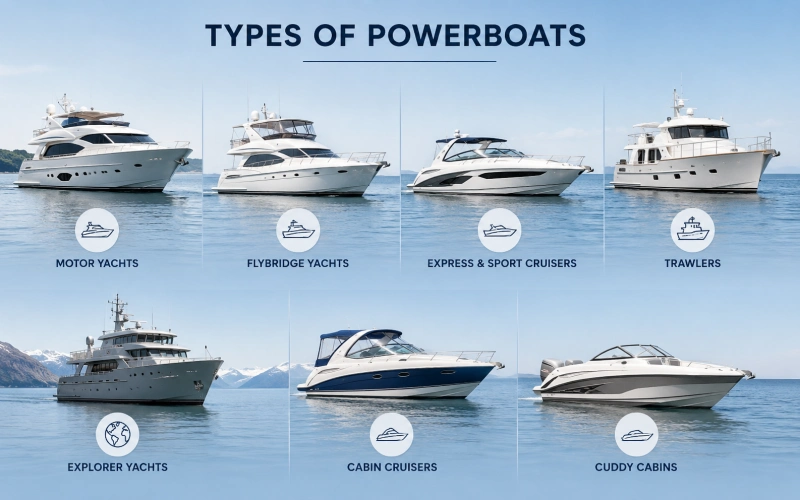
Motor Yachts
Motor yachts are powered cruising boats designed for comfort, accommodation, and longer trips. They are popular for luxury cruising, entertaining, and overnight travel.Best for: Luxury cruising, extended trips, and entertaining.
Flybridge Yachts
Flybridge yachts feature an elevated helm and outdoor living area above the main deck. Depending on the design, the flybridge may include additional seating, dining space, a second helm station, and entertainment areas.Best for: Cruising, entertaining, and buyers who want additional outdoor living space and visibility.
Express & Sport Cruisers
Express cruisers provide enclosed accommodation for coastal cruising and overnight trips, while sport cruisers place greater emphasis on performance, styling, and outdoor recreation.Best for: Weekend cruising, coastal travel, and short overnight trips.
Trawlers
Trawlers are cruising boats generally designed around fuel efficiency, range, and comfortable passage-making rather than high speed. Many use displacement or semi-displacement hulls and diesel engines.Best for: Long-range cruising and extended passages.
Explorer Yachts
Explorer yachts are built for extended cruising and travel to remote destinations. They typically emphasize range, storage, durability, and substantial onboard accommodation.Best for: Long-distance cruising, remote destinations, and expedition-style travel.
Cabin Cruisers
Cabin cruisers combine a relatively compact powerboat design with enclosed accommodation. Depending on the model, they may include sleeping berths, a galley, a head, and interior seating.Best for: Couples and families seeking overnight capability in a smaller boat.
Cuddy Cabins
Cuddy cabin boats are compact powerboats with a small enclosed cabin, typically providing basic shelter or sleeping space while retaining an open recreational layout.Best for: Day boating, short overnight trips, couples, and buyers who want limited cabin space without moving to a larger cruiser.
Types of Sailboats
Sailboats can be classified by hull design, intended use, and rig configuration. Common types range from simple daysailers and cruising sailboats to performance-oriented racing boats and traditional rigs such as ketches and schooners. For a more detailed comparison of rigs, layouts and buying uses, see our guide to the main types of sailboats.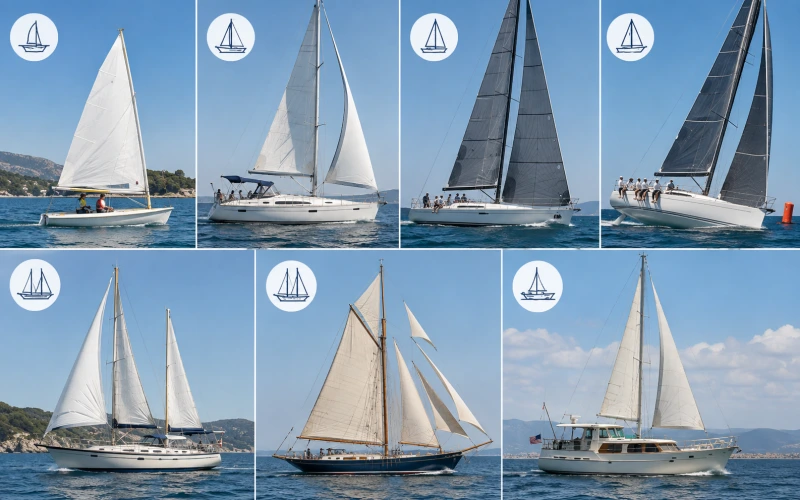
Daysailers
Daysailers are relatively simple sailboats designed mainly for short recreational outings rather than extended cruising.Best for: Learning to sail and recreational day sailing.
Sailing Cruisers
Sailing cruisers are designed for longer trips and typically provide sleeping accommodation, a galley, a head, and other cruising facilities.Best for: Coastal cruising, overnight trips, and extended sailing.
Cruiser-Racers
Cruiser-racers combine practical cruising accommodation with performance-oriented sailing characteristics, allowing owners to balance comfort with sailing performance.Best for: Cruising and recreational racing.
Racing Sailboats
Racing sailboats prioritize speed, handling, weight reduction, and sailing performance. Their layouts and equipment are generally more focused on performance than onboard comfort.Best for: Competitive sailing and performance-focused owners.
Ketches
Ketches are two-masted sailing vessels with a smaller mizzen mast positioned aft of the main mast and forward of the rudder post. This rig configuration provides additional sail options and can offer flexibility in sail handling.Best for: Offshore cruising and sailors who prefer flexible sail handling.
Schooners
Schooners are sailing vessels with two or more masts, traditionally with the forward mast shorter than the main mast. They are associated with classic sailing vessels as well as some larger cruising designs.Best for: Traditional sailing, cruising, and larger sailing vessels.
Motorsailers
Motorsailers combine sailing capability with a substantial engine and cruising-oriented accommodation, offering the option of sailing while retaining powered-cruising capability.Best for: Extended cruising and buyers who want both sailing and powered propulsion.
Types of Multihull Boats
Multihulls use two or more hulls and offer different characteristics from traditional monohull boats.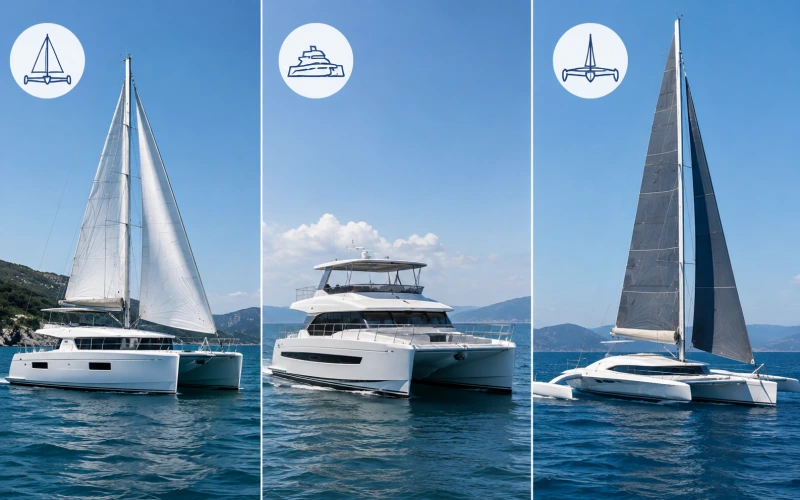
Sailing Catamarans
Sailing catamarans have two hulls connected by a central structure.They are known for:
- Wide beam
- Large living areas
- Strong stability at anchor
- Relatively shallow draft on many designs
Power Catamarans
Power catamarans use two hulls and engines as their primary propulsion.They can provide substantial interior and exterior space and may offer efficient cruising characteristics depending on their hull design, weight, and engines.
Best for: Long-distance cruising, family cruising, and buyers who want multihull stability without relying primarily on sails.
Buyers comparing multihulls can review sailing catamarans and power catamarans in more detail before choosing a propulsion type.
Trimarans
Trimarans have three hulls.They can offer high stability and performance, although their layouts and operating characteristics vary significantly by design.
Best for: Performance sailing and specialized cruising applications.
Types of Fishing Boats
Fishing boats are designed for different environments, fishing techniques, and target species.- Sportfishing Boats: Designed primarily for offshore fishing, and may be equipped with a large cockpit, fishing gear, a bait compartment, a fish hold, and dedicated rod storage
- Center Console Boats: The helm is located in the center of the hull, leaving usable space on both sides as well as in the bow and stern areas
- Walkaround Boats: Combine a small cabin or enclosed forward area with access around the sides. Best for coastal fishing and day boating
- Bass Boats: Designed primarily for freshwater bass fishing, with layouts optimized for casting and fishing equipment
- Flats Boats: Shallow-draft boats designed for fishing in very shallow coastal waters
- Bay Boats: Designed for inshore and shallow-water fishing in bays, estuaries, and protected coastal areas
- Jon Boats: Simple, often flat-bottomed boats used for fishing, hunting, and utility purposes in calm or shallow water
Types of Recreational Boats
Recreational boats are designed primarily for day boating, family outings, swimming, and watersports. Common types include bowriders, deck boats, pontoon boats, runabouts, and jet boats.- Bowriders: Feature open seating in the bow and are popular for family boating, swimming, and watersports
- Deck Boats: Have a wide, open layout with ample seating, making them well suited to family outings and recreational day boating
- Pontoon Boats: Use two or more pontoons to support a spacious deck and are commonly used for leisure, fishing, swimming, and entertaining
- Runabouts: Small, versatile boats designed for day trips, swimming, and a range of recreational activities
- Jet Boats: Use water-jet propulsion rather than a conventional propeller and are commonly used for recreational boating and watersports
Types of Small Boats and Tenders
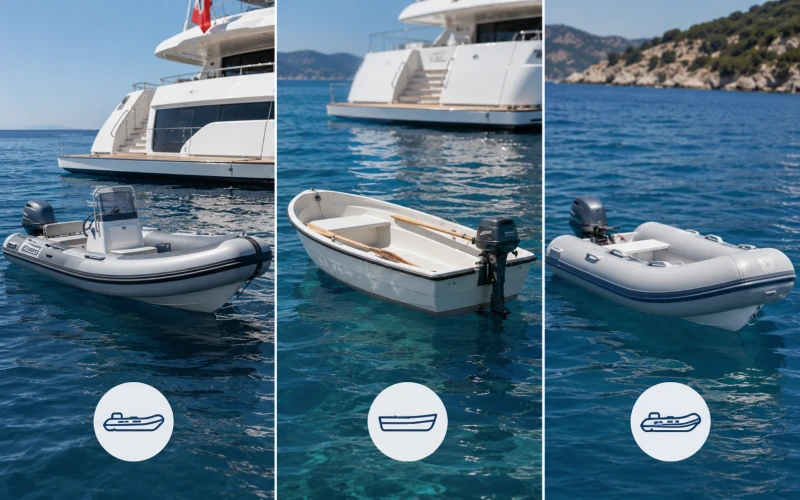
Small boats and tenders are commonly used as yacht tenders, for short coastal trips, fishing, diving, and watersports. The main types include RIBs, dinghies, and inflatable boats, with differences in size, construction, portability, and performance.
- RIBs: Rigid inflatable boats combine a rigid hull with inflatable tubes, offering stability, relatively light weight, and shallow draft
- Dinghies: Small, lightweight boats commonly used as yacht tenders, for short trips between shore and an anchored boat, or for general utility
- Inflatable Boats: Lightweight boats that can be inflated for transport and storage, with different sizes and designs for tender duties, recreation, fishing, and short-distance use
Example Listings of Boats for Sale
The following shows examples of boats of different types and sizes.
Lanzarote 77
- Length76.44 ft
- Cabins4
- Top speed29 kn
- TypeFlybridge yacht
The Lanzarote 77-foot luxury yacht, manufactured by Xiamen Tangrong Yacht Industry Co., Ltd., is a mid-to-large-sized motor yacht positioned for high-end cruising and comfortable living. Currently priced at US$2.38 million (tax-free), it offers high value for money compared to the original price of US$3 million, making it suitable for sophisticated buyers who value space, performance, and privacy.
Lamplighter
- Length80.50 ft
- Cabins3
- Top speed40 kn
- TypeFishing yacht
The Lamplighter fishing yacht is a luxury motor yacht built by Viking Yachts, specifically designed to deliver an unparalleled fishing experience.
2026 Iliad Catamarans 75
- Length75 ft
- Cabins3
- Top speed22 kn
- TypeCatamaran yacht
The 2026 Iliad 75 is a game-changing long-range catamaran that combines exceptional efficiency with luxurious accommodations. Designed for serious cruisers and charter operators, it offers a transatlantic range and Volvo power at a competitive price. This yacht represents a solid investment in the growing catamaran market.
Leopard 58
- Length57.70 ft
- Cabins6
- Top speed9 kn
- TypeCatamaran sailboat
Leopard 58 is a flagship luxury bluewater cruising catamaran built by Leopard Catamarans, designed for global voyaging. It features a reinforced twin‑hull structure with exceptional stability, seaworthiness and shallow draft, suitable for oceans worldwide. Powered by efficient engines, it offers long range, low consumption and smooth quiet performance.
2026 Custom DAYCHARTER
- Length71.80 ft
- Cabins2
- Top speed18 kn
- TypeSailboat
The 2026 Custom DAYCHARTER is not a standard mass-produced model, but rather a commercial sailing or motor yacht custom-built to meet operational requirements, with the core objectives of maximising frequency of use and profitability. Its design typically focuses on deck space, passenger flow and safety, emphasising open layouts and low-maintenance structures.
Listings and prices checked on September 2026
Prices are for reference only and may change. Check each individual listing for current pricing, specifications, and availability.
Boat Propulsion, Engine and Drive Types
Boat propulsion can be classified by how the engine and drive system are arranged, as well as by the type of power source used. These are separate characteristics, so a boat may combine an inboard engine with diesel power, for example.Engine Installation and Drive Systems
- Outboard: Common on fishing boats, center consoles, RIBs, and smaller recreational boats
- Inboard: Often used on cruisers, motor yachts, and larger boats
- Sterndrive: Common on sport cruisers, runabouts, and some recreational boats
- Pod Drive: Commonly used on many modern cruising yachts, offering excellent maneuverability and efficient propulsion
- Waterjet: Commonly used on high-speed boats, jet skis, and specialty vessels
Power Sources
- Gasoline: Common in smaller recreational boats and many outboard-powered boats
- Diesel: Widely used in trawlers, motor yachts, and larger cruising boats where range and efficiency are important
- Electric: Increasingly used on smaller recreational boats and some modern vessels
- Hybrid: Combines an internal-combustion engine with electric propulsion or energy storage and is increasingly used in some modern yachts and boats
Boat Hull Types
Hull design is another way to classify a boat. The hull affects stability, ride comfort, draft, efficiency, and performance in different water conditions.Hull Configuration
- Monohull: A traditional single-hull design used across many boats and yachts
- Catamaran: Uses two hulls to provide a wide beam, stability, and substantial living space
- Trimaran: Uses three hulls and can offer a combination of stability and performance depending on the design
Bottom Shape
- Deep-V: A V-shaped hull designed to improve offshore performance and handling in waves
- Modified-V: A compromise between stability, efficiency, and performance
- Flat-bottom: A shallow-draft hull generally suited to calm or shallow waters
Which Type of Boat Is Right for You?
The right boat depends on how you plan to use it, cruising area, passenger capacity, range, propulsion, purchase budget, and ongoing ownership costs.The table below suggests suitable boat types based on their primary purpose.
| Main Use | Boat Types to Consider |
|---|---|
| Day Boating | Bowrider, Center Console, Deck Boat, RIB |
| Family Boating | Bowrider, Deck Boat, Pontoon, Catamaran |
| Fishing | Center Console, Sportfishing Boat, Walkaround Boat, Bay Boat |
| Cruising & Overnight Trips | Motor Yacht, Express Cruiser, Cabin Cruiser, Sailing Cruiser, Catamaran |
| Long-Range Cruising | Trawler, Explorer Yacht, Motor Yacht, Power Catamaran |
| Watersports | Bowrider, Wake Boat, Ski Boat, Jet Boat |
| Sailing | Daysailer, Sailing Cruiser, Sailing Catamaran, Trimaran |
| Luxury Cruising | Motor Yacht, Flybridge Yacht, Explorer Yacht |
Buyers deciding between engine-powered cruising and sailing can compare a sailboat vs. motor yacht before narrowing the choice to a specific design.
What to Consider Before Buying a Boat
Choosing the right boat involves more than comparing boat types. Consider how you plan to use it, where you will cruise, its size and condition, and the total cost of ownership.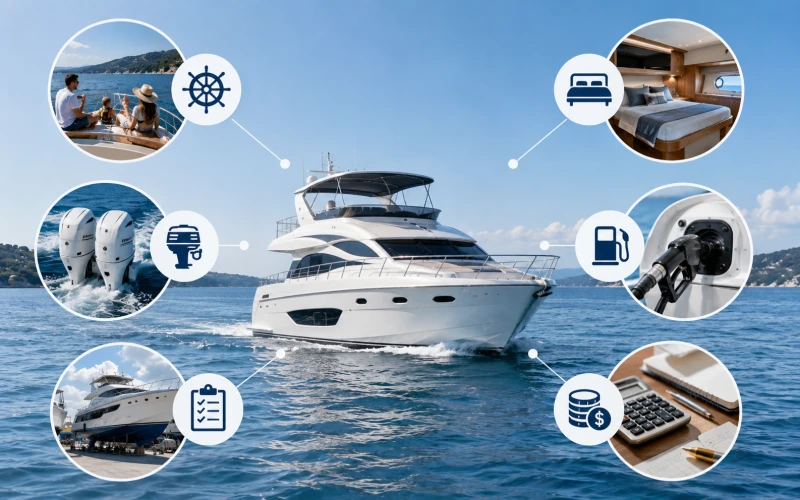
Intended Use, Cruising Area and Size
Consider whether you need the boat for day boating, coastal cruising, offshore passages, fishing, watersports, or extended cruising. Your cruising area and trip length will influence the ideal hull design, range, size, and onboard facilities.
Capacity and Accommodation
Choose a boat that provides enough space for the number of passengers and the type of trips you plan to take. For overnight or extended cruising, consider cabins, heads, galley space, storage, and living areas.
Range and Propulsion
Consider the range, cruising speed, fuel capacity, and propulsion system that match your boating plans. Powerboats may use outboards, sterndrives, or inboard engines, while larger cruising yachts commonly use diesel propulsion.
New vs. Used Boats
New boats typically offer the latest equipment, customization options, and manufacturer warranties. Used boats can provide more size or equipment for the budget. Buyers comparing pre-owned yachts for sale should pay close attention to condition, maintenance history and survey findings.
After choosing the right category, compare the pricing, warranty, depreciation and survey trade-offs in our new vs. second-hand yacht guide.
Condition, Survey and Maintenance History
For a used boat, review maintenance records, engine hours, survey reports, repair history, and major equipment condition. A professional marine survey can help identify structural, mechanical, electrical, and other issues that may not be obvious during a viewing. Before making an offer, buyers should also understand typical used yacht survey costs and what may be included in the inspection process.
Purchase Price and Ownership Costs
The purchase price is only part of the cost of owning a boat. Budget for insurance, storage or mooring, fuel, maintenance, repairs, registration, and crew where applicable. Before setting a purchase budget, estimate maintenance, berthing, insurance, fuel and crew with our yacht ownership cost calculator.
Final Thoughts
There is no single best boat type for every buyer. The right choice depends on how you plan to use the boat, where you will cruise, how much space and range you need, and your budget.Once you have narrowed down the boat type, compare individual models based on age, condition, specifications, layout, range, equipment, and asking price. For used boats, maintenance history and survey results should also be part of the evaluation.
Exploring boats for sale by type can make it easier to compare similar models and identify options that match your requirements.
👉Browse boats and yachts for sale by type
About This Guide
This guide was compiled and reviewed using current YachtTrading listings, manufacturer specifications and established boating references. Listing details and market availability should be verified before purchase.
Disclaimer
This guide is for general informational purposes only. Boat specifications, prices, performance, regulations, and ownership costs may vary by model, location, and market conditions. Buyers should verify details and seek appropriate professional advice before purchasing.
FAQ
Q1: What type of boat is best for cruising?
A: Motor yachts, trawlers, express cruisers, sailing yachts, and catamarans are common choices for cruising. The best option depends on cruising range, speed, accommodation, stability, and budget.
Q2: What type of boat is best for offshore use?
A: Offshore-capable motor yachts, trawlers, explorer yachts, sportfishing boats, and appropriately designed sailing yachts can be used offshore. The vessel's specific design and certification matter more than its category name alone.
Q3: Are catamarans better than monohulls?
A: Neither is universally better. Catamarans can offer stability, space, and shallow draft, while monohulls can provide different handling characteristics, layouts, and marina options. The better choice depends on the owner's priorities.
Q4: What type of boat should I buy?
A: Start with your intended use, cruising area, passenger requirements, desired range, preferred propulsion, and ownership budget. Then compare specific boat models within the categories that match those requirements.
Q5: What size boat is suitable for long-distance cruising?
A: The appropriate size depends on the number of passengers, range, sea conditions, storage, accommodation, and intended cruising area. Long-distance buyers should evaluate the vessel's actual range, fuel capacity, seaworthiness, and equipment rather than choosing by length alone.
Q6: Do larger boats always cost more to own?
A: Generally, larger boats tend to have higher operating and maintenance costs, but size is not the only factor. Engine type, age, equipment, fuel consumption, crew requirements, marina fees, and maintenance condition can significantly affect annual ownership costs.
Q7: Should I choose a boat based on its type or its specific model?
A: Boat type is a useful starting point, but the specific model is more important when making a purchase decision. Compare individual boats based on condition, age, specifications, layout, range, equipment, maintenance history, and total ownership costs.
Q8: What type of boat is best for a first-time buyer?
A: For many first-time buyers, a simple, versatile boat such as a bowrider, center console, or small cabin cruiser can be a practical starting point. The best choice depends on your intended use, boating experience, cruising area, and budget.