Boat loan percentage rates commonly range from around 6% to 10%, although the final rate depends on the borrower's credit profile, down payment, loan amount, vessel age, loan term and current lending conditions. Buyers with strong credit and lower loan-to-value ratios may qualify for more competitive rates, while older vessels or higher-risk applications may receive higher rates.
This guide explains current boat loan rate factors, how yacht financing works, and practical strategies to improve your chances of securing better loan conditions.
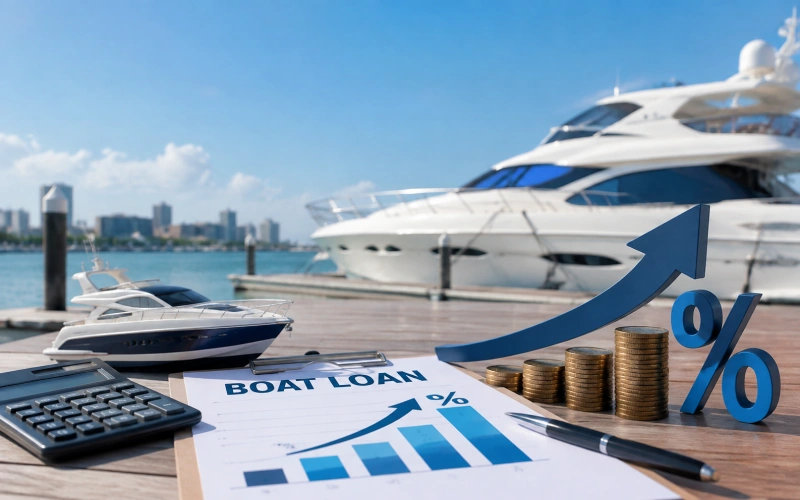
How Much Are Typical Boat Loan Percentage Rates?
As of 2026, advertised and estimated boat loan rates commonly fall within a broad range of approximately 6% to 10%, depending on the lender, borrower and vessel.New Boat Loan Rates
New boats often receive more competitive financing terms because they are easier for lenders to evaluate.As of August 2026, examples of publicly advertised new boat loan rates from selected lenders include:
- South Carolina Federal Credit Union: 7.49% APR for 0–60 month terms
- BrightBridge Credit Union: 8.84% APR for a 66-month term
Advantages of financing a new vessel include:
- Clear purchase price and documentation
- Predictable depreciation patterns
- Lower uncertainty regarding condition and maintenance history
- Easier resale value assessment
Used Boat Loan Rates
Used boat financing usually requires more detailed evaluation because the lender must determine the vessel's current market value and condition.Examples of current advertised used boat loan rates from selected lenders (published in August 2026) include:
- South Carolina Federal Credit Union offers used boat loans with rates starting from 7.99% APR for terms up to 0-60 months
- BrightBridge Credit Union lists used boat loan rates at 9.84% APR for a 66-month term
Factors such as boat age, maintenance history, documentation, and survey results can influence financing terms.
Financing for New Boats vs. Used Boats
| Factor | New Boat Financing | Used Boat Financing |
|---|---|---|
| Rate potential | Often more competitive | May be higher |
| Valuation | Purchase price is clearer | Survey and appraisal may be required |
| Vessel Condition | Usually predictable | Maintenance history matters |
| Loan Term | Potentially longer | May be limited by vessel age |
| Documentation | Generally simpler | More condition records required |
Key Factors Affecting Boat Loan Interest Rates
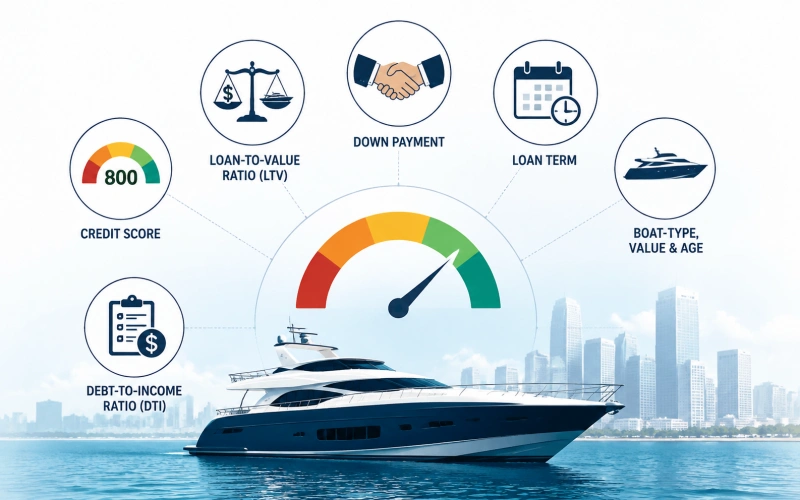
Boat loan percentage rates are usually determined through risk assessment. Lenders evaluate both the buyer and the vessel before deciding the final financing terms. The main factors include:
Credit Score
Credit score is one of the most important factors affecting marine loan rates.A strong credit profile can help buyers obtain:
- Lower interest rates
- Higher approval chances
- More flexible loan terms
Loan-to-Value Ratio (LTV)
Loan-to-value ratio (LTV) measures the relationship between the loan amount and the vessel's value.For example:
- A luxury yacht valued at $1,000,000
- A loan amount of $700,000
A lower LTV usually reduces lender risk because the buyer has more equity invested in the boat.
Down Payment
The required down payment varies depending on the lender, boat type, purchase price, and buyer qualifications.Boat loan down payments may commonly range from approximately 10% to 30%, although requirements vary significantly by lender, vessel value, loan size and borrower qualifications.
Some specialized maritime lending institutions also set different down payment requirements based on the loan amount and creditworthiness in the financing solutions they offer.
Loan Term
The loan term affects both monthly payments and total interest costs.The term of a boat loan is typically determined based on the vessel's value, age, and the loan amount:
- Smaller boats may have shorter repayment periods
- Mid-size yachts may qualify for longer terms (e.g., 10–15 years)
- High-value yachts may receive extended financing options
Boat Type, Value and Age
Unlike traditional consumer loans, boat financing depends heavily on the asset being financed.Lenders may evaluate:
- Motor yacht, sailboat, or multihull type
- Manufacturer reputation
- New or used boats
- Age and depreciation risk
- Maintenance history
- Market demand
- Marine survey results
Debt-to-Income Ratio (DTI)
Debt-to-income ratio (DTI) measures how much of a borrower's income is already committed to debt payments.Formula: DTI = Monthly debt payments ÷ Gross monthly income
A lower DTI generally indicates stronger financial capacity.
Lenders consider DTI to determine whether a buyer can comfortably manage:
- Existing financial obligations
- New yacht loan payments
- Long-term ownership costs
Example Yacht Financing Scenario: Buying a $1 Million Yacht
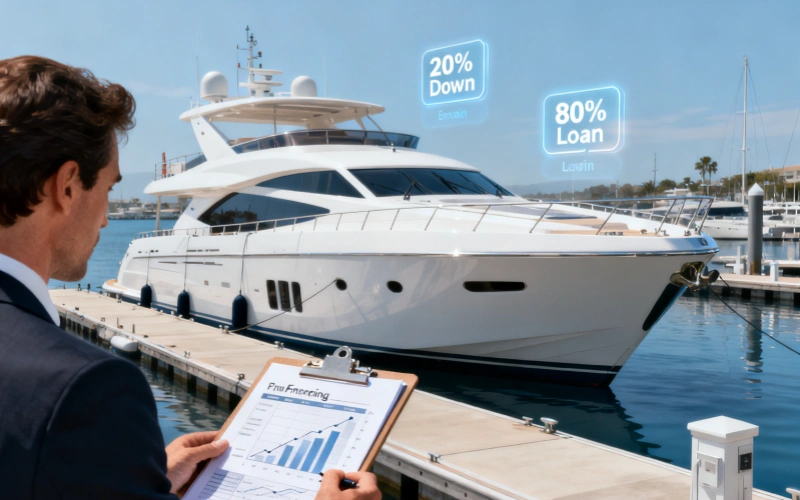
The following scenario shows how financing may work when purchasing a mid-size luxury yacht.
Example Purchase Details
- Yacht Purchase Price: $1,000,000
- Down Payment (20%): $200,000
- Estimated Loan Amount: $800,000
- Financing Type: Secured marine loan
- Possible Loan Term: 10–15 years, depending on lender requirements
Illustrative Yacht Loan Payment Examples
The estimated payments below assume a fixed-rate secured marine loan of $800,000. They are provided for illustration purposes only and do not represent actual lender offers.
| Illustrative Rate | 10-Year Monthly Payment | 15-Year Monthly Payment |
|---|---|---|
| 6% | Approximately $8,882/month | Approximately $6,751/month |
| 8% | Approximately $9,706/month | Approximately $7,645/month |
| 10% | Approximately $10,572/month | Approximately $8,597/month |
Note: Illustrative calculations only. Actual payments, fees and loan conditions vary by lender.
However, the final approval and loan terms will depend on factors such as:
- Buyer's financial profile
- Loan structure
- Yacht valuation and survey results
Boat Loans vs Auto Loans vs Mortgages
Boat financing shares similarities with other secured loans, but yachts are unique assets that require additional evaluation.| Category | Boat Loan | Auto Loan | Mortgage |
|---|---|---|---|
| Collateral | Boat or yacht | Vehicle | Real estate |
| Asset Evaluation | Vessel condition, market value, survey report | Vehicle age, mileage, condition | Property appraisal and location |
| Typical loan term | Often longer for larger vessels | Usually shorter | Commonly 15–30 years |
| Depreciation Risk | Affected by maintenance and market demand | Faster depreciation | Usually more stable long-term |
| Approval Focus | Buyer finances + vessel quality | Credit + vehicle value | Income, assets, property value |
Because yachts require specialized valuation and maintenance considerations, boat loan approval is often more detailed than standard vehicle financing.
Fixed vs Variable Boat Loan Rates: Which Is Better?
When comparing boat loan percentage rates, buyers should also consider whether the loan uses a fixed or variable interest rate.The main difference is how the rate changes over time.
Fixed Boat Loan Rates
A fixed-rate boat loan keeps the same interest rate throughout the loan term.Advantages
- Predictable monthly payments
- Easier long-term budgeting
- Protection against future rate increases
- Plan to keep the yacht for many years
- Prefer stable financial planning
- Want predictable ownership costs
Variable Boat Loan Rates
Variable-rate loans change based on market interest conditions.Potential Advantages
- Initial rates may be lower
- Borrowers may benefit if interest rates decline
- Monthly payments may increase
- Long-term costs are less predictable
- Future rate changes are uncertain
Where Can Yacht Buyers Get Boat Financing?

Yacht buyers typically explore three main financing options: banks, marine lenders, and financing support through yacht brokers.
Banks
Traditional banks may offer boat loans or marine financing services for qualified customers.Advantages
- Existing banking relationships and familiarity with communication processes
- Ability to provide a comprehensive assessment based on an individual's assets and financial situation
- Competitive loan terms may be offered to customers with good credit
- Not all banks offer specialized marine loans
- For large yachts, pre-owned boats, or complex transactions, some banks may require additional documentation or impose restrictions on the scope of financing
Marine Finance Companies
Specialized marine lenders focus specifically on boat financing.Advantages
- More industry-specific experience
- Financing options designed for yacht buyers
- Better understanding of complex vessel transactions
Yacht Brokers
Experienced yacht brokers can also help buyers navigate financing options.A yacht broker may assist with:
- Connecting buyers with financing providers
- Understanding available loan structures
- Coordinating purchase documentation
- Managing communication between parties
How to Get Better Boat Loan Rates
Before applying for boat financing, buyers can take several steps to improve their chances of receiving competitive loan terms.Improve Your Credit Profile
Before applying:- Review your credit report
- Correct inaccurate information
- Reduce outstanding credit balances
- Avoid opening multiple new accounts
- Maintain consistent payment history
Increase Your Down Payment
A larger down payment can improve financing conditions by reducing lender exposure.Benefits include:
- Lower LTV
- Smaller loan amount
- Reduced monthly payments
- Greater lender confidence
Compare Multiple Lenders
Boat loan rates vary between lenders. Comparing offers allows buyers to evaluate:- Interest rates
- Loan terms
- Prepayment conditions
- Financing flexibility
Choose the Right Loan Term
The ideal loan term depends on cash flow and long-term ownership goals. Buyers should also consider annual ownership costs, including insurance, maintenance, marina fees, and crew expenses.Longer Loan Terms
- Lower monthly payments
- Easier short-term budgeting
- Higher total interest costs
- Longer repayment period
- Lower total interest
- Faster repayment
- Higher monthly payments
Conclusion: Understanding Boat Loan Percentage Rates Before Buying a Boat
For boat buyers, finding the right financing option is not only about securing the lowest possible rate. It is also about choosing a loan structure that matches your ownership plans, cash flow, and long-term goals.
👉Explore New Yachts for Sale
👉Browse Used Yachts for Sale
About This Guide
This guide was prepared using publicly available marine lending information and general yacht purchasing considerations. It is intended to help buyers understand common financing terminology and should not replace advice from a qualified lender or financial professional.
Disclaimer
Boat loan rates, approval requirements, and financing terms vary by lender, country, vessel type, and borrower qualifications. The information provided is for educational purposes only and should not be considered financial advice. Buyers should consult qualified lenders or financial professionals before making financing decisions.
FAQ
Q1: What credit score do you need for a boat loan?
A: Boat loan credit score requirements vary by lender. Borrowers with stronger credit profiles generally have better chances of receiving competitive interest rates and financing terms.
Q2: What is considered a good boat loan interest rate?
A: A good boat loan interest rate depends on current market conditions, lender requirements, borrower qualifications, and the vessel being financed. Buyers with strong credit, lower loan-to-value (LTV) ratios, and stable financial profiles are more likely to qualify for competitive rates.
Q3: How much down payment is required for a yacht loan?
A: Boat and yacht loan down payments may range from approximately 10% to 30%, although higher-value yachts, older vessels or more complex transactions may require additional equity.
Q4: How long can a boat loan last?
A: Boat loan terms vary by lender, loan size and vessel age. Smaller loans may use shorter terms, while qualified borrowers financing higher-value yachts may receive terms of 10 to 15 years or longer.
Q5: Are boat loan rates higher than car loan rates?
A: Boat loan rates may differ from auto loan rates because boats are specialized assets with different valuation, maintenance, and resale considerations. The final rate depends on the borrower and vessel.
Q6: Do boat loan rates change when Federal Reserve rates change?
A: Variable-rate boat loans may be affected by changes in market interest rates, while fixed-rate loans generally remain unchanged after approval. The relationship depends on the lender's pricing structure and loan agreement.
Q7: What is a good interest rate for a boat loan?
A: A good boat loan rate depends on current market conditions, the borrower’s credit profile, the down payment, the loan term and the vessel being financed. Buyers should compare the total loan cost rather than relying only on the lowest advertised rate.
Q8: Are used boat loan rates higher than new boat loan rates?
A: Used boat financing may carry higher rates or stricter requirements because lenders need to evaluate the vessel’s age, condition, market value, maintenance history and survey results.