There is no standard percentage that applies to every used yacht. The right offer depends on the yacht's fair market value, condition, maintenance history, comparable listings, and the seller's position.
Instead of starting with a fixed discount from the asking price, estimate the yacht's fair market value first, then set your target purchase price, maximum price, and initial offer.
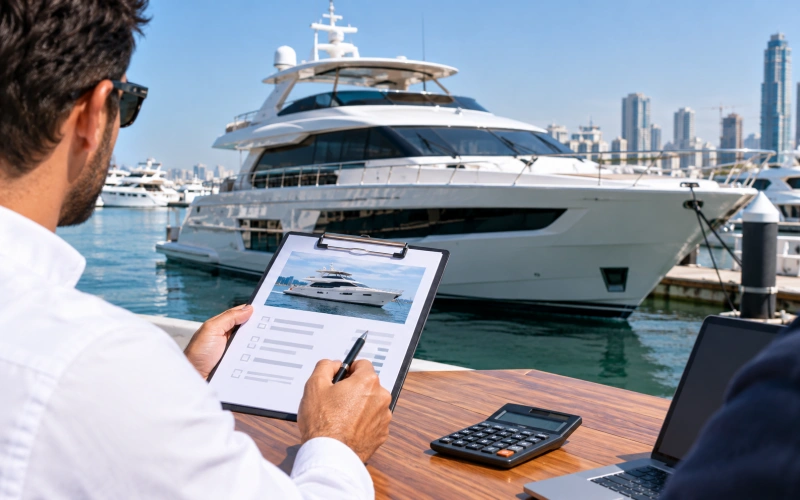
How to Set Your Initial Offer on a Used Yacht
Before making an offer, establish four key price points: your estimated fair market value, target purchase price, maximum purchase price, and initial offer. These give you a framework for deciding how much to offer without relying on an arbitrary percentage below the asking price.Set Your Four Key Price Points
| Price Point | What It Means |
|---|---|
| Fair Market Value | What you believe the yacht is reasonably worth based on comparable vessels, condition, specification, and market evidence |
| Target Purchase Price | The price you would ideally like to pay |
| Maximum Purchase Price | The highest purchase price you are prepared to pay, taking account of your valuation, total budget and other acquisition costs |
| Initial Offer | The opening price you present to the seller as your starting point for negotiation |
Your initial offer does not necessarily need to equal your estimated fair market value. It can be below your target purchase price to leave room for negotiation, but it should still be credible and supported by the yacht's market position, condition, and comparable vessels.
Hypothetical Offer Example: A Used 60-Foot Flybridge Yacht
For illustration, assume a used 60-foot flybridge yacht has an asking price of $1,000,000. The figures below are hypothetical and are not a valuation of a specific listing.For this example, assume that comparisons with yachts of a similar make, model, age, specification and condition support an estimated value range of $900,000–$950,000 after adjustments for relevant differences. Comparable asking prices are reference points; verified recent sale prices, where available, provide additional evidence.
Based on the yacht's condition, equipment, maintenance history, and comparable listings, you set:
| Measure | Amount |
|---|---|
| Asking Price | $1,000,000 |
| Estimated Fair Market Value | $900,000–$950,000 |
| Target Purchase Price | $925,000 |
| Maximum Purchase Price | $950,000 |
| Initial Offer | $895,000 |
The initial offer is a negotiation position, not necessarily your estimate of the yacht's fair market value. In this example, the buyer starts at $895,000 to leave room for negotiation while keeping a target purchase price of $925,000 and a maximum price of $950,000.
The $895,000 opening offer is 10.5% below the $1,000,000 asking price, but this percentage should not be treated as a standard discount for used yachts. The appropriate opening offer depends on the yacht's market position, condition, comparable vessels, maintenance history, and the buyer's negotiation strategy.
These figures are illustrative only and do not represent the current market value or asking price of a Westport 60 ft Flybridge Yacht. Actual offers should be based on relevant comparable yachts, the vessel's condition, survey findings, equipment, maintenance history, and current market conditions.
What Determines How Much You Should Offer?
The right offer depends on more than the yacht's asking price. Before deciding how much below asking price to offer, consider the yacht's market value, condition, maintenance history, market position, and total acquisition cost.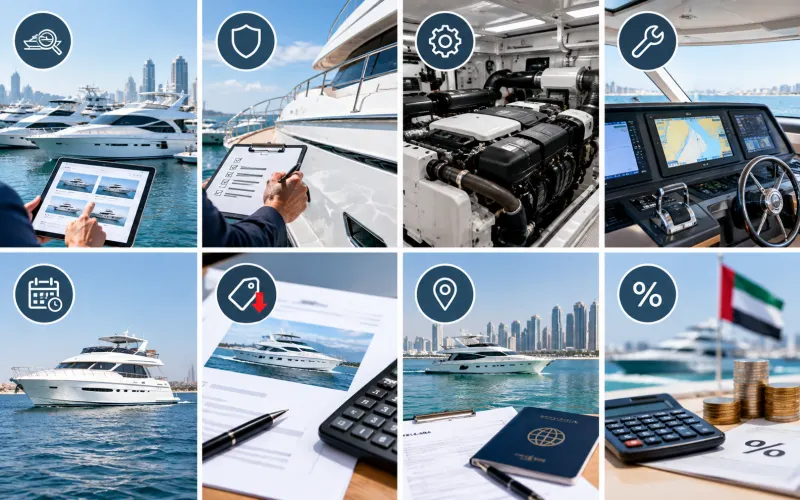
Fair Market Value and Comparable Yachts
Compare the yacht with several similar vessels based on:- Yacht brands, make, model, and year
- Length, layout, and engine configuration
- Engine hours and equipment
- Condition and maintenance history
For background on how age and upkeep influence value, see our guide to boat depreciation and resale value.
Yacht Condition
Condition can make a significant difference even between yachts of the same model and year. Consider the hull, interior, exterior, onboard systems, electronics, and overall level of upkeep.A well-maintained yacht with good records may justify an offer closer to asking price, while visible defects or poor upkeep may support a lower offer.
Engine Hours and Maintenance History
Look at engine and generator hours together with their service history. High hours do not automatically mean poor value if the machinery has been properly maintained, while low hours do not guarantee good condition.Review available service records, major repairs, replacement work, and evidence of regular maintenance.
Deferred Maintenance, Repairs and Upgrades
Consider both known repairs and costs that may arise soon after purchase. Items such as aging equipment, overdue servicing, worn components, outdated electronics, or systems approaching replacement can affect the yacht's overall value to a buyer.You should also distinguish between necessary repairs and optional upgrades. A seller's recent investment in desirable equipment may support the asking price, but buyers should not assume that every upgrade adds its full purchase cost to the yacht's market value.
Time on the Market
A yacht that has been listed for a long period may provide more room for negotiation, particularly if there has been limited buyer interest. However, time on the market alone does not prove that a yacht is overpriced.Previous Price Reductions
Check whether the asking price has already been reduced. A recent reduction may indicate that the seller has already adjusted the price in response to market conditions, while repeated reductions may provide useful context for evaluating the current asking price.Location, VAT and Tax Status
Location and VAT or tax status can affect the buyer's total acquisition cost. When comparing yachts, make sure you understand their location, applicable taxes or duties, VAT position where relevant, and any significant delivery or relocation costs.Two similar yachts may not be directly comparable if their tax status or acquisition costs are substantially different.
Should You Always Offer Below the Asking Price?
Not necessarily. The asking price is the seller's starting point, but that does not automatically mean the yacht is overpriced.Whether you should offer below asking depends first on how the yacht is priced relative to comparable vessels.
If the yacht is already competitively priced, making a significantly lower offer simply because it is a used yacht may not be a sensible strategy. You could risk losing a fairly priced yacht to another buyer.
On the other hand, if the asking price is noticeably above comparable yachts, or the vessel has condition or maintenance issues that are not reflected in the price, there may be a stronger case for offering less.
Two yachts of the same model and year can justify different offers. A vessel with documented servicing, well-maintained systems and good overall condition may support a price closer to asking, while one with deferred maintenance and incomplete records may warrant a lower offer. Engine hours should be assessed alongside service history, rather than used alone to judge value.
When Can You Justify a Lower Offer?
A lower offer is more defensible when you can point to specific evidence.For example:
- The asking price remains above relevant comparables despite a long listing period or previous reductions
- Significant maintenance has been deferred
- Engine or generator work is required
- Electronics are obsolete or failing
- Maintenance records are incomplete
- A recent survey identifies material defects
- The yacht requires substantial refurbishment
- The condition is inconsistent with the asking price
A more constructive approach is: "Based on the comparable yachts we have reviewed and the maintenance work identified, we believe this offer reflects the vessel's current condition and market position."
That gives the seller something to evaluate.
When Should You Offer Close to Asking Price?
There are also situations where a buyer may want to make a relatively strong offer.For example:
- The yacht has just been listed at a competitive price supported by relevant comparables
- The asking price is already competitive
- Comparable yachts are priced similarly
- The yacht has excellent maintenance records
- Engine hours are favorable for its age
- Major systems have recently been serviced or replaced
- The yacht has undergone a meaningful refit
- The model is in strong demand
- There are multiple interested buyers
A good purchase is not necessarily the yacht with the largest percentage discount.
It is the yacht you can buy at a price that makes sense relative to its condition and market value.
How Does a Yacht Survey Affect Your Offer?
A yacht survey can give you evidence to support a price adjustment, but a survey finding does not automatically mean the seller must reduce the price. The impact depends on the severity of the issue, the estimated repair cost, the yacht's overall condition, and the terms of the purchase agreement.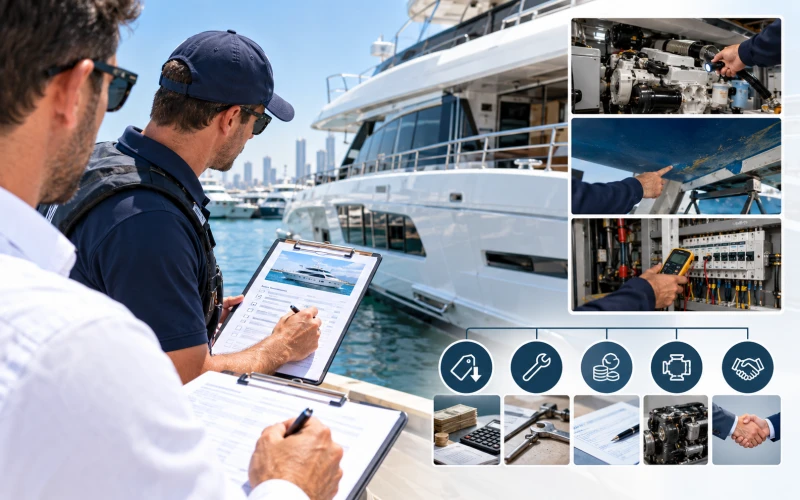
Should You Make an Offer Before a Yacht Survey?
In many yacht transactions, a buyer may make an initial offer subject to conditions such as a personal inspection, marine survey, sea trial, and inventory. The exact conditions, deadlines, and deposit provisions depend on the purchase and sale agreement.An IYBA article on escrow and deposits describes purchase agreements that include inspection, survey, sea-trial and inventory conditions. Buyers should check their own agreement for the applicable deadlines, notice requirements and deposit provisions.
For buyers, this means you do not necessarily need to wait for the survey before making an initial offer. Instead, make sure the purchase agreement clearly sets out the applicable inspection, survey and sea-trial conditions before committing to the transaction.
When planning the inspection stage, review our guide to used yacht survey costs to budget for the survey and possible additional checks.
What Survey Findings Can Support a Price Adjustment?
A pre-purchase marine survey is designed to help a buyer understand the yacht's actual condition before completing the purchase. According to the American Boat & Yacht Council, a pre-purchase survey can provide information needed to make an informed purchase decision and may include operational testing and a sea trial. ABYC also notes that a marine survey can be useful when negotiating price based on repairs the yacht needs.A survey may affect your offer when it identifies issues such as:
- Significant mechanical or electrical defects
- Structural or hull-related concerns
- Systems that require immediate repair or replacement
- Deferred maintenance that was not apparent during the initial viewing
- Equipment that is not functioning as represented
- Repairs that could create substantial near-term ownership costs
For further reading on powerboat construction and condition assessment, explore David Pascoe’s boat-buying and surveying books.
What Can You Negotiate After a Yacht Survey?
If the survey identifies material issues, you can discuss several possible solutions with the seller:- A reduction in the purchase price
- Seller-completed repairs before closing
- A credit or allowance for agreed repairs
- Replacement of specific defective equipment
- Another adjustment agreed to by both parties
Your negotiation should therefore connect the survey findings, repair implications, and agreed purchase price rather than simply applying a fixed percentage discount.
For a broader overview of surveys, taxes, legal fees, escrow, and other acquisition expenses, see our yacht closing costs guide.
What If the Seller Rejects Your Offer?
A rejected offer does not necessarily end the negotiation.The Seller Rejects the Offer
First, determine whether the seller is willing to make a counteroffer.Then compare the counteroffer with your own valuation.
If the difference is too large, walking away may be the right decision.
If the seller will not counter, ask whether the disagreement concerns price or other offer terms, then decide whether your evidence justifies revising the offer.
The Seller Makes a Counteroffer
Do not automatically split the difference.Using the earlier example, if you offer $895,000 and the seller counters at $975,000, the midpoint is $935,000. That figure is below your $950,000 ceiling but above your $925,000 target. It is not automatically the right price: check whether the yacht's value and the agreed terms justify it.
The Seller Says the Price Is Firm
If the price is firm, you may still discuss the closing date, included inventory or agreed repairs, subject to the purchase agreement.Common Mistakes When Making an Offer on a Used Yacht
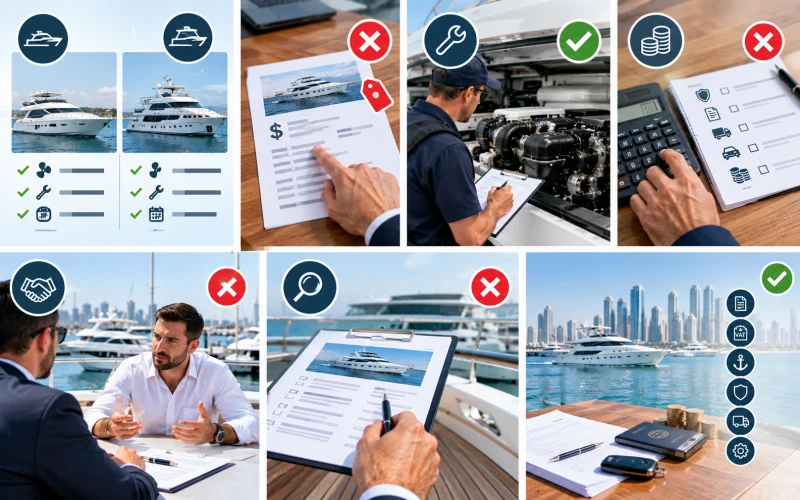
Mistake 1: Comparing Yachts Only by Length and Year
Two yachts with the same length and model year can have very different values because of equipment, engine hours, maintenance and condition.
Mistake 2: Treating Asking Prices as Sale Prices
An advertised price shows what the seller is asking. It does not necessarily show the final transaction price.
Mistake 3: Ignoring Maintenance History
Engine hours alone do not tell the complete story. Review the available maintenance records and major repair history.
Mistake 4: Deducting Every Future Expense
Not every future maintenance expense is a negotiation point. Focus on material deferred work and costs that are unusually high relative to the yacht's condition.
Mistake 5: Making an Unsupported Lowball Offer
A low offer without evidence can make productive negotiation more difficult.
If you believe the yacht is overpriced, explain the comparable market evidence and condition factors supporting your position.
Mistake 6: Treating Every Survey Finding as a Discount
A survey identifies the yacht's condition. It does not mean every item in the report should be deducted from the purchase price.
Focus on significant findings and their actual financial or operational impact.
Mistake 7: Forgetting the Total Acquisition Cost
The purchase price is only one part of buying a yacht.
Depending on the yacht and transaction, buyers may also need to consider:
- VAT or other applicable taxes
- Registration
- Survey
- Insurance
- Delivery
- Documentation
- Financing costs
- Immediate maintenance
Used Yacht Offer Checklist
Before submitting an offer, review the following:- Have I compared several genuinely similar yachts?
- Have I considered model, year and specification?
- Have I reviewed engine hours?
- Have I reviewed available maintenance records?
- Do I understand the yacht's current condition?
- Has the asking price already been reduced?
- How long has the yacht been listed?
- Are there identifiable maintenance or repair requirements?
- Have I considered the yacht's VAT or tax position?
- Have I established my target purchase price?
- Have I established my maximum price?
- Can I explain why my opening offer is reasonable?
- Is the offer structured with appropriate survey and sea-trial conditions?
- Do I understand what happens if the survey identifies a material defect?
Final Takeaway: Make an Evidence-Based Offer
There is no universal percentage that tells you how much below asking price you should offer on a used yacht. The strongest offer is based on comparable yachts, actual market evidence, condition, maintenance requirements, and the costs you will inherit after purchase.Once you have identified a yacht that fits your budget and requirements, compare its asking price with similar yachts currently available and use the information above to determine a realistic offer.
👉 Browse Used Yachts for Sale
About This Guide
This guide explains how buyers can use comparable yachts, condition reports and acquisition costs to plan an offer on a used yacht.
Disclaimer
This guide is for general informational purposes only and is not financial, legal, tax or professional yacht-buying advice. Buyers should conduct appropriate due diligence and consult qualified professionals before purchasing a yacht.
FAQ
Q1: How much below asking price should I offer on a used yacht?
A: There is no universal percentage. A reasonable offer depends on comparable yachts, the yacht's condition, equipment, maintenance history, time on the market, previous price reductions and other transaction factors.
Q2: Can you negotiate the price of a used yacht?
A: Yes. Used-yacht transactions are generally negotiated, but the amount of flexibility varies considerably between vessels. Your negotiating position is stronger when you can support your offer with comparable market evidence and documented condition issues.
Q3: How do I know if a used yacht is overpriced?
A: Compare it with several similar yachts while accounting for model, age, specification, engine hours, equipment, condition, maintenance history and location. Do not compare asking prices based on length and year alone.
Q4: Should I make an offer before the yacht survey?
A: A buyer may make an initial offer subject to the appropriate contractual conditions, including survey and sea trial, depending on the transaction structure.
Q5: Can I negotiate after a yacht survey?
A: Potentially, particularly when the survey identifies significant issues that were not previously known or reasonably reflected in the offer. Whether and how you can renegotiate depends on the purchase agreement and the circumstances of the transaction.
Q6: What is a lowball offer on a yacht?
A: A lowball offer is an offer substantially below what the market evidence supports without a reasonable justification. A low offer is not necessarily a lowball offer. If comparable yachts and documented condition issues support the number, it can be a legitimate negotiating position.
Q7: Can a yacht survey justify renegotiating the purchase price?
A: Yes. A yacht survey can provide a basis for renegotiating the purchase price when it identifies material defects, significant repair requirements, or conditions that were not reflected in the original offer. However, not every survey finding justifies a price reduction. The buyer should focus on material issues, their likely cost or impact, and the terms of the purchase agreement.