Quick Answer
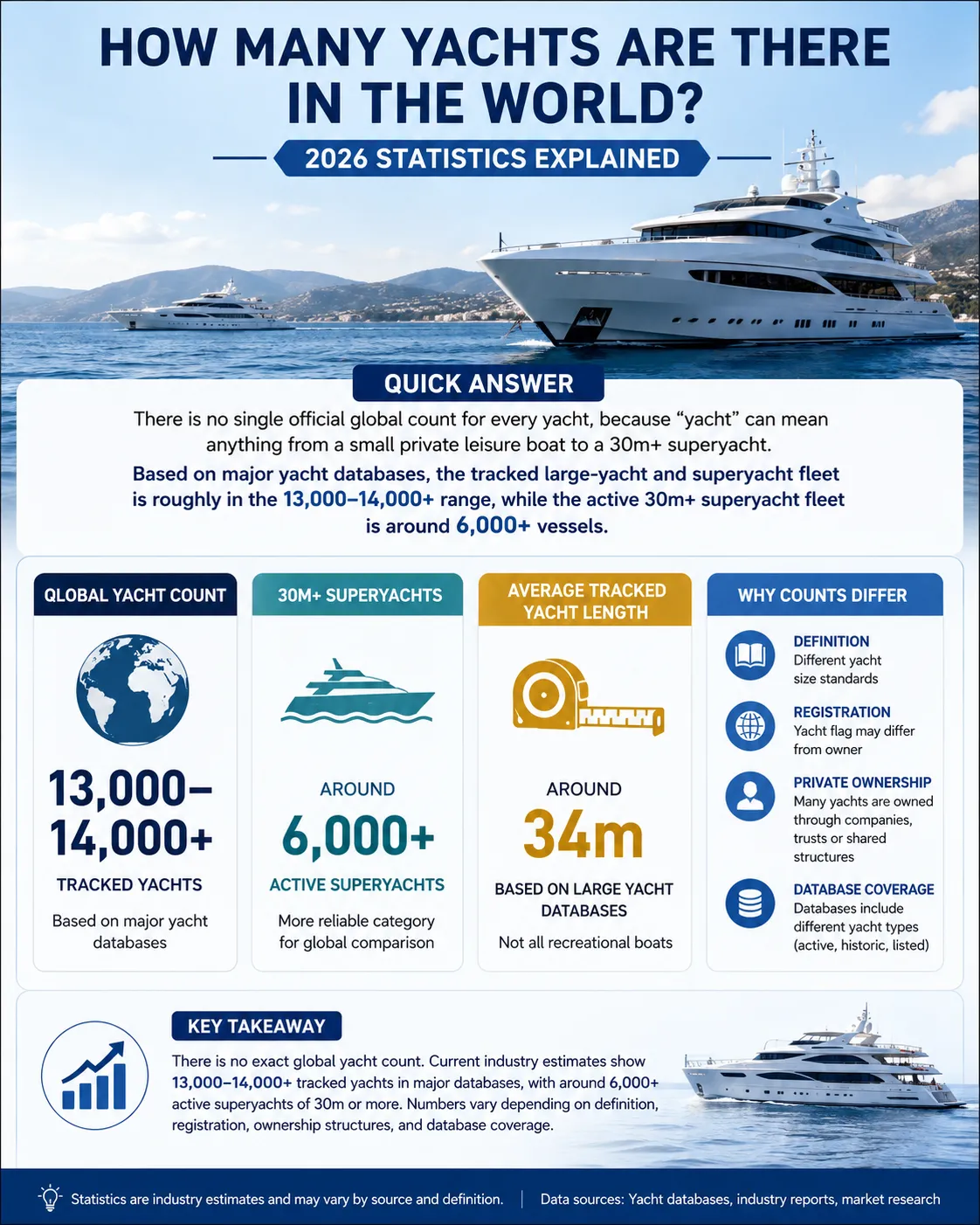
There is no single official global count for every yacht, because “yacht” can mean anything from a small private leisure boat to a 30m+ superyacht. Based on major yacht databases, the tracked large-yacht and superyacht fleet is roughly in the 13,000–14,000+ range, while the active 30m+ superyacht fleet is around 6,000+ vessels.
| Question | Best Estimate | Important Note |
|---|---|---|
| How many yachts are there in the world? | 13,000–14,000+ tracked yachts | Depends on yacht definition and database coverage |
| How many 30m+ superyachts are active? | Around 6,000+ | More reliable category for global comparison |
| How many yachts are listed in major databases? | 13,000–14,000+ | May include active, historic, listed or tracked vessels |
| What is the average yacht length? | Around 34m | Based on large yacht databases, not all recreational boats |
| How many people own yachts? | No exact public number | Ownership can involve companies, trusts, families or shared ownership |
Why Is It So Hard to Count Every Yacht in the World?
Counting every yacht in the world is difficult because there is no single global definition of what qualifies as a yacht.
Unlike commercial ships, private yachts are registered under different national authorities, ownership structures, and industry databases. As a result, global yacht statistics often vary depending on which vessels are included.
Three main factors make accurate counting challenging:
Different Yacht Definitions
The term “yacht” can refer to a wide range of vessels. Some owners consider a 12-metre private motor yacht a yacht, while industry databases usually focus on larger luxury vessels, such as superyachts above 24 or 30 metres.
For comparison:
- Small private yacht: around 8–15 metres
- Superyacht: generally 24m+ or 30m+ depending on the source
- Megayacht: often refers to vessels above 60m or 80m
Because different organizations use different standards, total yacht estimates can vary significantly.
Private Ownership Limits Transparency
Many luxury yachts are owned through companies, family offices, trusts, or shared ownership structures rather than directly by individuals. This makes it difficult to accurately identify every yacht owner or connect yachts to specific countries.
Registration Does Not Always Equal Ownership
A yacht’s registration country may be different from the owner’s nationality or operating location. For example, a yacht owned by a European, American, or Middle Eastern owner may be registered under another flag for operational or legal reasons.
Therefore, global yacht statistics should be viewed as industry estimates rather than an exact worldwide count.
Yachts vs Superyachts vs Recreational Boats: What Counts?
Understanding yacht categories is essential before looking at global statistics.
| Term | Common Meaning | Count Reliability |
|---|---|---|
| Yacht | Private leisure vessel, usually larger and more luxurious than ordinary boats | Medium |
| Superyacht | Luxury yacht generally above 24m or 30m depending on industry standards | Higher |
| Megayacht | Informal term often used for yachts above 60m or 80m | Medium |
| Recreational boat | Includes smaller motorboats, fishing boats, sailboats and leisure vessels | Very broad |
The reason many statistics focus on superyachts is that these vessels are easier to track. Large yachts usually require professional crews, international registration, shipyards, brokers and maintenance networks, creating better industry records.
How Many Superyachts Are There Worldwide?
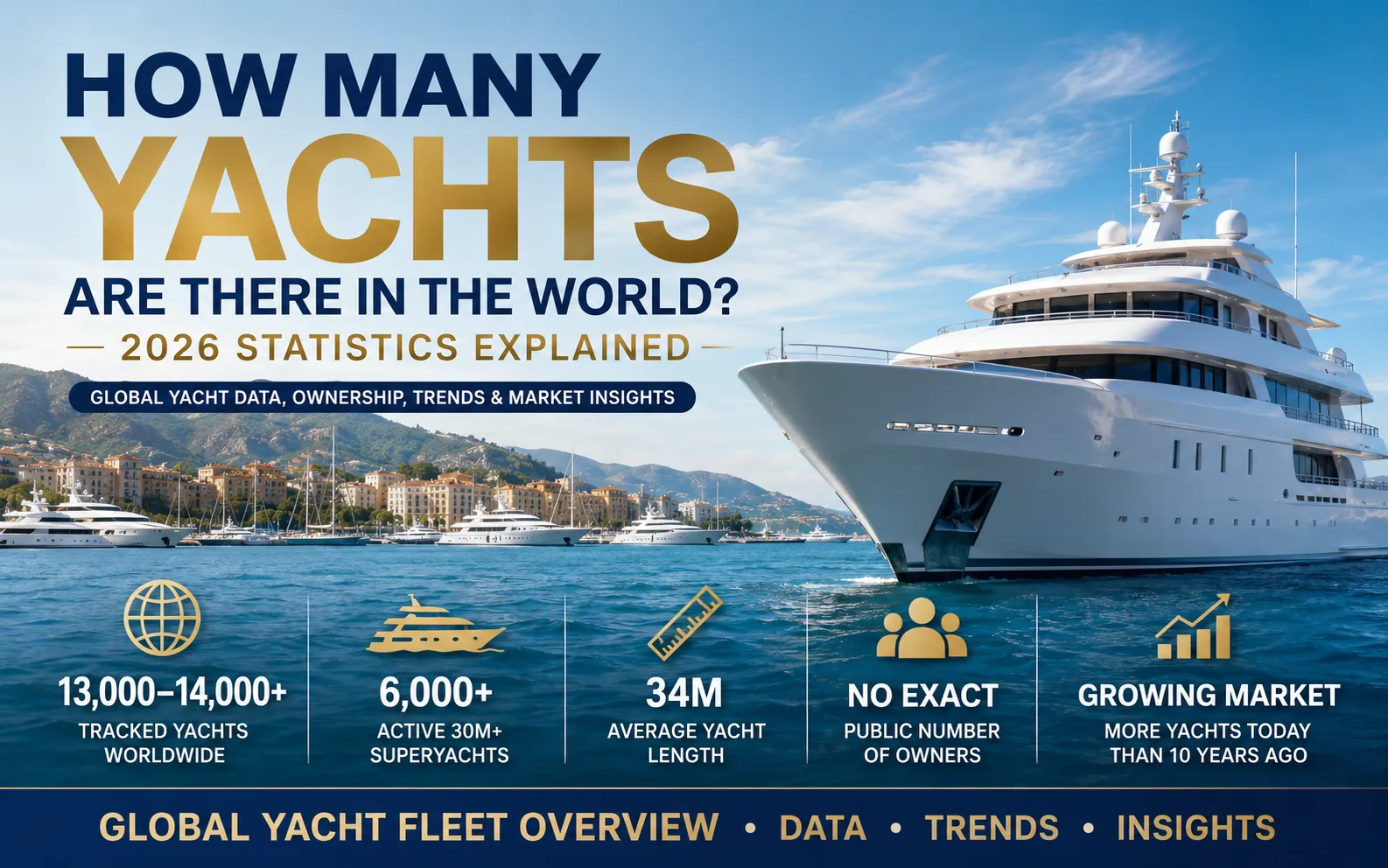
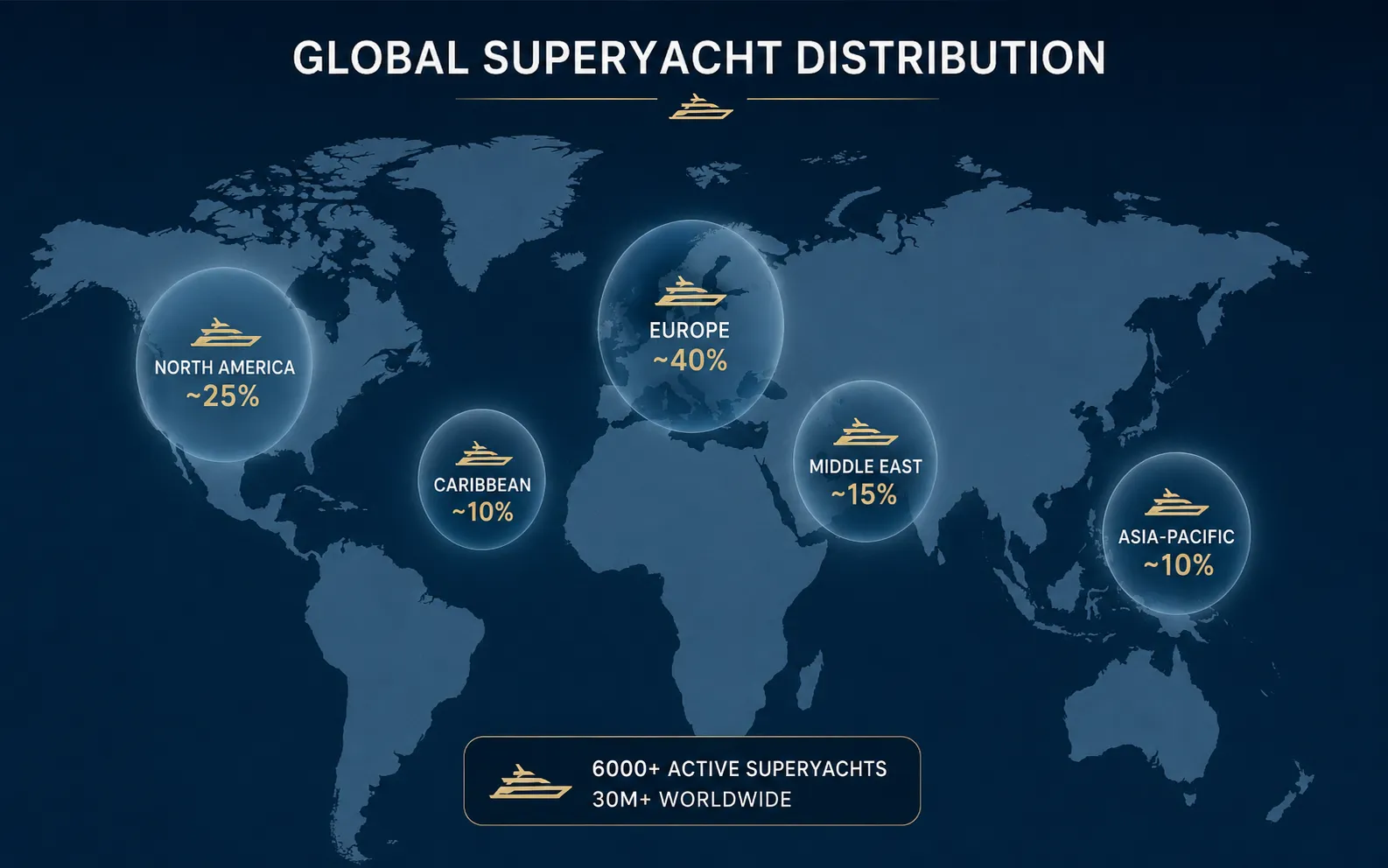
The number of superyachts worldwide depends on the size definition and database used, but the active 30-metre-plus superyacht fleet is estimated at around 6,000+ vessels globally.
Superyachts are easier to track than smaller recreational yachts because they usually require professional crews, international registration, shipyard records, and specialist industry databases.
However, broader yacht directories may record 13,000–14,000+ yachts, as these databases can include not only active superyachts but also:
- Recently delivered yachts
- Charter yachts
- Previously active vessels
- Historic yachts
- Industry-tracked yachts of different categories
The difference between these figures highlights why there is no single official worldwide yacht count.
The global superyacht fleet is mainly concentrated in major luxury yachting regions, including:
- Mediterranean Europe
- North America
- Middle East
- Caribbean
- Asia-Pacific
Among these markets, the Mediterranean remains the world’s leading superyacht cruising region. Countries such as France, Italy, Greece, and Spain attract thousands of private yachts and charter vessels each year due to their coastline, marinas, and established yachting infrastructure.
How Many People Own Yachts?
There is no official global database showing the exact number of yacht owners, because many yachts are registered under companies, trusts, family offices, or shared ownership structures rather than individual names.
The number of yacht owners is also not equal to the number of yachts. Some wealthy individuals own multiple yachts, while some yachts are owned collectively by several investors or managed through corporate entities.
Common yacht ownership structures include:
- Private individuals
- Family offices
- Holding companies
- Trust structures
- Shared ownership groups
For example, one owner may operate several yachts in different regions, while a single large yacht may belong to a company rather than a specific person.
Because of these factors, estimating the total number of yacht owners worldwide is extremely difficult. However, yacht ownership remains concentrated among high-net-worth individuals, business leaders, investment groups, and royal families.
Which Country Has the Most Yachts?
The answer depends on whether the measurement is based on yacht ownership, registration country, cruising location, or marina activity.
There is no universally accepted ranking of “which country owns the most yachts,” because different datasets measure different things.
For example:
- A yacht may be owned by a US citizen but registered under a foreign flag.
- A European owner may keep a yacht in the Mediterranean.
- A Middle Eastern owner may operate a yacht internationally.
However, several regions consistently rank among the world's largest yacht markets.
United States
The United States remains one of the strongest yacht markets worldwide due to:
- A large population of high-net-worth individuals
- Extensive coastline
- Strong boating culture
- Major yacht hubs such as Florida and California
The US market includes everything from smaller private yachts to some of the world's largest superyachts.
Major yacht locations include:
- Florida
- California
- Fort Lauderdale
- Miami
Fort Lauderdale is often called the “Yachting Capital of the World” because of its large marina network, yacht services, and international boat shows.
Europe
Europe remains the historic center of luxury yachting.
Countries with strong yacht ownership and cruising activity include:
| Country | Why It Is Important |
|---|---|
| Italy | Major yacht builders and Mediterranean cruising culture |
| France | Luxury destinations and shipbuilding expertise |
| Greece | One of the world's most popular yacht cruising areas |
| Spain | Strong charter market and Mediterranean ports |
| United Kingdom | Long history of yacht ownership and marine services |
Italy is especially influential because many of the world's leading yacht manufacturers are based there, including:
Middle East
The Middle East has become one of the most important markets for large luxury yachts.
Countries such as:
- United Arab Emirates
- Saudi Arabia
have attracted some of the world's largest private yachts due to significant wealth concentration and luxury tourism development.
What Is the Average Yacht Length?
The average yacht length depends on which type of yacht is included in the calculation. For large yachts tracked by specialist industry databases, the average length is around 34 metres, but this figure does not represent all recreational boats and smaller private yachts worldwide.
The reason is that major yacht databases mainly focus on professionally tracked vessels, especially luxury yachts and superyachts that require international registration, shipyard records, brokers, and ongoing management.
A general yacht size classification looks like this:
| Yacht Category | Typical Length | Common Use |
|---|---|---|
| Small yacht | 8–15 metres | Weekend cruising, coastal leisure |
| Mid-size yacht | 15–25 metres | Private cruising and longer trips |
| Superyacht | 24–60 metres | Luxury private use and charter |
| Large superyacht | 60 metres+ | Ultra-luxury travel and extended voyages |
| Megayacht | 80 metres+ | Custom-built vessels for UHNW owners |
Are There More Yachts Today Than 10 Years Ago?
Yes, the global yacht market has grown over the past decade, although the exact increase is difficult to measure because there is no single database tracking every yacht worldwide.
The growth has been mainly driven by several factors:
Rising numbers of high-net-worth individuals (HNWIs) have increased demand for luxury assets, including private yachts and superyachts. Wealth growth in regions such as North America, Europe, the Middle East, and Asia-Pacific has introduced more buyers to yacht ownership.
Continued yacht production and innovation have also supported market expansion. Yacht builders are producing larger, more advanced vessels with longer cruising ranges, improved technology, and highly customized interiors, especially in the superyacht segment.
The growth of the yacht charter market has further expanded access to yachting. Many clients now experience private cruising through charter before considering full yacht ownership, creating a wider pipeline of future buyers.
Over the past decade, the market has also shifted toward larger and more personalized yachts, with strong demand for 30–60 metre superyachts, explorer yachts, and custom-built vessels.
For buyers, this growth means there are now more options available across different price levels, from smaller private yachts to luxury superyachts. However, ownership decisions should consider not only the purchase price but also long-term costs such as maintenance, crew, insurance, and marina fees.
The Most Expensive Verified Yachts in the World
The highest-value yachts are usually custom-built vessels created for billionaires, royal families, and private owners.
When discussing the most expensive yacht in the world, it is important to separate verified yachts from internet rumors.
The frequently mentioned “History Supreme” yacht valued at $4.8 billion should be treated as an unverified claim rather than a confirmed yacht record.
More reliable examples include:
| Yacht | Estimated Value | Owner / Association |
|---|---|---|
| Azzam | About $600 million | Built by Lürssen |
| Eclipse yacht | Around $500 million+ | Associated with Roman Abramovich |
| Dubai yacht | Around $400 million+ | Owned by Dubai royal family |
| Koru yacht | Estimated hundreds of millions | Owned by Jeff Bezos |
The value of these yachts comes from much more than size. Factors include:
- Custom engineering
- Rare materials
- Interior design
- Crew facilities
- Technology systems
- Helicopter platforms
- Swimming pools and beach clubs
What These Yacht Numbers Mean for Buyers
Understanding global yacht statistics helps buyers better understand where they fit within the international yacht market.
The yacht market covers a wide range of ownership levels.
For example:
- First-time buyers may consider smaller motor yachts or sailing yachts.
- Experienced owners often move into 30–50 metre yachts.
- Ultra-high-net-worth individuals may commission custom superyachts above 70 metres.
Before purchasing a yacht, buyers usually need to consider:
- Purchase price
- Maintenance costs
- Crew expenses
- Marina fees
- Insurance
- Fuel consumption
- Resale value
👉 For buyers interested in exploring available vessels, professional yacht marketplaces provide access to:
Disclaimer
The content of this article is intended solely to provide information on the yacht industry, analyze market trends, and serve as a reference; it does not constitute investment advice, a recommendation to purchase, or a commercial commitment of any kind. The global yacht counts, market data, price estimates, and industry statistics mentioned in this article are derived from publicly available sources and industry research. Due to variations in yacht definitions, statistical standards, and data sources, the relevant figures may vary to some extent. Before making any decisions regarding yacht purchases, investments, or business matters, readers should consider their specific circumstances and consult professional organizations or industry experts. This article assumes no liability for any direct or indirect losses arising from the use of the information contained herein.
FAQ
Q1: How many yachts are there in the world?
A: There is no single official count, but major yacht databases suggest that the tracked large-yacht and superyacht fleet is in the 13,000–14,000+ range, depending on definition and source.
Q2: How many superyachts are there in the world?
A: The active 30m+ superyacht fleet is generally estimated at around 6,000+ vessels, while broader superyacht databases may list more because they include historic, inactive, listed or database-tracked yachts.
Q3: How many people own yachts in the world?
A: The active 30m+ superyacht fleet is generally estimated at around 6,000+ vessels, while broader superyacht databases may list more because they include historic, inactive, listed or database-tracked yachts.
Q4: What percentage of people own yachts?
A: Even using broad yacht-count estimates, yacht ownership represents a tiny fraction of the global population, far below 0.1%.
Q5: Which country has the most yachts?
A: The United States and major European yachting markets are usually among the leading regions, but rankings differ depending on whether the data tracks owner nationality, registration, marina location or yacht activity.
Q6: What is the average yacht length?
A: For large yachts tracked in specialist databases, the average length can be around the mid-30-metre range, but this does not represent small recreational boats.