



The second helm station and open deck provided by a flybridge make the entire vessel more versatile in its use; it is no longer merely a ‘sailing and relaxation’ vessel, but a comprehensive platform for ‘sailing, living and socialising’.
From a market perspective, users searching for ‘flybridge yacht for sale’ are often already in the mid-to-late stages of the decision-making process. They are more concerned with whether the layout is practical, the brand is reliable, and the long-term ownership costs are manageable, rather than simply comparing prices. Let’s now explore how to select a flybridge yacht!
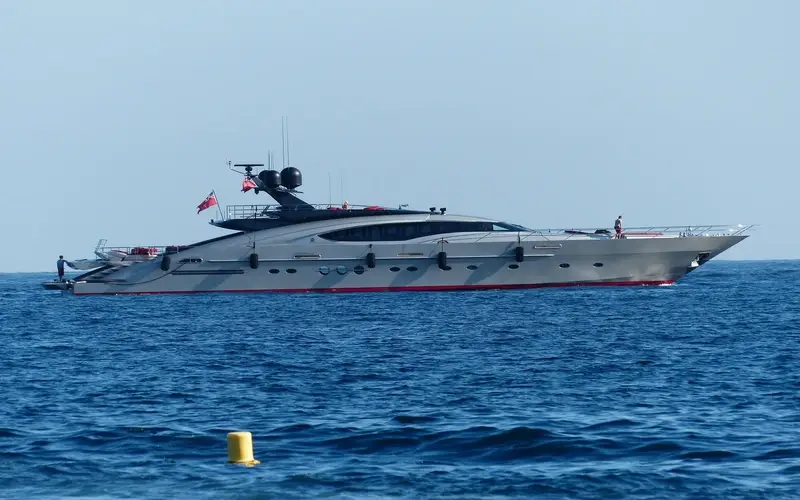
Your usage scenarios determine your purchasing strategy
When selecting a flybridge yacht, ‘usage scenarios’ are more important than any technical specification, as they directly determine whether you will regret this investment.
If you plan to take frequent weekend trips, such as short cruises in Singapore, Hong Kong or the Mediterranean, you’ll need a model that’s easy to handle and has moderate maintenance costs. In this case, the 40–50-foot range is more suitable. A classic used flybridge yacht like the Princess 42, for example, is not only more affordable to get started with, but also keeps mooring, fuel and maintenance costs within manageable limits, making it ideal for establishing a routine.
👉 See Princess 42

Princess 42
- Build Year2012
- Length44.30 ft
- Cabins2
- Top speed27 kn
- TypeFlybridge yacht
The Princess 42 is a classic entry-level flybridge yacht, approximately 13.5 meters (44 feet) in length, and enjoys high recognition in the global small to medium-sized luxury yacht market.
If your primary focus is family holidays or multi-day cruises, then space becomes the top priority. You will need at least a three-cabin layout, a fully equipped galley, en-suite bathrooms, and a sufficiently spacious flybridge area. In this scenario, medium to large flybridge yachts offer distinct advantages, as their flybridge and interior spaces can comfortably accommodate multiple people without feeling cramped.
If your objective is business hospitality or socialising, the value of a flybridge yacht is amplified. The flybridge itself serves as a natural ‘seaside lounge’, capable of accommodating multiple people simultaneously. In this context, you must consider not only the space but also the brand’s image; brands such as Sunseeker, for example, hold an advantage in design language and market perception, making it easier to command a ‘premium’ in social settings.
How to choose the right type of superyacht?
Many buyers searching for ‘new flybridge yachts’ tend to overlook one key issue: there are actually significant differences between flybridge yachts, and the type you choose determines a completely different user experience.
The first category is the sport-oriented flybridge yacht (Sport Flybridge). These vessels typically feature sleeker lines and higher speeds, but at the expense of some interior space. They are suitable for those who still prioritise the driving experience whilst also wanting the benefits of a flybridge.
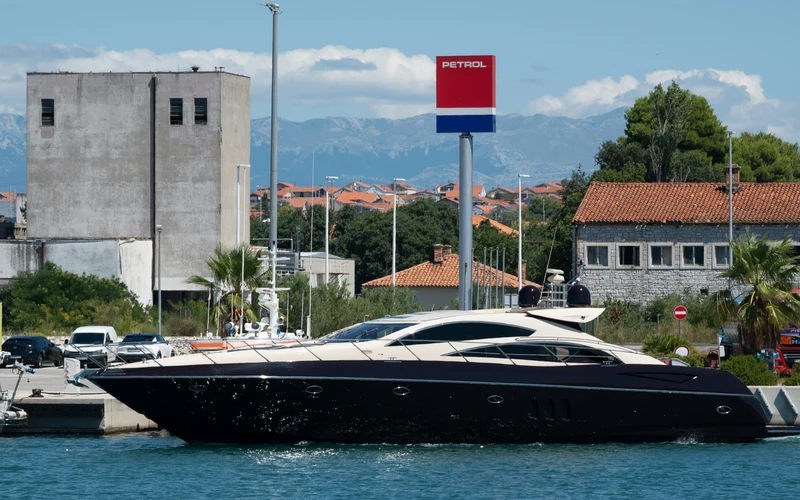
The second category is the standard cruising flybridge yacht (Classic Flybridge), which represents the mainstream of the market. The design focuses on space utilisation, comfort and stability, making it more suitable for families. These vessels typically feature a wider hull, a larger saloon and more comprehensive living facilities.
The third category comprises semi-custom or custom flybridge yachts, such as the bespoke solutions offered by certain high-end brands. The advantage of these vessels is that you can tailor the layout to your specific requirements, for example by adding crew quarters, enlarging the master bedroom, or redesigning the flybridge functional areas. However, this comes with a longer build time and a higher budget.
Size Selection Guide
Size not only affects the price but also determines the limits of your future usage.
40–50 feet yacht: Entry-level and transitional stage
This is the most suitable range for first-time flybridge yacht buyers. They are easy to handle and can be operated without a full-time crew. New models such as the Artemis 47 feature a more youthful design and efficient use of space, whilst not imposing excessive maintenance demands, making them a typical choice for a ‘first flybridge yacht’.
50–80 feet yacht: The Mainstream Range
This is the most active segment of the market. You can find full three- or even four-cabin layouts, whilst still enjoying a generously sized flybridge. This size is well-suited to family holidays and short to medium-range cruising, making it the ‘most frequently used’ size category.
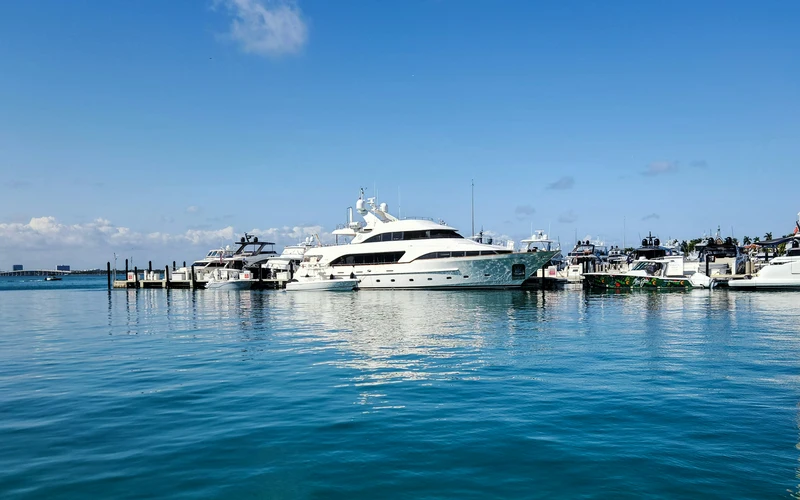
80 feet and above yacht: Pre-Superyacht Class
Once you enter this price bracket, flybridge yachts begin to resemble superyachts in terms of their characteristics. You will need to consider crew requirements, long-term mooring costs and the vessel’s ability to sail across regions. Take the Horizon V72, for example: not only does it offer more space, but its structural stability and range also make it better suited to long-term use.
Budget Recommendations
Budget planning is key to determining whether you can ‘afford to buy, afford to maintain and enjoy for the long term’.
Firstly, the purchase cost:
Prices for new flybridge yachts vary significantly, ranging from US$1 million to over US$5 million, depending on size, brand and level of customisation. Used flybridge yachts, however, can be acquired at a lower price; for instance, a second-hand 40-foot model typically costs between US$300,000 and US$800,000.
Secondly, there are the hidden costs:
Many newcomers underestimate this aspect, which includes mooring fees, fuel costs, insurance, annual maintenance and crew expenses. Generally speaking, the total annual costs amount to between 8% and 12% of the purchase price.
Whilst second-hand yachts are attractive in terms of purchase price, their positioning is close to that of small superyachts, meaning maintenance and upgrade costs are not insignificant; they are therefore better suited to experienced buyers.
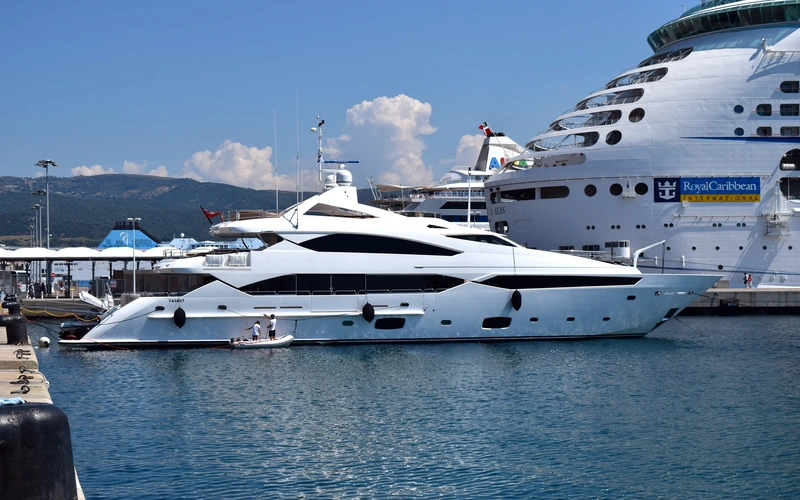
Recommended Popular Superyacht Models
When selecting a flybridge yacht, simply looking at ‘popular models’ is of little significance; it is far more important to understand why these models have remained popular in the market over the long term. The models listed below represent typical choice paths for buyers at different stages—from entry-level to intermediate, and on to the high-end.
First is the entry-level new-build representative, the Artemis 47. These 40–50-foot new flybridge yachts essentially address the question of ‘whether they can be used frequently’. The Artemis 47’s strengths lie in its sensible dimensions and efficient use of flybridge space, whilst not imposing excessive operational burdens. For buyers searching for a ‘flybridge yacht for sale’ for the first time, this type of vessel allows them to quickly establish a routine of use without reducing the frequency of their outings due to complex maintenance.
👉 Browse Artemis yacht

Artemis 47
- Length51.60 ft
- Top speed10.50 kn
- TypeFlybridge yacht
The Selene 47 is the larger sister of the groundbreaking Selene 43. The Selene 47 enjoys many benefits of the larger design, including a more spacious salon, higher engine room height, a pantry, and a lazarette. The Cruiser Stern with an extended waterline also provides the yacht with a cruising speed of 9 knots and excellent fuel economy. The galley is offset to the starboard side, as is the bench in the pilothouse. These two changes create a more spacious feel in the salon and the pilothouse respectively. A small helm chair can be installed at the lower helm. The Selene 47 is designed with long - range cruising couples in mind. With two cabins and two heads, this yacht is also a great family cruiser. The stability of the Selene 47 is evident even in rough seas. The yacht has a range of no less than 2,000 nautical miles and is capable of traversing ocean passages just like any other Selene.
Next is the Horizon V72, a typical representative of the mid-to-large flybridge yacht segment. This category falls firmly within the realm of ‘long-term investment assets’. V72-class vessels, typically around 70 feet in length, usually feature a full four-cabin layout, a separate crew quarters, and enhanced long-range cruising capabilities. Yachts of a similar size (such as the 72-foot class) can typically accommodate eight or more people, whilst offering stable cruising performance and a substantial range. The core value of these vessels lies not merely in their space, but in their ‘long-term liveability’ and ‘social capacity’.
👉 Browse Horizon V72
Horizon V72
- Length72.10 ft
- TypeFlybridge yacht
The Horizon V72 is an exceptional and ready-to-go luxury yacht model designed by the internationally renowned yacht architect Greg Marshall, incorporating the concept of green marine navigation. Thoughtfully equipped with a complete set of navigation equipment and amenities, the owner of the V72 can simply turn the key to start the engine and immediately set sail into the open sea, enjoying a perfect maritime journey.
In the second-hand market, the Princess 42 is a highly representative used flybridge yacht. Its enduring popularity stems not from outstanding specifications, but from the fact that it has ‘no obvious shortcomings’: a two-cabin layout, dual-bathroom design, stable cruising speed (approximately 27–32 knots) and a well-established brand reputation. For buyers with a limited budget who wish to enter the flybridge yacht sector, it represents a relatively low-risk option.
Moving up a tier is the Heesen 28 (approximately 28 metres in length). Yachts of this class are approaching the realm of small superyachts. As a high-end Dutch shipyard, Heesen typically emphasises structural strength, seagoing performance and build quality, positioning itself within the premium segment of the global yacht market. Buyers opting for this type of used flybridge yacht are generally not seeking to ‘experience the flybridge’ per se, but rather to enter the superyacht circle at a lower cost.
👉 View Heesen 28 for sale
Heesen 28
- Build Year1989
- Length92 ft
- Cabins5
- Top speed18 kn
- TypeFlybridge yacht
This 28.2-meter Heesen/Mulder motor yacht, built in 1989 and completely refitted in 2004 at a cost of €5,000,000, represents a remarkable opportunity to acquire a comprehensively rebuilt Dutch classic. The 2004 refit was truly transformational: the interior was completely gutted and rebuilt, 20mm teak laid on side decks, flybridge, and aft cockpit, the entire hull and superstructure repainted, and new MTU engines installed.
To summarise the core logic of this section:
• 40–50 feet (Artemis 47): addresses the question of ‘whether it will be used frequently’
• 60–70 feet (Horizon V72): addresses the question of ‘whether it is practical’
• Entry-level pre-owned (Princess 42): addresses the question of ‘value for money’
• High-end pre-owned (Heesen 28): addresses the question of ‘advancement’
A Step-by-Step Breakdown of the Complete Purchase Process
Purchasing a flybridge yacht is not a simple transaction, but a systematic process. What truly determines whether you have bought the right boat is not the price, but the rigour of the process.
Step 1: Defining Your Requirements
Most buyers start by viewing boats straight away, which is the wrong approach. The correct method is to first clarify three key points:
• Frequency of use (5 times a year vs 20 times a year)
• Number of people (2 people vs 10 people)
• Usage scenarios (short trips/holidays/business)
The conclusions reached at this stage will directly determine whether you opt for a new flybridge yacht or a used flybridge yacht, as well as the size range.
Step 2: Market Screening
Only once your requirements are clear should you proceed to the screening stage. You need to search for flybridge yachts for sale through both brokers and online platforms.Focus on three key dimensions:
• Brand (e.g. Princess, Horizon, Heesen)
• Year of manufacture (determines depreciation and maintenance costs)
• Service history (whether there is a complete maintenance record)
The objective of this stage is not to ‘choose one’, but to shortlist 3–5 comparable vessels.
Step 3: On-site Inspection
Many buyers rely solely on photographs, which is extremely risky. During an on-site inspection, you must pay attention to the following details:
• Engine condition (start-up sound, vibration, fuel consumption records)
• Cabin humidity and odours (to assess whether there are any water ingress issues)
• Electrical systems (whether radar, navigation and generator are functioning correctly)
• Flybridge structure (whether there are signs of ageing or modifications)
Taking the Princess 42 as an example, even if the exterior appears in good condition, you must pay close attention to the engine hours and maintenance records, as these directly impact future costs.
Step 4: Sea Trial
A sea trial is not merely an ‘experience’ but a technical validation. You should pay particular attention to:
• Whether acceleration is smooth
• Whether steering response is responsive
• Whether there is any abnormal vibration in the hull
• Stability at different speeds
Particularly for flybridge yachts over 50 feet, a sea trial allows you to directly assess whether the vessel suits your usage habits.
Step 5: Professional Survey
This is the most essential step in the entire process, particularly when purchasing a used flybridge yacht.
A survey typically includes:
• Hull structural inspection (for hidden damage)
• Engine and propulsion system inspection
• Electrical and piping system inspection
For example, with high-end pre-owned yachts such as the Heesen 28, failure to conduct a professional survey can easily lead to substantial repair costs later on.
Step 6: Price Negotiation and Contract
This stage involves more than just ‘haggling’; it also covers:
• Equipment included (e.g. lifeboats, electronic equipment)
• Delivery conditions (e.g. whether refurbishment or repairs are included)
• Payment structure (deposit + balance)
Experienced buyers typically use the survey report as a basis for negotiation.
Step 7: Delivery and Operational Preparation
Once the transaction is complete, there are a series of key steps to follow:
• Registering the flag (affects taxation and operational areas)
• Purchasing insurance (mandatory and essential)
• Arranging a berth (particularly in areas with limited resources, such as Singapore)
• Establishing a maintenance regime (regular servicing, cleaning and inspections)
If you are purchasing a medium-to-large flybridge yacht such as the Horizon V72, you will also need to consider crew recruitment and management.
Step 8: Long-Term Management
Many people assume that buying a boat is the end of the process, but in fact, it is only the beginning. Long-term management includes:
• Annual maintenance (approximately 8%–12% of the purchase price)
• Depreciation management (determining the optimal time to sell)
• Usage planning (maximising utilisation and minimising idle costs)
Summary
The key to purchasing a flybridge yacht is not to choose the ‘most expensive’ or ‘largest’ model, but to find the one that best suits your specific needs. From entry-level 40-foot models to high-end options exceeding 70 feet, each step corresponds to a different lifestyle and cost structure. Whether you are considering a new or used flybridge yacht, a rational decision-making process is always more important than acting on impulse.
FAQ
Q1: What is the main difference between flybridge yachts and other types of yachts?
A: The defining feature of a flybridge yacht is its upper-deck flybridge area for steering and leisure. Compared to sports yachts, it offers more indoor and outdoor space, making it better suited for family use, socialising and extended cruising; consequently, it offers clear advantages in terms of comfort and versatility.
Q2: Should first-time buyers opt for a new or second-hand flybridge yacht?
A: If you have a sufficient budget and are seeking the full experience, we recommend a new flybridge yacht; if you wish to minimise risk and control costs, a second-hand flybridge yacht is more suitable, but you must carefully inspect the vessel’s condition and maintenance records.
Q3: Are flybridge yachts suitable for long-term living?
A: Flybridge yachts over 60 feet typically feature full living facilities, including multiple bedrooms, a kitchen and en-suite bathrooms. Short-term or seasonal living is entirely feasible, though mooring and maintenance conditions must still be considered.
Q4: What are the approximate annual maintenance costs for a flybridge yacht?
A: Generally, annual maintenance costs for a flybridge yacht amount to approximately 8%–12% of the vessel’s purchase price, covering mooring fees, insurance, fuel, servicing and crew expenses; costs increase with the size of the vessel.
Q5: Where can I find a reliable flybridge yacht for sale?
A: It is advisable to search for flybridge yachts for sale through professional yacht brokerage firms or reputable platforms. This ensures access to accurate information regarding the vessel’s condition, reduces transaction risks and helps avoid hidden issues that may arise later.